
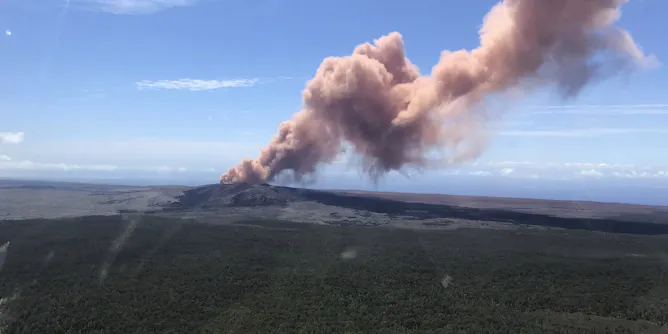
How do scientists predict volcanic eruptions? To do so with accuracy, they need to know the individual volcano and its history very well.
Articles on Earth science
Displaying 61 - 80 of 105 articles
Mercury found in prehistoric rock bolsters the idea that volcanoes caused a mass extinction 200m years ago.
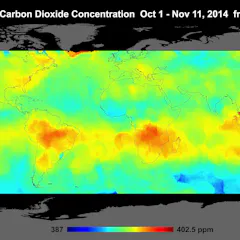
Why use satellites to study Earth’s climate? Researchers leading a new mission explain how images from space will help them analyze which parts of the Americas soak up the most carbon.
Almost half a million years ago a huge flood started breaking the apart the land bridge that joined England and France.
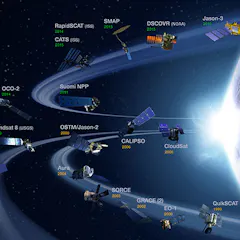
President Trump’s 2018 budget request cuts funding for NASA Earth observation research and cancels four missions. Weather forecasters, businesses, scientists and the armed forces rely on this data.
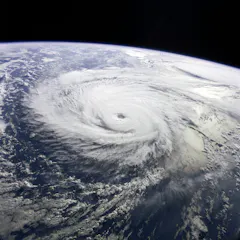
Far from being “politicised science”, as a Trump advisor has claimed, NASA’s satellite monitoring has been a crucial help in understanding the planet we live on.
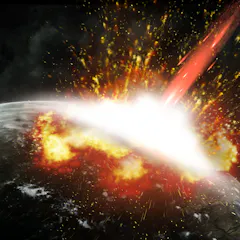
New research suggests how asteroids may have helped create conditions for life on Earth. But we shouldn’t get too carried away with the idea – yet.
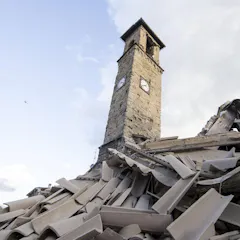
Amatrice’s still-standing ancient clocktower has become an iconic image from last week’s deadly earthquake. But it is not the only unusual survivor.
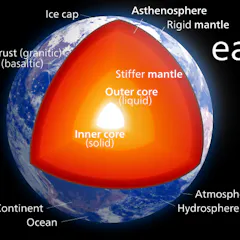
The Earth’s inner core is more than half a billion years older than previously thought, shows a study. The results could help us better understand the processes that shape the planet’s surface.
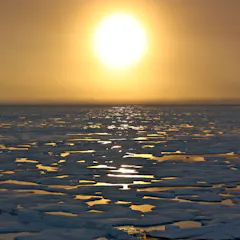
The House proposes slashing funding for earth science from NASA’s budget, yet this science is critical to understanding – and coping with – the dramatic effects of a warming Arctic around the world.
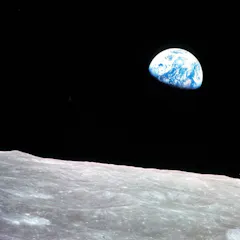
The moon might harbor bits of the Earth that blasted off our planet billions of years ago. These lunar time capsules could hold secrets about conditions here at home back when life was first emerging.
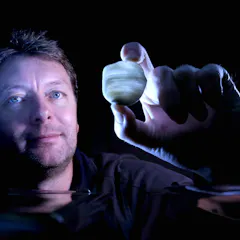
Stalagmites in Scottish preserve 3,000 years of climate history, suggesting human migration is linked to wet and dry periods.
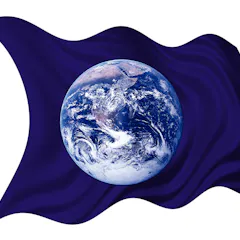
The history of Earth Day reveals its true nature: a day about people, not really a celebration of an amazing planet – like a true birthday.
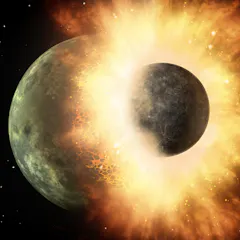
New experiments show that the asteroids that slammed into Earth and the moon more than 4 billion years ago were vaporised into a mist of iron. The findings, published in Nature Geoscience, suggest that…
The Conversation organised a public question-and-answer session on Reddit in which James Dyke, a lecturer in Complex System Simulation, discussed planetary boundaries and whether global industrialised…
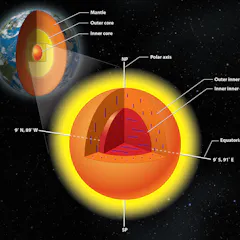
The planet Earth’s inner core is not a single solid mass but comprised of two layers, and new evidence about the core’s composition from a team of US and Chinese geophysicists suggests that the innermost…
A British volcanologist has won one of the most prestigious awards in science – the Vetlesen Prize, which is considered to be the earth sciences equivalent of the Nobel Prize. Stephen Sparks of the University…
The Earth’s climate has always changed. All species eventually become extinct. But a new study has brought into sharp relief the fact that humans have, in the context of geological timescales, produced…
Ten years on from the devastating Boxing Day earthquake and tsunami, our understanding of very large earthquakes has grown enormously. From satellites monitoring changes on the Earth’s surface to drilling…
Plate tectonics – the large-scale movement of Earth’s lithosphere or outer layers – started around three billion years ago, but how those movements started was a bit of a mystery – until today…
Top contributors
-

Harold T. Stearns Professor of Earth Science, Wesleyan University
-
Professor in Earth Sciences, Nanyang Technological University, Singapore, and Emeritus Professor of Mineral Physics, University of Cambridge
-
Professor of Earthquake Science, The University of Melbourne
-
Associate Professor, School of Geosciences, University of Sydney
-
Earthquake Scientist, Monash University
-
Professor of Palaeobiology, University of Leicester
-
Lecturer in Geosciences, University of Montana
-
Assistant Director of the Global Systems Institute, University of Exeter
-
Senior Research Fellow, Future Industries Institute, Adelaide University
-
ARC Future Fellow and Associate Professor in Igneous Petrology/Volcanology, The University of Queensland
-
Associate Professor of Tectonics, University of Sydney
-
Professor of Earth Sciences and Environmental Studies, USC Dornsife College of Letters, Arts and Sciences
-
Associate Professor, Connected Waters Initiative, UNSW
-
Professor of Practice in Meteorology, Professor of International Affairs & Director Center for Solutions to Weather and Climate Risk, Penn State
-
Royal Society University Research Fellow & Associate Professor of Geophysics, University of Oxford