
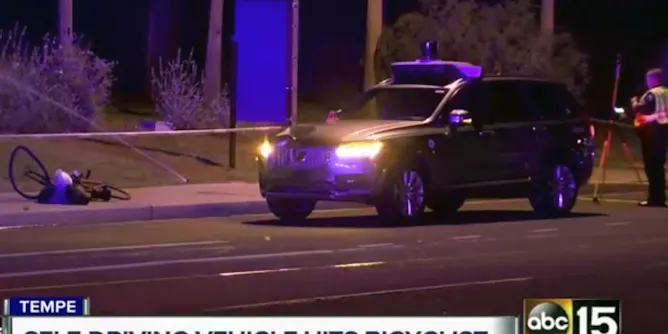
Companies developing autonomous vehicles are missing out on the local knowledge and values of the people who live where these cars are tested. And that lack of engagement sets up bigger problems.
Articles on Driverless cars
Displaying 61 - 80 of 140 articles
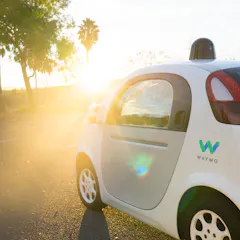
Uber, Tesla and Waymo (Google) are leapfrogging traditional car makers like Ford, VW and General Motors when it comes to self-driving cars.
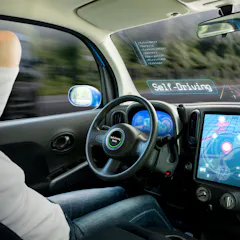
Traditional car manufacturing may have gone from Australia with a loss of jobs, but one senior figure in the motor industry sees a potential for new jobs thanks to driverless cars.

A sociolinguist wonders if they’ll ever be able to interpret the waves, high beams and middle fingers of human drivers.
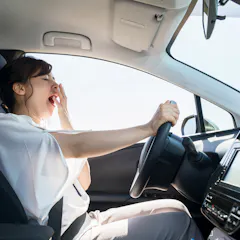
Human-operated cars affect health in three main ways, all negatively. How might driverless cars be healthier?
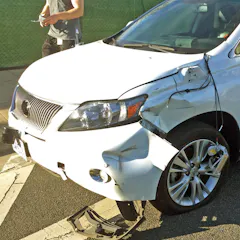
If autonomous vehicles are going to be safer than human drivers, they’ll need to improve their ability to perceive and understand their surroundings – and become the ultimate defensive drivers.

It’s going to be difficult for UK government-backed autonomous vehicle projects to compete with Silicon Valley – unless they have something neat under the bonnet.
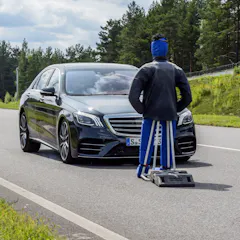
Driver aid systems and self-driving vehicle control systems could override a driver who is trying to attack people and prevent tragedy.
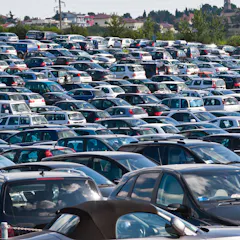
Cities around the world are starting to rethink the vast areas of land set aside for parking. The convergence of several trends likely will mean this space becomes available for other uses.
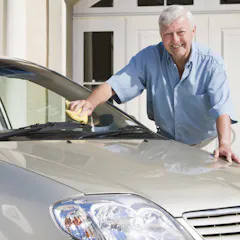
Could we really reduce the number of vehicles on our roads from 37m to 9m?

Are mobility scooters harbingers of a future where small and versatile electric vehicles roam our cities?
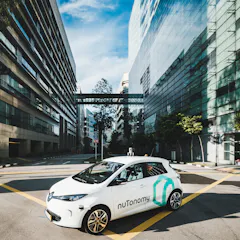
It’s clear autonomous vehicles will disrupt our cities, their land use and planning. Whether they make urban life better or worse depends on how well we anticipate and adapt to their impacts.
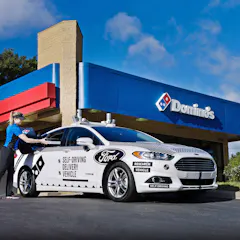
Domino’s Pizza and Ford have teamed up to offer pizza delivery via driverless cars in Michigan. Is it the way of the future?
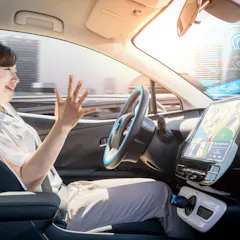
The first set of ethical rules on how self-driving cars should operate have been adopted by the German government.
We are witnessing dramatic advances in the deployment of autonomous systems, but are we designing robots that can be trusted?

Autonomous vehicles have many benefits, but they may be bad news for nature conservation.

The unexpected behaviour of even simple bots is only going to get more dramatic as AI scales up.

Cars are effectively becoming computers on wheels – and very attractive to cyber criminals.
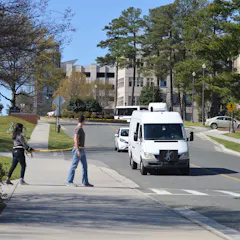
Pedestrians ensure their safety by making eye contact with human drivers. Autonomous cars will have to communicate with nearby people in other ways.

A glimpse of tomorrow’s world.
Top contributors
-

Professor, Director of the Centre for Robotics, Queensland University of Technology
-
Associate Professor, Human Systems Labs, University of Windsor
-
Honorary Professor of Planning, The University of Queensland
-
Professor of Sustainability, Curtin University
-
Professor in Robotics, Queensland University of Technology
-
Professor of Advanced Technology Transitions, Arizona State University
-
Senior Research Scientist, Texas A&M Transportation Institute, Texas A&M University
-
Associate Professor in Urban Planning, The University of Queensland
-
Director, Assuring Autonomy International Programme, University of York
-
Honorary Professor of Transport Studies
-
Associate Professor, University of Leeds
-
Professor of Transport Technology and Sustainability, Swinburne University of Technology
-
Professor of Human Geography, The University of Queensland
-
Associate Professor in Urban Planning, The University of Melbourne
-
Professor of Systems Security, Coventry University