
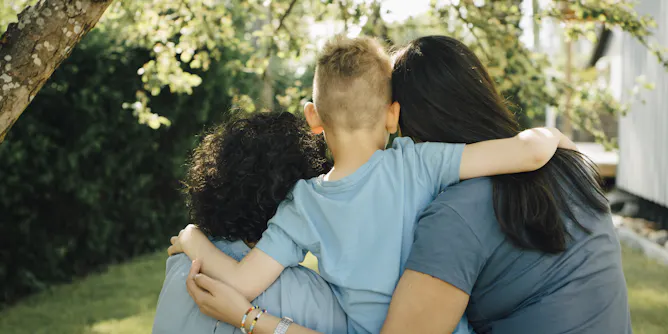
It is generally recommended to tell children they were conceived with a donor. Knowledge of origins gives a stronger sense of identity and better wellbeing.
Articles on Donor conception
Displaying all articles

A baby was born from a 30-year-old frozen embryo, raising questions about fertility, family and the future of donor conception.

Donor conception, surrogacy, artificial womb technologies … a new book delves into how families are changing.
There are 5 key reasons why this reform should go ahead.

Taking a DNA test kit sounds like harmless fun but some people end up getting more than they bargained for.

A pending bill in Colorado would disclose donor information to children and their parents and set limits on how many families can use a single individual’s egg or sperm.

Victorians who need donated eggs and sperm face limited choice, lengthy waits and high costs.
When can a donor be a legal parent? The latest High Court ruling doesn’t make it clear how much involvement a donor needs to have.
Sperm donation websites are the Ubers and Airbnbs of the fertility world. But why are they so popular? New research explains the reasons why some men donate.

The National Health and Medical Research Council call for public submissions on whether sex selection should be allowed without a medical reason recognises changing social attitudes.
Thanks to IVF and donor conception, infertile couples, single women and lesbian couples now have a better chance of starting families. But while common, it’s rarely openly discussed.
Thanks to IVF and donor conception, infertile couples, single women and lesbian couples now have a better chance at starting families. But how does it all work? Ask the experts here.
Clinics aren’t compelled to disclose their success rates, so it’s impossible to compare all clinics. Even when they do, the pretty graphs on clinic websites can be difficult to understand.
Most heterosexual parents who conceive via donor conception never tell their children.

Historically, donors were told it was best they were anonymous, while recipients were told it was best not to tell their child.
Top contributors
-

Dean and Professor, Law School, La Trobe University
-
Monash University
-
Adjunct Professsor, School of Psychology, Faculty of Health and Medical Sciences, Adelaide University
-
Principal Research Fellow, Australian Research Centre in Sex, Health and Society, La Trobe University
-
Associate Professor; Director, Psychology Clinic, Swinburne University of Technology
-
Associate Professor in Sociology, Swinburne University of Technology
-
PhD candidate, Flinders University
-
Research Fellow, The Centre for Digital Cultures and Societies, The University of Queensland
-
Professor of Law, George Washington University
-
PhD candidate, English Literature, Australian National University
-
Casual Academic, Deakin University
-
Deputy Executive Dean and Associate Dean (Academic), Faculty of Humanities, Arts and Social Sciences, The University of Queensland
-
PhD student, La Trobe University
-
Professor of Genetics and Public Engagement, University of Leicester
-
Professor of Law, University of Virginia