

Is meat healthy or not? The answer can depend on who funded the research, according to a new study.
Articles on Dietary guidelines
Displaying 1 - 20 of 36 articles

Red meat and dairy may be grabbing the headlines, but processed foods and sugary drinks remain the real drivers of chronic disease.

Irregularities in how the government developed the updated guidelines raise questions about its conclusions.

Australia’s dietary guidelines will soon consider environmental impacts. We need locally relevant indicators to support more sustainable food production.

What’s actually happening in your body when you eat an entire cucumber? Two dietitians explain.

Children, busy parents and young people can be more easily swayed by unhealthy food ads. We found campaigns aimed at all of them.

A growing body of research is finding a robust link between diet and sleep quality. But it’s not just the usual suspects like caffeine and alcohol that can get in the way of restful sleep.

Many of us gain weight over Christmas and spend more than we’d like entertaining. Here’s how to keep both in check.

A healthy diet in line with the Australian Dietary Guidelines is cheaper than an unhealthy diet. Switching could save $160 off a family of four’s fortnightly shopping bill.

More people are opting for a “social omnivore” lifestyle – could it save the planet, your health and your social life?

Official estimates indicate that meat consumption is falling in the UK – but not all of the data agrees.

Dietary guidelines can do a better job clarifying the differences between beneficial and harmful forms of processing.

The oils in fish are excellent buffers against disease. Why don’t we eat more fish?
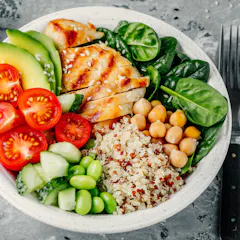
If dietary guidelines are going to work, they need to be more specific about what ‘variety’ means.

Childhood, adolescence, pregnancy, menopause, 75+: how your diet should change with each stage of life
The Conversation, CC BY56.6 MB (download)
Once you get older, the focus moves to trying not to lose your muscle tissue. So as you age, your protein requirements actually start to go up.

When a manufacturer lists a serving size on their food label, it’s based on their expectations of what you’ll eat, not what the dietary guidelines recommend.

‘Why is nutrition so confusing?’ is a common lament, but the truth is out there. Forget fad diets and media hype. It’s time to harness the power of science to create a healthy and sustainable diet.

A recent study revisited the issue about eating foods high in cholesterol, such as eggs. The findings are nuanced but suggest that those with high cholesterol may want to limit food with cholesterol.

Dietary guidelines fail to change our eating habits. So, how can we make them more relevant?

After 20 years, Public Health England finally released a revised Eatwell Guide – here’s what changed.
Top contributors
-

Laureate Professor in Nutrition and Dietetics, University of Newcastle
-
Associate Professor, Deakin University
-
Senior Visiting Fellow, School of Medical Sciences, UNSW
-
Professor of Community Health and Wellbeing, The University of Queensland
-
Adjunct Senior Research Fellow, Adelaide University
-
Executive Director, Swette Center for Sustainable Food Systems, Arizona State University
-
Professor of Population Health, University of Oxford
-
Honorary Associate Professor, University of Leicester
-
Consultant psychiatrist and PhD candidate, Deakin University
-
Associate Professor of Nutrition Science and Policy, Tufts University
-
Senior lecturer in Public Health Nutrition and Associate Dean, Faculty of Science, University of Reading
-
Programme Leader, MRC Epidemiology Unit, University of Cambridge
-
Retired nutritionist, Defence Science and Technology Organisation
-
Principal Research Scientist, Agriculture, CSIRO
-
Professor of Agronomy (Agriculture), University of Sydney