

Rising sea levels mean bigger waves will “redesign” coastlines.
Articles on COP26
Displaying 61 - 80 of 278 articles

Electric cars are expensive in Australia partly because European emission standards reward manufacturers for selling them there. There’s an obvious fix.

Yes COP26 fell short, but we still have reasonable odds of limiting global warming to 2°C.
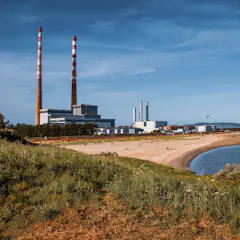
To combat global warming we need to use atmospheric greenhouse gas observations to keep track of emissions.

More than 100 world leaders have pledged to end the destruction of forests by 2030 as a way to slow climate change. That will require changing how the world produces four widely used commodities.
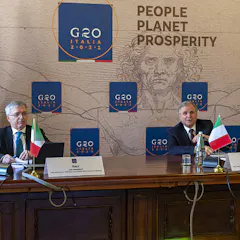
Central banks have a responsibility in addressing the challenge of climate change. But how? Experts explore some ideas.
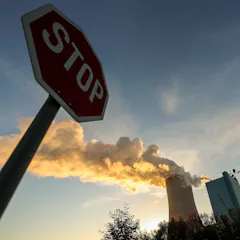
Watch a panel discussion on Thursday 18 November as climate change experts react to COP26.
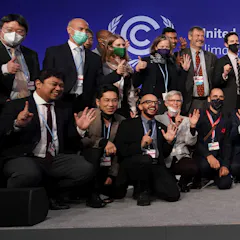
Stabilising Earth’s climate depends on a lot more than deals struck at conferences like Glasgow. But those agreements set a frame for real-world decisions.

Loss and damage – the three words which define the Glasgow summit’s disappointing outcome.
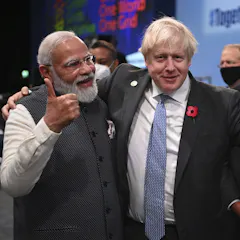
Rather than slow the decline in coal use, India’s actions at COP26 ensure it and other polluting nations, including Australia, will be under even greater scrutiny.

The hope we need is realistic – not wishful thinking, denial or delay disguised as naïve optimism.

Forestry is a surprising winner in detailed projections prepared by Victoria University. Queensland has the most to lose from a move to net-zero.
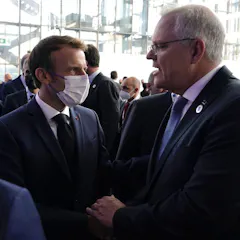
Post Macron and Morrison, what exactly is diplomacy and why is it in decline?
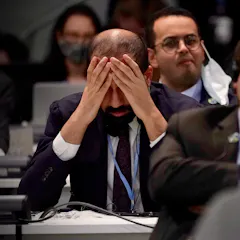
From weak 2030 targets to controversial rules around carbon trading, let’s take a look at the summit’s defining issues.
The sale of traditional vehicles would have to cease completely by 2038 to reach the government’s target. So where’s the plan to get there?
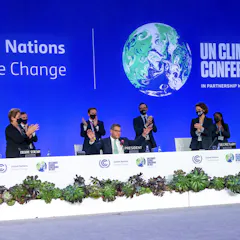
Has the summit delivered on its goals?

COP26 saw incremental progress but not the breakthrough moment needed.

Politicians have more incentive to react to current climate disasters, but more investment is needed in preparing for future problems.
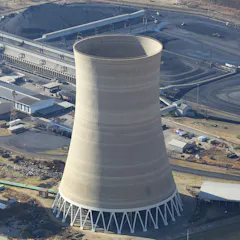
Pitched at an initial US$8.5 billion, the partnership has the potential to be one of the largest individual climate finance transactions to date. But can a just transition be achieved?

Most of the $2,000 per year increase in income by 2050 is due to the success of a new hydrogen industry.
Top contributors
-

Professorial Fellow, University of Canberra
-
Environment + Energy Editor and Host of the Climate Fight podcast series, The Conversation
-
Research Associate, Institute for Climate Risk and Response, UNSW
-
Professor of Physical Climate Change; Director of the Priestley Centre for Climate Futures, University of Leeds
-
Professor of Practice in Climate Policy, University of Oxford
-
Visiting Fellow, Crawford School of Public Policy, Australian National University
-
Associate Professor of Law, University of Waikato
-
Head of Atmospheric, Oceanic and Planetary Physics, University of Oxford
-
Professor of International Relations, The University of Queensland
-
Professor, School of Economics, The University of Queensland
-
Professor Emerita, Department of Biological Sciences, Macquarie University
-
Professor of Political Philosophy, UNSW
-
Senior Research Fellow, School of Geography, Earth and Atmospheric Sciences, The University of Melbourne
-
Assistant Professor, Université Mohammed VI Polytechnique
-
Adjunct Professor of Energy, Murdoch University