
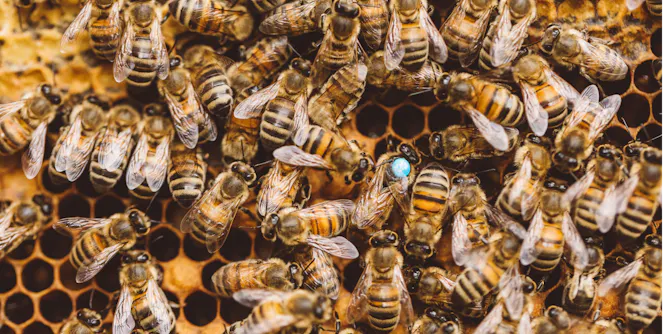
The waggle dance is performed by forager bees to convey important information about food sources.
Articles on Communication
Displaying 101 - 120 of 322 articles
Honeybees possess one of the most complex examples of nonhuman communication. New research suggests that it is learned and culturally passed down from older to younger bees.

Doctors don’t always tell you they’re unsure what’s behind common symptoms, such as a stomach ache. And that can have serious effects.

In a story where you have to choose your words carefully, it’s important to convey meaning to audiences in other ways.

Compassionate listening is an overlooked practice, but urgently needed in both interpersonal and political communications.

Looking for sparks between the sheets this Valentine’s Day?

Repeated storytelling from elderly relatives doesn’t necessarily always signal age or cognitive decline. It’s about conveying memories and values to a new generation.

People who experience mansplaining suffer lower organizational commitment and job satisfaction, and higher turnover intention, emotional exhaustion and psychological distress.

Using urine and signature whistles from other dolphins, a team of scientists has shown that dolphins use signature whistles like names and hold mental representations of other dolphins in their minds.

The relationship between the state and media soured just months into the Kenyatta regime.

How to use language clues to see through someone’s ‘expert’ facade.

Hiding in plain sight, they’re subtle reminders that we’re being watched, tracked, studied.

Refugees from non-English speaking backgrounds with disabilities face the twin obstacles of English language courses that don’t work for them and disability services that don’t speak their language.

The ways Americans talk about firearms is full of contradictions, two communication scholars explain – and that powerfully shapes the country’s approach to gun policy.

With online use ever-increasing, so is the rise of ghosting – when friends decide to disappear into the social ether.

Communication helps group members to size up the intentions of the others.

New research has found what may be language in electrical impulses transmitted between mushrooms.

The ‘Die Hard’ actor is suffering from a communications disorder that affects 2 million Americans.

Bruce Willis’ family today revealed he has been diagnosed with aphasia. So what actually is aphasia and why haven’t we heard of it before?

People often try to seem confident and certain in their message so it will be trusted and acted upon. But when information is in flux, research suggests you should be open about what you don’t know.
Top contributors
-

Senior Lecturer and Coordinator, Health and Medical Humanities, University of Sydney
-
Senior Research Scientist at the Australian E-Health Research Centre, CSIRO
-
Adjunct professor, professional communication, University of Canberra
-
Director of Behavioral Science & Policy Initiative, Schaeffer Institute of Public Policy & Government Service, USC Price School of Public Policy, USC Dornsife College of Letters, Arts and Sciences
-
Science Communication Researcher, Stellenbosch University
-
Professor of Public Relations, Michigan State University
-
Postdoctoral research fellow, The University of Queensland
-
Senior Lecturer, Australian National Centre for the Public Awareness of Science, Australian National University
-
Professor of Speech Pathology, University of Technology Sydney
-
Professor in Ageing and Health, University of Sydney
-
Associate Professor, Emerging Media Studies, Boston University
-
Quality of life researcher and occupational therapist, The University of Queensland
-
Anatomy & Physiology Lecturer, Charles Sturt University
-
Associate Professor of Organisational Behaviour, Bond Business School, Bond University
-
Associate Professor (hon) at the Centre for Public Awareness of Science, Australian National University