
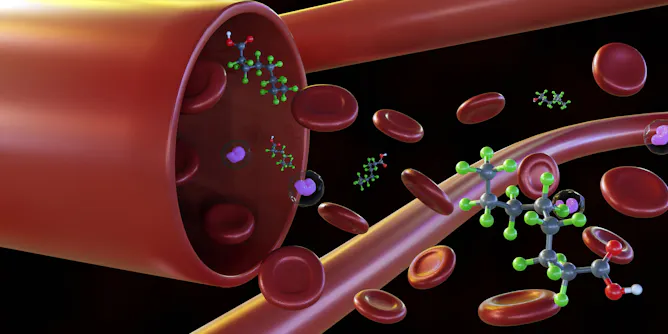
Your body likely contains an accumulation of various PFAS types, making it difficult to trace them to their sources.
Articles on Chemical pollution
Displaying 1 - 20 of 43 articles

New research shows seals are being affected by chemical pollution in the Arctic food web and rapid climate-driven warming that is transforming their sea ice habitat.
An organism can appear compliant under single chemical regulation while still carrying a potentially concerning mixture burden.

Marine protected areas can’t stop pollution flowing in from the land and Northern Ireland’s seagrass meadows are paying the price.

A new study provides the first evidence that re-entering space debris pollutes Earth’s upper atmosphere.

Until now, UK regulation has focused on just a few well-studied Pfas, mainly through drinking water standards.

Concentrations of a forever chemical known as TFA is increasing in rainwater, drinking water, soil and plants.
A recent survey of environmental toxicologists has revealed that they believe that chemical pollution can and is affecting the health of humans and wildlife.

It’s taken years for Australia to ban three types of forever chemicals. But Europe plans to ban thousands of these chemicals to avoid future issues.
Tires are complex chemical products. When they wear away, they release additives into the environment that can poison wildlife.

Huge numbers of chemical discharges into our waterways are not being classified as a pollution incidents.

A forever chemical known as TFA is accumulating in our environment, contaminating our rivers, food and even our wine.

How a three-year investigation into chemical pollution began.

Despite achieving Unesco biosphere status on the basis of its marine reserves, hazardous chemical contaminants pollute the seas around the Isle of Man.
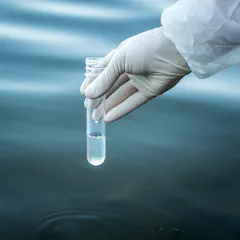
The scale of the chemical industry’s lobbying campaign and clean-up costs for PFAS have been revealed by a new collaboration of scientists and journalists.

Should we use less-polluting and silent fireworks, drones and laser light shows to replace traditional displays? Research shows there is still an environmental cost.
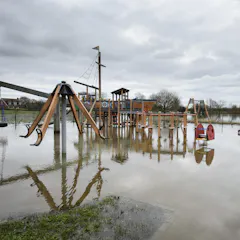
As floods get more severe and more frequent as a result of climate change, the risk of toxic pollutants being released from old landfills rises.
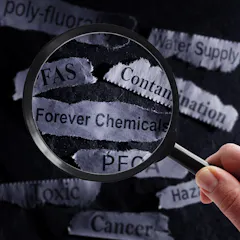
Scientists and engineers are developing new ways to destroy PFAS efficiently and sustainably.

Modern pharmaceuticals have revolutionised disease prevention and treatment. But eventually, the chemicals can end up in rivers, oceans and soils.
Oil and gas companies operating in the North Sea are regularly breaching legal limits and releasing too much polluted wastewater, a new report claims.
Top contributors
-

Professor of Biology, University of Portsmouth
-
Senior Lecturer in Chemical Engineering, University of Surrey
-
Associate Professor of Environmental Health, University of Birmingham
-
Professor of Water Science, Liverpool John Moores University
-
Professor of Environmental Chemistry and Head of Department of Environmental Sciences, Stockholm University
-
Assistant Professor, Faculty of Arts and Science, Nipissing University
-
Senior Lecturer in Ecology, Anglia Ruskin University
-
Associate Professor, Geosciences, Lund University
-
Professor of Chemistry, RMIT University
-
Professor, School of Engineering, University of Guelph
-
Professor of Environmental Chemistry, University of Birmingham
-
Associate Professor in Persistent Organic Pollutants, University of Birmingham
-
Professor of Biotechnology, Aston Institute for Membrane Excellence, Aston University
-
Senior Lecturer in Evolutionary Biology, Cardiff University
-
PhD Researcher, University of Bath