
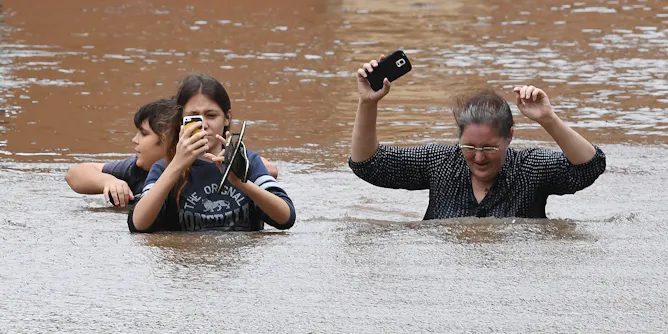
Research on the impacts on schooling of COVID and bushfire and flood disasters has found academically the kids are mostly OK. It’s their well-being and recovery from trauma that demand our attention.
Articles on bushfires 2020
Displaying 1 - 20 of 79 articles

They overlook a vast body of evidence that crown fire – the most extreme type of fire behaviour in which tree canopies burn - is more likely in logged native forests.
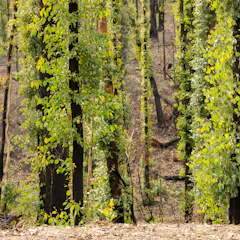
First the fires, then the pandemic. It’s not just the damage to infrastructure, houses, environment and farmland that makes recovery difficult; the emotional and physical toll is often gruelling too.
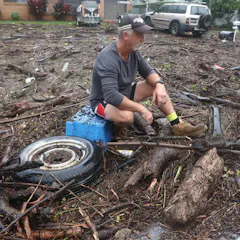
Evacuation and relief centres are often the first place disaster-affected people go, and should provide a minimum standard of living and care. But this standard is not always met.
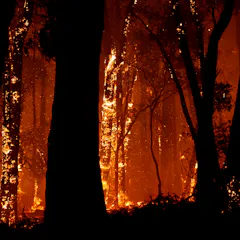
The method, using satellite data and other information, could reduce the work of fire forensics teams after bushfires.
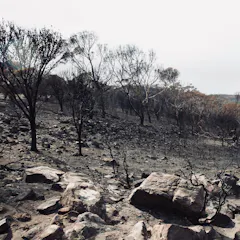
A year since the fires, I feel an underlying sadness and concern for the future. From my discussions with other conservationists, I know I’m not the only one to feel this way.

The federal government has ordered a national koala audit, but the animals are notoriously difficult to detect. But accurately counting koalas is critical to saving them.
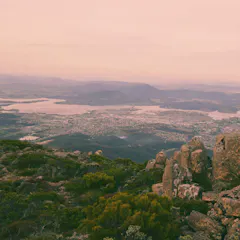
Set in the smoky shadow of Australia’s 2019 and 2020 bushfire season, Flanagan explores the loss of our world through the shattering of a family.
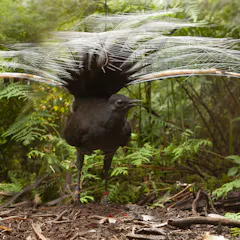
The Superb Lyrebird is famous for its song and dance, but what is less known is their extraordinary role as world-class ecosystem engineers.
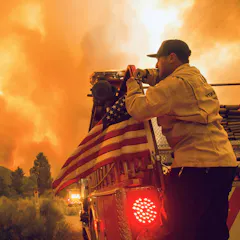
California’s bushfire disaster is eerily reminiscent of Australia’s Black Summer. We share the same fiery fate, and must learn to adapt.
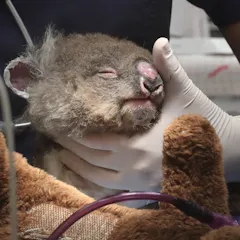
Ahead of National Science Week, Chief Scientist Alan Finkel reflects on the growing value of citizen science, emphasising the need for more collaboration as we deal with an evolving climate.
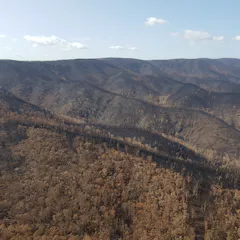
Many scientific concepts, including bushfires and climate change, happen at scales outside human perception. So how can we ever understand them?
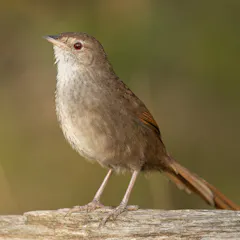
Scientists and bureaucrats moved logistical mountains to rescue the eastern bristlebird from bushfires this year. As climate change worsens, wildlife evacuations will become more common.

The story of the Kangaroo Island Micro-trapdoor spider offer insight into the challenges ahead for invertebrates – the tiny engines of Australia’s biodiversity – after this year’s cataclysmic fires.
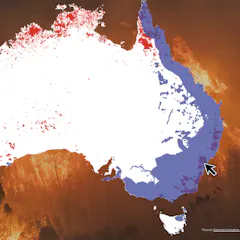
Last summer, Australia’s wildlife burned in one of our country’s worst bushfires. So what’s become of animal and plant survivors in the months since?
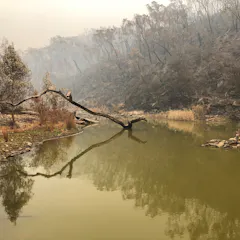
When the post-bushfire rains finally arrived, the situation for many fish species went from dangerous to catastrophic. A slurry of ash and mud washed into waterways, sending oxygen levels plummeting.

Scientists and the community are building nests to help save the stunning green carpenter bee from extinction.
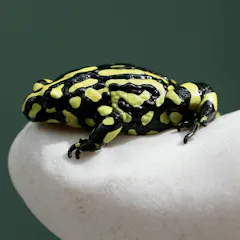
After the bushfires, we went looking for endangered corroboree frogs. Normally, they respond to our calls. But at some sites, the ponds were silent.
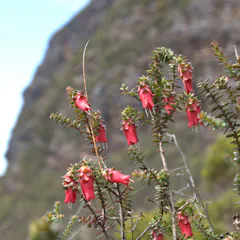
Three quarters of WA’s Stirling Ranges national park now experience fire cycles twice as frequent as species recovery rates.
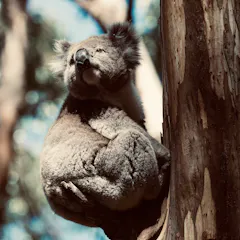
Koalas are notoriously difficult to detect. Traditional methods are costly and labour intensive. So we found a more efficient way to locate koalas in eastern NSW, using drones.
Top contributors
-

Professor of Pyrogeography and Fire Science, University of Tasmania
-
Research Fellow in Environmental Science, University of Tasmania
-
Professor in Conservation Science, School of Ecosystem and Forest Science, The University of Melbourne
-
Professor in Conservation Science, School of the Environment, The University of Queensland
-
Professor, Bushfire Science, Fenner School of Environment & Society, Australian National University
-
Professor of Wildlife Conservation, Australian National University
-
Visiting Research Fellow, Adelaide University
-
Emeritus professor, University of Wollongong
-
Journalist, author, broadcaster, Queensland University of Technology
-
Deputy Head of School, School of Architecture and Built Environment, University of Newcastle
-
Senior Research Scientist, South Australian Museum; Flinders University
-
Professor of Conservation Biology, Charles Darwin University
-
Adjunct Senior Lecturer, School of Architecture and Built Environment, University of Newcastle
-
Associate Professor, School of Architecture and Built Environment, University of Newcastle
-
Lecturer, School of Environment and Science, Griffith University