
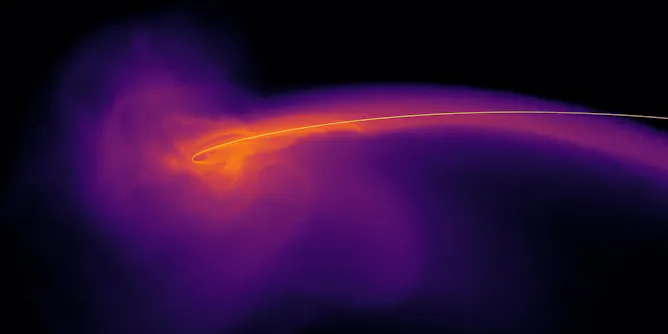
If a star gets too close to a black hole, it gets shredded and produces a complex ball of light. These videos are the first time this dramatic event has been simulated in detail.
Articles on Black holes
Displaying 21 - 40 of 159 articles
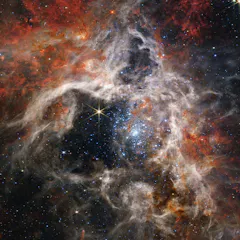
Research casts doubt on theories predicting that light black holes formed immediately after the Big Bang.
X-rays emitted around black holes can tell astrophysicists about how fast they’re growing.
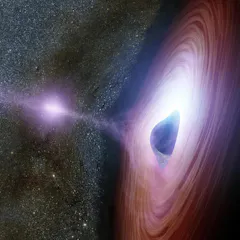
Studying theoretical, fast-spinning black holes is helping physicists understand more about the elusive black holes out in the universe.
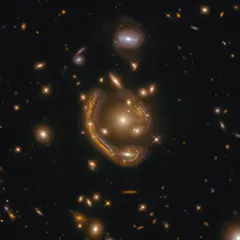
Observations during historical solar eclipses confirmed Einstein’s theory of gravity, and led to the predictions of black holes.
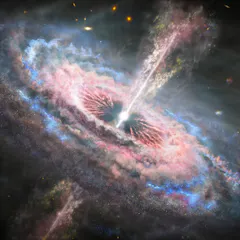
The discovery raises big questions about widely accepted models of galaxy formation.
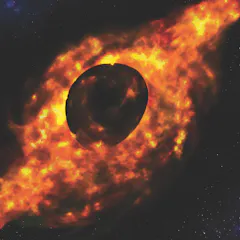
The black hole J0529-4351 is 500 trillion times brighter than the Sun.
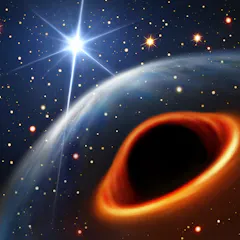
It’s too heavy to be a neutron star and too light to be a black hole. So what is it?
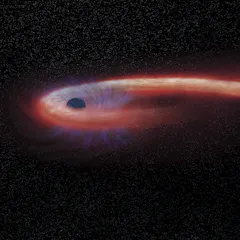
Pictures of black holes have a white outline around them when photographed, due to one of black holes’ unique and key features.
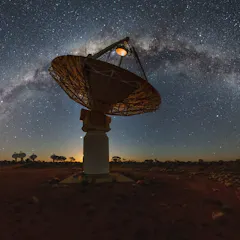
Do all big black holes in very massive galaxies emit radio waves? We used the latest radio telescopes to find out.
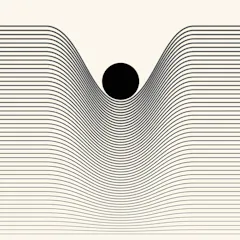
Einstein’s theory of general relativity suggests that our universe originated in a Big Bang. But black holes, and their gravitational forces, challenge the limits of Einstein’s work.

An astronomer and ‘black hole historian’ explains how the parts of the universe black holes grow in might influence how quickly they become bright, supermassive objects.
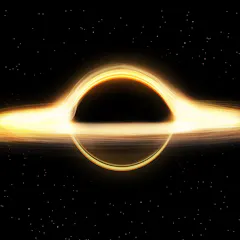
Black holes are known for pulling in all kinds of stuff – including light. Here’s how that actually works.
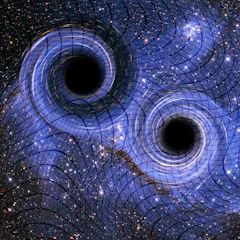
Astronomers have for the first time detected the background hum of gravitational waves likely caused by merging black holes.

New data from the IceCube collaboration shows neutrino emissions from within our Milky Way galaxy – but figuring out where exactly these ghost particles come from is harder than it seems.
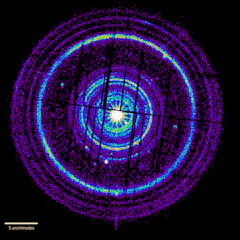
Radiation from the brightest cosmic explosion ever seen may have been mixing with gas and dust around its dying star – making the signal last longer.
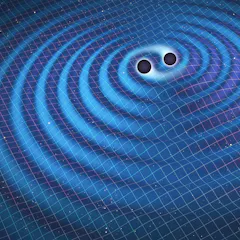
Upgrades to the hardware and software of the advanced observatory should allow astrophysicists to detect much fainter gravitational waves than before.
Artificial intelligence tools are making waves in almost every aspect of life, and astronomy is no different. An astronomer explains the history and future of AI in understanding the universe.
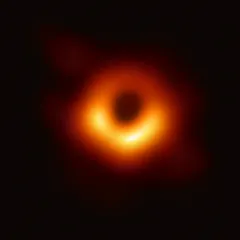
Beyond just looking at black holes, the next-generation Event Horizon Telescope collaboration is the first to bring together perspectives from across the sciences and humanities.
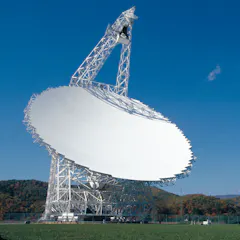
Many telescopes use the radio spectrum to learn about the cosmos. Just as human development leads to more light pollution, increasing numbers of satellites are leading to more radio interference.
Top contributors
-

Emeritus Professor, ARC Centre of Excellence for Gravitational Wave Discovery, OzGrav, The University of Western Australia
-
Professor of Astrophysics, University of Sydney
-
University Distinguished Professor of Astronomy, University of Arizona
-
Professor, Curtin Institute of Radio Astronomy, Curtin University
-
Senior Lecturer in Physics, Western Sydney University
-
Professor, Radio Astronomy, University of Sydney
-
Professor of Theoretical Astrophysics, Monash University
-
Professor of Astronomy, Swinburne University of Technology
-
Professor and Director of the Centre of Excellence for Data Science, AI and Modelling, University of Hull
-
Senior Lecturer and ARC Future Fellow, Monash University
-
Senior Curator (Astronomy), Museums Victoria Research Institute; The University of Melbourne
-
ARC Laureate Fellow, Swinburne University of Technology
-
Professor, Swinburne University of Technology, Swinburne University of Technology
-
Professor of Astrophysics, University of Southampton
-
Professor of Astronomy, UMass Lowell