
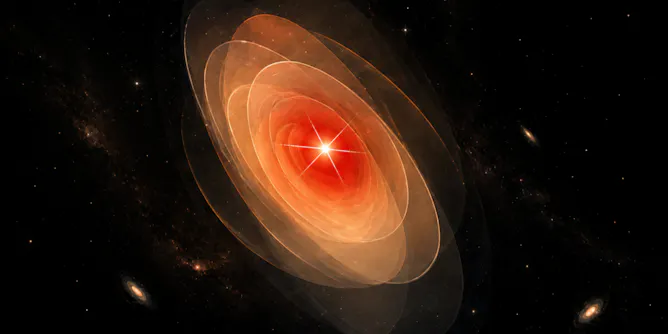
It turns out these little red dots might actually be evidence of supermassive black holes.
Articles on Supermassive black holes
Displaying 1 - 20 of 54 articles
Black holes are a mainstay in sci-fi movies. How do these massive black holes, spread throughout our universe, actually work in real life?
The satellites the world relies on for navigation, communication and more get their bearings from distant black holes – but radio noise is blurring the picture.
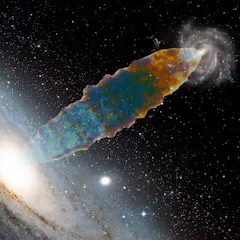
Understanding the evolution of radio galaxies is crucial for unravelling the broader processes that shape the universe.
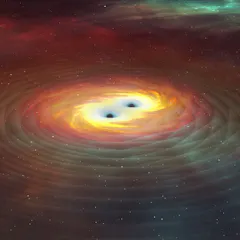
Gravitational waves carry information about massive cosmic events and help scientists to ‘listen’ to space.
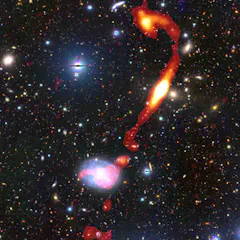
It’s been a bit troublesome to understand the physics behind what’s going on with Inkathazo.
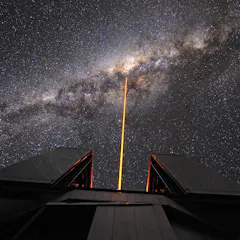
The discovery helps explain a long-running cosmic mystery about why some stars hurtle through space much faster than others.
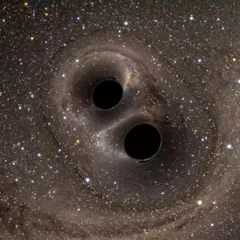
Most objects in the universe have been around for way longer than modern astronomy – digging into historical records can help scientists shed light on a cosmic mystery.
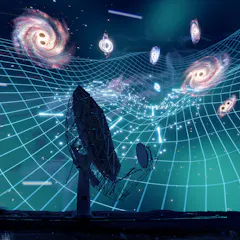
A new effort to map the rumblings in spacetime caused by enormous black hole collisions paints a surprisingly loud and lopsided picture of the universe.
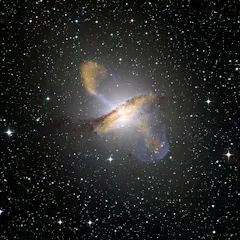
New analysis of radio telescope data links the shape of galaxies to the supermassive black holes they host.
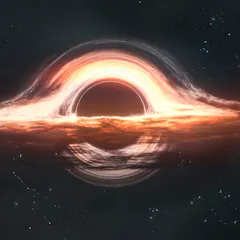
New research can help us understand how supermassive black holes formed – and why many of them appear to be more massive than expected.
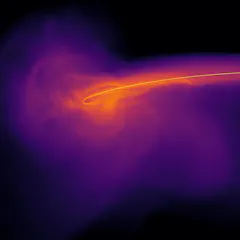
If a star gets too close to a black hole, it gets shredded and produces a complex ball of light. These videos are the first time this dramatic event has been simulated in detail.
X-rays emitted around black holes can tell astrophysicists about how fast they’re growing.
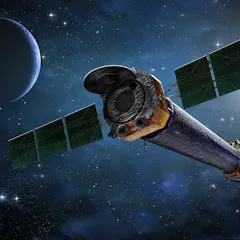
2024 marks 25 years since NASA’s Chandra X-ray Observatory started detecting X-rays from energetic astronomical events.

MeerKAT has made remarkable contributions to South African and international science.
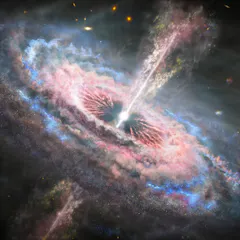
The discovery raises big questions about widely accepted models of galaxy formation.
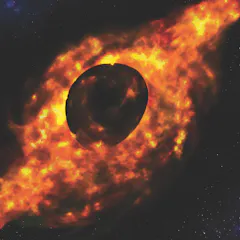
The black hole J0529-4351 is 500 trillion times brighter than the Sun.
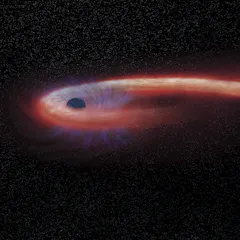
Pictures of black holes have a white outline around them when photographed, due to one of black holes’ unique and key features.
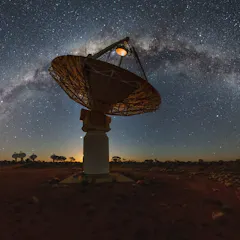
Do all big black holes in very massive galaxies emit radio waves? We used the latest radio telescopes to find out.

An astronomer and ‘black hole historian’ explains how the parts of the universe black holes grow in might influence how quickly they become bright, supermassive objects.
Top contributors
-

Professor of Astrophysics, University of Sydney
-
Post-doctoral researcher in Astrophysics, University of the Western Cape
-
JASPER Postdoctoral Researcher, University of Arizona
-
Senior Curator (Astronomy), Museums Victoria Research Institute; The University of Melbourne
-
Postdoctoral Research Fellow, Astrophysics, The University of Queensland
-
Postdoctoral Researcher of Astrophysics, University of Bath
-
Assistant Professor of Applied Mathematics, Durham University
-
Professor of Physics & Astronomy, Yale University
-
Lecturer of Physics and Astronomy, Cardiff University
-
Associate Professor, The University of Queensland
-
Professor of Observational Astronomy, University of Leicester
-
Professor in High Energy Astrophyics, Adelaide University
-
Associate Professor, University of Hertfordshire
-
Reader (Physics and Astronomy), University of Sussex
-
Research scientist & Head of Science Operations and Support, e-MERLIN/VLBI National Radio Astronomy Facility, Jodrell Bank Centre for Astrophysics, University of Manchester