
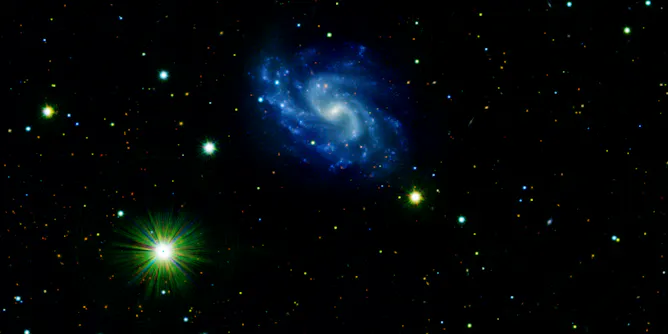
Our universe’s most exciting days are well behind us, with new research showing the universe is now slowly but surely dying.
Articles on Big Bang
Displaying 61 - 80 of 80 articles
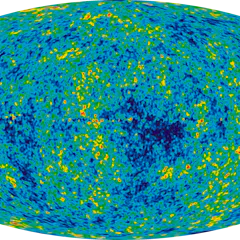
This month marks the 50th anniversary of the discovery of the Cosmic Microwave Background, which is the radiation left over from the birth of the universe.
Subatomic particles have shaped and continue to shape our universe but despite perfect predictions by physicists, the theory about unseen particles is still wrong.
Several dwarf galaxies have been discovered close to our own Milky Way and are adding to our understanding of how galaxies form. But why haven’t astronomers seen them before?
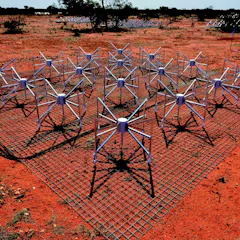
More than 100 million years has been wiped off the age of the first stars but there is still the question of what happened in the first billion years of the universe. Earlier this month the European Space…
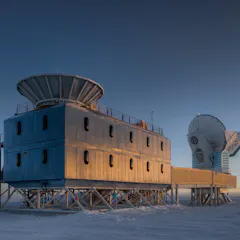
One of this century’s greatest potential discoveries concerning the origins of the universe has now fallen to galactic dust. That’s according to a new joint-analysis of all the existing data – including…
Recent observations suggest that there is something not quite right with our view of our universe – that something is skewing our view of the oldest radiation arriving at our telescopes. What’s causing…
It’s almost three months since a team of scientists announced it had detected polarised light from the afterglow of the Big Bang. But questions are still being asked about whether cosmic dust may have…
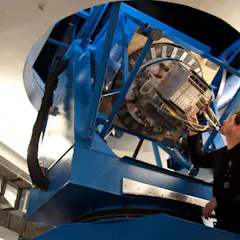
Scientists at the Harvard-Smithsonian Centre for Astrophysics in the US have announced overnight what they believe is the indirect detection of gravitational waves in the afterglow of the Big Bang. The…
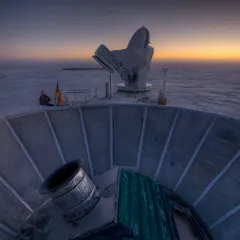
The cosmological community is bubbling with the news that the BICEP2 experiment may have detected gravitational waves through measuring the radiation left over from the big bang. If the findings are correct…
The discovery of an ancient star formed approximately 13.6-billion years ago just after the Big Bang is telling us much about the early universe. The star – designated SMSS J031300.36-670839.3 – lies within…
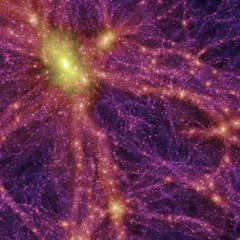
According to cosmologists, galaxies are joined together by filaments, quite literally. These filaments form the cosmic web and are made of mostly dark matter, many stars and some gas. Observing these filaments…
Cosmologists have detected a long sought component in the Cosmic Microwave Background (CMB), which will help us to further…

We are living in an era of science denial. An era when well-established facts are disputed, fake experts are interviewed by the media and blog posts trump science papers. It’s an era of vaccine denial…

Melbourne Researchers Rewrite Big Bang Theory sang a recent headline in the Sydney Morning Herald. It was one of many suggesting the Big Bang theory had been somehow overthrown. As the principal investigator…

Earlier this week, headlines in several major newspapers screamed: “Melbourne researchers rewrite Big Bang theory”. You might think this is a reference to a new script for a popular TV show, but as a cosmologist…
A spiral galaxy in the early universe, billions of years before many other spiral galaxies formed, has been witnessed for…
Today, the University of Melbourne’s Professor Stuart Wyithe was awarded the 2011 Malcolm McIntosh Prize for Physical Scientist of the Year for his work on the origin of galaxies. The multi-award winning…
An excess of counter-clockwise rotating, or “left-handed,” spiral galaxies have been found, providing evidence that the universe…

Last week, scientists set a new distance record, seeing a burst of gamma-rays from a star that exploded when the universe was only 520 million years old. The light from this distant source has been travelling…
Top contributors
-

Professor of Astrophysics, University of Sydney
-
Pro Vice-Chancellor Flagship Initiatives, Swinburne University of Technology
-
Professor of Astrophysics and Royal Society University Research Fellow, University of Hertfordshire
-
Associate Professor in Astronomy, Monash University
-
Cosmologist, University of Tasmania
-
Research Scientist, SETI Institute
-
University Distinguished Professor of Astronomy, University of Arizona
-
Reader in Astrophysics, UCL
-
Emeritus Professor of Cosmology and Astrophysics, Institute of Astronomy, University of Cambridge
-
John Curtin Distinguished Professor (Radio Astronomy), Curtin University
-
Professor, The University of Queensland
-
PhD Candidate, University of Southern Queensland
-
Research Professor and Director of the International Institute for Accelerator Applications, University of Huddersfield
-
Senior Lecturer in Particle Physics Informatics, Brunel University of London
-
ARC Laureate Fellow & Distinguished Professor, Centre for Astrophysics & Supercomputing, Swinburne University of Technology