
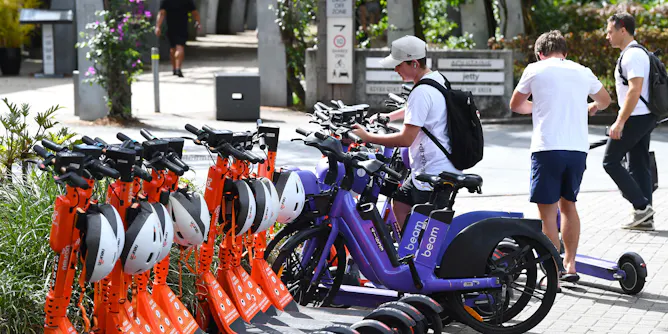
Low-income customers who qualify for subsidised rates are five times more likely to use shared e-scooters and e-bikes for daily travel. People with disabilities also value them.
Articles on Bicycle-sharing systems
Displaying 1 - 20 of 73 articles
Bike riders wear helmets and high-vis vests to reduce their vulnerability on the road. Problem is a new study finds this dehumanises cyclists, putting them more at risk of aggression from drivers.
Lagos is famous for its congested traffic. Cycling could help change this image.
Around the world, very few public transport agencies make money, while ride-sharing companies are making huge losses. So why partner up, and how do those partnerships work?

To boost their attractiveness to tourists and residents alike, in 2020 the towns of Gongju and Buyeo – once Imperial capitals – launched the “Smart Town Challenge” to link online and offline services.

On paper, swapping gas-guzzling trucks for bikes may sound like an appealing option for greening e-commerce. However, there are sizeable obstacles to implementing this in cities.

A new study finds congestion charging and creating car-free streets and separated bike lanes have been most effective at reducing car use in European cities.

Is it affordable? Is it safe? Here are some key things to consider if you’re considering buying one of these vehicles or using them in a share scheme.
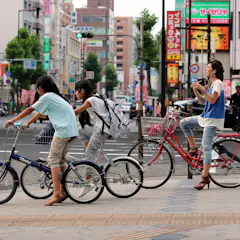
Women in cities tend to get more walking done, which is beneficial to both their health and the climate. Making streets safer for cycling would give them greater access to cities too.
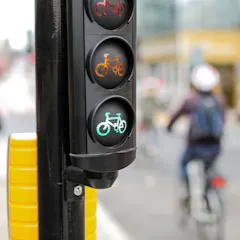
London was rated 2021’s most congested city.
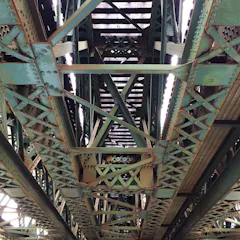
What will the US$1.2 trillion infrastructure bill pay for? Here are some of the things it will help build, fix or remove.
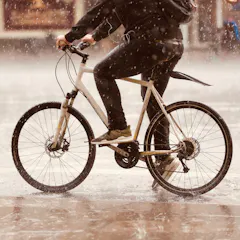
Cyclists in Melbourne are less likely than those in Dublin or Seville to ride in the rain. Understanding why is crucial.

Data from the UK Musician’s Union shows that half of their members have experienced sexual harassment at work.

It’s time to stop demonising cyclists and cycling activists as elitists — the accusation fails at the first test.

Bike-share programs don’t just cater for residents. When tourists use them too, that greatly increases the value the whole community gets from these bikes.

The need for social distancing sparked a cycling boom, cutting air pollution and boosting city dwellers’ mental and physical health. But when the pandemic ends, will it be back to life as usual?

And the winner is … e-bikes? A new entrant is set to overtake Brisbane’s CityCycle scheme in the race for the shared mobility market.

An increase in cyclists due to the COVID-19 pandemic means that cities need to look at what it means to develop and maintain inclusive bicycle infrastructure.

Australian bicycles are largely influenced by sport, not utility. We should embrace cargo bikes for their usefulness, over speed.

New bike lanes are a good idea for health and air quality, but the convenience of car travel for most journeys will remain.
Top contributors
-

Associate Professor in Urban Planning, The University of Queensland
-
Professor of Human Geography, The University of Queensland
-
Chris Rissel is a Friend of The Conversation.
Senior Research Fellow, College of Medicine and Public Health, Flinders University
-
Professor, Faculty of Health Sciences, Simon Fraser University
-
Affiliate
-
Honorary Professor of Planning, The University of Queensland
-
Professor of Cultural Studies, University of Wollongong
-
Professor of Urban and Environmental Policy and Planning, Tufts University
-
Adjunct Professor, School of Engineering and Built Environment, Griffith University
-
Honorary Professor of Transport Studies
-
Principal Research Associate, University of Cambridge
-
PhD Candidate, Cities Research Institute, Griffith University
-
Adjunct Professor, Civil and Environmental Engineering, and Co-Director, Transportation Sustainability Research Center, University of California, Berkeley
-
PhD Candidate, Faculty of Health Sciences, Simon Fraser University
-
Survey Researcher, University of California, Berkeley