
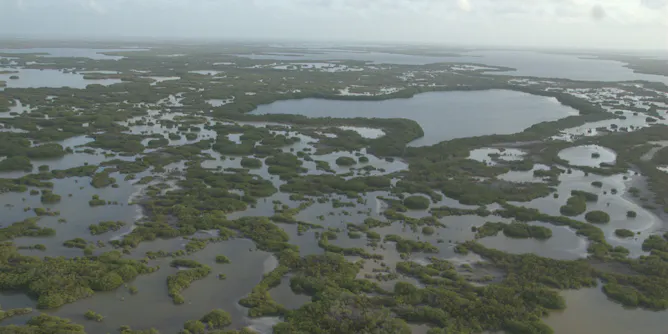
A new study estimates that mangroves prevent over $65 billion in damage from coastal storms every year, and says mangrove protection should be funded in the same way as infrastructure like seawalls.
Articles on Aquaculture
Displaying 41 - 60 of 77 articles
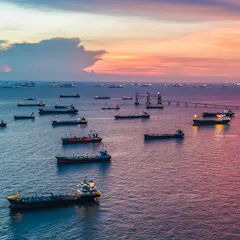
The Great Acceleration inaugurated the Anthropocene in the 1950s. Now, a similar race for resources and space is happening in the ocean.

Consumers are increasingly concerned about the sustainability of their fish.

Combining aquaculture and hydroponics, aquaponics unearths value in “waste” flows and re-routes them back into the economy. It’s an inspiring example of how a circular-economy business model can work.
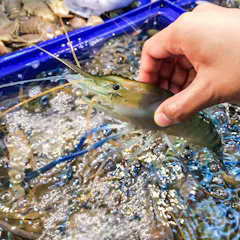
Entire populations of prawn ‘super-females’ are now being commercially distributed. The science behind this continues to advance and could have a far-reaching impact on both humans and animals.
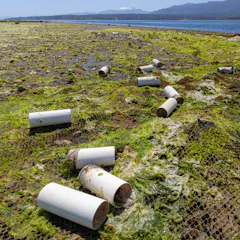
Growing demand for large salt-water clams is leaving parts of the B.C. coast littered with plastic debris.
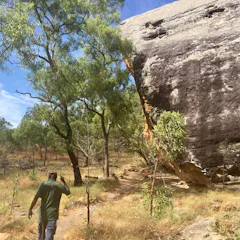
The World Heritage Listing for Victoria’s Budj Bim fish traps was ground-breaking. Here are five other Australian Indigenous sites that also deserve greater attention.
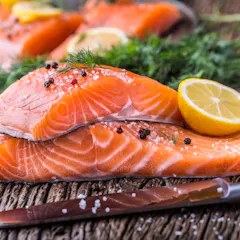
Fish farming has been criticised for a lack of sustainability – here’s what has been changing and what still remains a challenge.
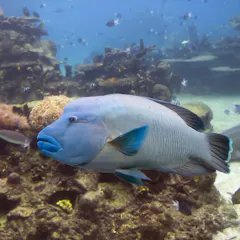
Analysis of last summer’s heatwave shows it killed farmed salmon and decimated kelp forests, as well as shifting grape harvests and fish spawning times forward by several weeks.
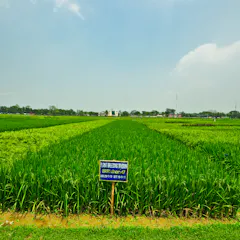
Rising seas and groundwater depletion, both driven by climate change, are making soils saltier in many parts of the world. Farmers will need help adapting, especially in developing countries.

Many people focus just on agriculture and new technologies for feeding the world’s growing population. Yet, fisheries are the centerpiece of billions of people’s diets.
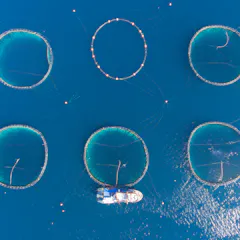
Aquaculture is endangering the marine environment, threatening the livelihood of small-scale fishers and food security.
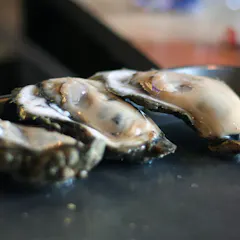
Oysters are big business along the Gulf Coast, but raising them off-bottom – which yields a premium product – is just starting there. Hurricane Michael showed it won’t be easy.
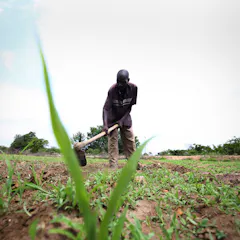
There have been a variety of approaches to tackle malnutrition. The continent needs to learn from past mistakes across the world.

Many critics say that fish farms mainly sell their output to wealthy countries and don’t provide much benefit to poor people in producing countries. Three aquaculture experts show why this view is wrong.

Oysters grow in seawater and filter their food from it, so how do you shield them from waterborne diseases? Scientists are working to develop strains that are resistant to a fast-spreading herpes virus.
A new study shows that sustainable fish farming in deep ocean waters could produce as much seafood as all of the world’s wild fisheries, in a space the size of Lake Michigan or Africa’s Lake Victoria.

In an extract from his new book, Tim Flannery explains how giant kelp farms could suck carbon dioxide from the air and store it in the ocean’s depths, while encouraging species like fish and oysters.

Due to rising sea levels, low-lying island nations are in immediate danger. If drastic measures are taken, this disastrous trend can be transformed into an opportunity for sustainable development.
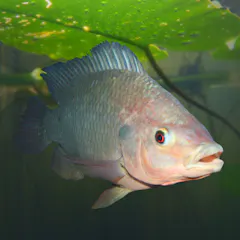
In light of World Oceans Day, it’s important to note the important role aquaculture can have on the continent.
Top contributors
-

Professor of Aquatic Resources Development, University of Stirling
-
Professor of International Development, Michigan State University
-
Postdoctoral Researcher, Department of Psychology, University of Alberta
-
Lecturer in Aquaculture, University of Stirling
-
Adjunct Associate Professor, University of Guelph
-
Professor, University of Tasmania
-
Postdoctoral Scholar, National Center for Ecological Analysis and Synthesis, University of California, Santa Barbara
-
Professor of Fish Physiology, University of Stirling
-
Professor of Computer Science, University of Sheffield
-
Emeritus Professor at Research Center for Oceanography, Indonesian Institute of Sciences (LIPI)
-
Assistant Professor, Institute of Marine and Environmental Technology, University of Maryland, Baltimore County
-
Honorary Fellow in Economics, The University of Queensland
-
Chief Research Scientist - Environment, CSIRO
-
Postdoctoral Researcher, Entomology and Biological Control, Rhodes University
-
Postdoctoral researcher, Universitat Autònoma de Barcelona