
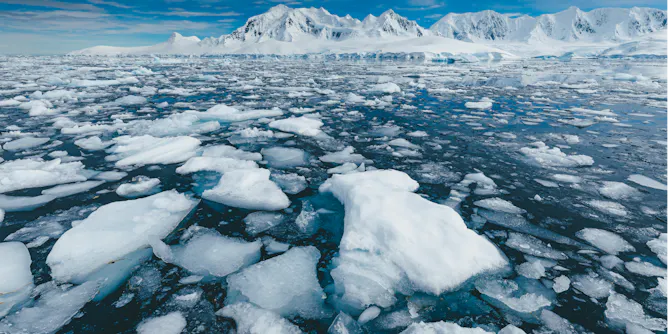
This remarkable seasonal change in Antarctic sea ice is like a heartbeat within our planet’s climate system. We need to better understand it.
Articles on Antarctic sea ice
Displaying all articles
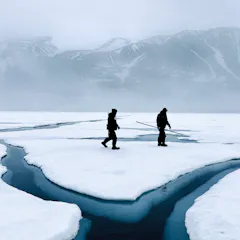
The 20th anniversary of the annual report tracks how sea ice, snow cover and many other vital signs of the Arctic have changed, and the impact that’s having on people and wildlife.

New research explores the wide-ranging consequences of record low summer sea ice in Antarctica. From more ocean warming to extra icebergs, it’s bad news we must hear.

When sea ice forms later, the communities of tiny algae that live within it change too. Detecting these early signals now could help us adapt to a changing world.
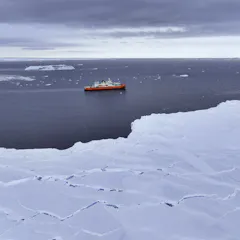
The Antarctic Slope Current shields Antarctica from warm waters. But new research shows meltwater is speeding up the current, which could make it more unstable.

Part of the system that pumps water, heat and nutrients around the globe is at risk. Climate change could slow the Antarctic Circumpolar Current down 20% by 2050.
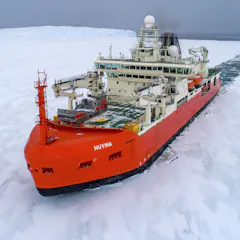
A parliamentary report has called on for a second icebreaking vessel and more reliable funding for Antarctic research.
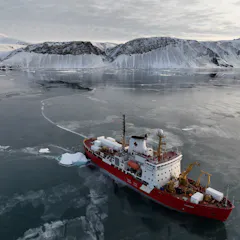
The last ice area is projected to be the last place on Earth to retain year-round sea ice by 2040. A recent Arctic expedition to the area has provided key data that could help guide conservation efforts.

These powerful ‘rivers in the sky’ provide a huge share of annual precipitation in many regions, including California. They can also melt sea ice, with global climate implications.

Some 7,000 years ago, West Antarctica’s ice sheet retreated, most likely driven by warmer ocean currents slipping under the ice. This could happen again – unless we cut emissions fast.

Ocean warming seems the main driver of Antarctica’s sea-ice loss. But as satellites show, the change is not universal and sea ice persists in East Antarctica and the Weddell Sea.
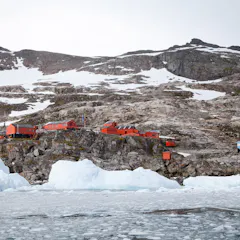
The proliferation of Antarctic research stations – 77 in all – is increasing knowledge of the continent but also the human impacts. A new study has identified the best ways to limit these impacts.
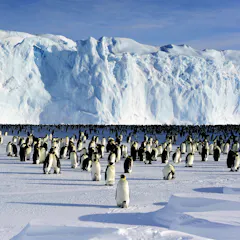
The first comprehensive assessment of trends in Southern Ocean ecosystems reveals an urgent need to address climate change. The summary for policymakers can guide decision-makers.
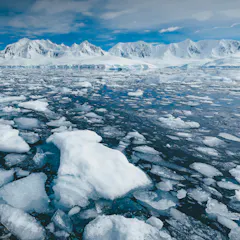
The rapid changes in the Southern Ocean and Antarctica highlight the urgency of better direct observations and measurements, beyond satellite monitoring and modelling.
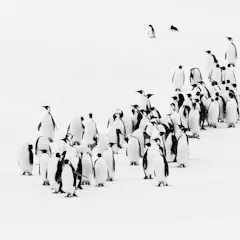
If we want to live in a world with Emperor penguins, we need to cut emissions steeply and protect parts of the ocean around Antarctica where climate change will have the biggest impact.
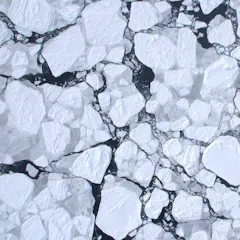
Antarctic sea ice is now nearly 9% below normal. But the dramatic decline is not universal around the continent, which makes it difficult to predict the overall impact of climate change.
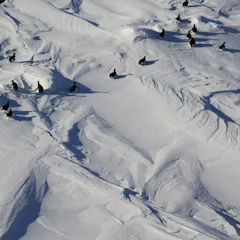
Sea ice around Antarctica has always followed a predictable seasonal cycle. Now, we’ve experienced a sudden dramatic loss, and the changes are here to stay.
Top contributors
-

Senior Research Associate in Physical Oceanography, University of Tasmania
-
Marine Physicist, National Institute of Water and Atmospheric Research (NIWA)
-
Professor in Ocean Physics, University of Auckland, Waipapa Taumata Rau; Earth Sciences New Zealand
-
Senior Scientist, National Snow and Ice Data Center (NSIDC), Cooperative Institute for Research in Environmental Sciences (CIRES), University of Colorado Boulder
-
Fieldwork Coordinator/Research Technician, CSIRO
-
Research Fellow in Physics, University of Otago
-
Alaska Climate Specialist, University of Alaska Fairbanks
-
Associate Professor in Conservation Biology, University of Canterbury
-
Associate Professor in Physics, University of Otago
-
Senior Lecturer in Climate Science, Monash University
-
Associate Professor for Remote Sensing and Glaciology, University of Canterbury
-
Senior Research Fellow, University of Otago
-
Ice Sheet & Climate Modeller, Te Herenga Waka — Victoria University of Wellington
-
NASA Postdoctoral Fellow, NASA
-
Assistant Research Fellow, University of Otago