
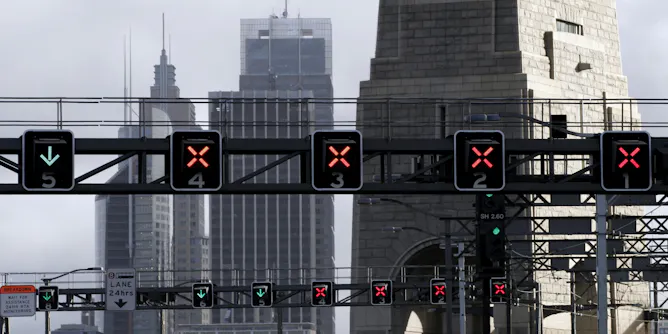
Faced with the eye-watering costs of building infrastructure, it makes sense to turn to much more cost-effective smart technology to get traffic flowing.
Articles on transport infrastructure
Displaying 21 - 28 of 28 articles

A breakdown in the road or rail systems often causes commuter chaos in Australia. Some overseas cities are more resilient because they have other options – and our bicycle network could give us that.

Some countries have already committed to using electric aircraft on domestic routes. These aircraft could slash costs and emissions on some of Australia’s busiest flight routes.
The Coalition’s infrastructure budgets over this term of government have been around the midpoint of government investment over the past decade. But how projects are chosen leaves a lot to be desired.
Despite boasts of ‘record’ infrastructure spending, relative to GDP it’s comparable to previous budgets. What’s different is that Treasurer Frydenberg has chanced his arm more over the longer term.
The focus on roads reflects the fact that this infrastructure program lags well behind the growth of our biggest cities, resulting in less-than-ideal transport patterns.
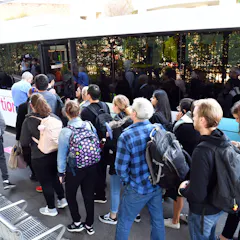
The major parties are promising projects costing tens of billions of dollars, with a surprisingly large overlap between them. Yet only two have been endorsed by infrastructure authorities.

Every major transport study since the 1970s has identified Sydney’s western rail corridor as the priority for an upgrade. The latest patronage figures confirm that’s where the need is greatest.
Top contributors
-

Transport and Cities Program Director, Grattan Institute
-
Associate Professor of Urban Planning, The University of Melbourne
-
Professor of Transport Technology and Sustainability, Swinburne University of Technology
-
Honorary Senior Fellow in Transport Planning, The University of Melbourne
-
Adjunct Research Fellow, School of Human Sciences, The University of Western Australia
-
PhD student, Australian National University
-
Postdoctoral Research Fellow, Melbourne School of Design, The University of Melbourne
-
Associate, Grattan Institute
-
Curtin University
-
Vice-Chancellor's Senior Research Fellow, RMIT University
-
Senior Researcher, Urban Transformations Research Centre, Western Sydney University
-
Senior Lecturer in Urbanism, University of Sydney
-
Senior Research Consultant, Institute for Sustainable Futures, University of Technology Sydney
-
Adjunct Professor, Institute of Transport and Logistics Studies, University of Sydney Business School, University of Sydney
-
Elaine Stratford is a Friend of The Conversation.
Professor, School of Geography, Planning, and Spatial Sciences, University of Tasmania