
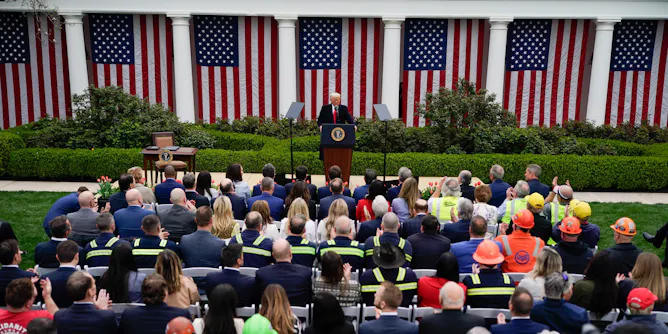
The president’s actions are driven by nostalgia rather than reality.
Articles on Tariffs
Displaying 141 - 160 of 367 articles

Diversifying exports takes time; what needs to be in place to achieve this?

The word ‘deficit’ may sound alarming, but America’s trade gap is a sign of its financial and economic dominance.

Financial markets have reacted very badly to the upending of global trade. But that doesn’t mean you should panic.
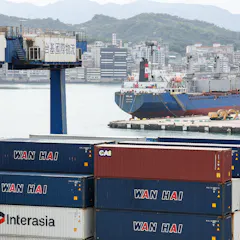
Geopolitical threats from China and the United States abound. That could be a tough pill to swallow for Taiwan − and American consumers.

To calculate its ‘reciprocal tariffs’, the Trump administration has opted for a crude formula with no basis in trade theory. We are all going to pay the price.

What impact the Trump tariffs might have on Australia generally and the election in particular is among the issues discussed in this week’s election special podcast.

Unfortunately for the Romans, high tariffs often led to higher prices, black markets and other economic woes.
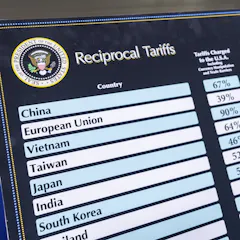
Countries worldwide plot their response to Trump’s wave of tariffs.

One bizarre consequence of Trump’s tariff wars could be the chance to watch Netflix for free.

Foreign investment thrives on stability. Trump’s tariffs − and the current climate of uncertainty − could drive capital away.

The trade war is likely to lead to more energy-intensive goods produced in the US, and dampen international investment in renewable energy.

The so-called ‘Liberation Day’ announcements played out like a reality TV cliffhanger. What might the next ‘episode’ have in store for the rest of the world?

The strength of these alliances depends on whether Trump views Tokyo and Seoul as bulwarks against China’s rise or vassals that can be extorted for financial gain.
Modelling of how Trump’s tariffs will hit global trade suggests the US will be the biggest loser – while a few nations may emerge as surprising winners.
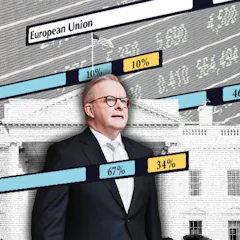
Australia has escaped some of the highest tariff levels, but will still feel economic pain. There are three main ways we can respond.
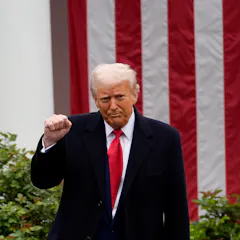
The US president has imposed a baseline 10% “reciprocal” tariff on all imports, with some countries facing a much higher rate.

The Trump administration’s current use of 19th-century tools to solve 20th-century problems threatens to take America back to the 19th century.

Danielle Smith’s approach to Trump’s tariffs against Canada reflects an outdated economic approach to tariffs that involves inertia or sheer subservience.
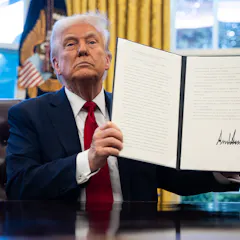
Donald Trump’s aggressive foreign policy is being cast as necessary for national security. This ensures he’ll encounter little pushback from Congress or the courts.
Top contributors
-

Professorial Fellow, University of Canberra
-
Professor, and Executive Director: Institute for International Trade, and Director of the Jean Monnet Centre of Trade and Environment, Adelaide University
-
Associate Professor of Political Science, Georgia State University
-
Senior Research Fellow, Institute for International Trade, Adelaide University
-
Distinguished Professor, Arthur J. Gosnell Professor of Economics, & Head, Department of Sustainability, Rochester Institute of Technology
-
Professor of Trade Law and Taxation, Queensland University of Technology
-
Associate Professor of Economics, University of South Carolina
-
Emeritus Professor of Law, University of Auckland, Waipapa Taumata Rau
-
Professor of Economics, University of Minnesota Duluth
-
Associate Professor of Agri-Food Trade and Policy, University of Guelph
-
Professor of Economics, Auckland University of Technology
-
Honorary Research Fellow, City Political Economy Research Centre, City St George's, University of London
-
Professor Emeritus of Economics, Babson College
-
Senior Lecturer in Economics, Bournemouth University
-
Professor of Law and Director of the UOW Transnational Law and Policy Centre, University of Wollongong