
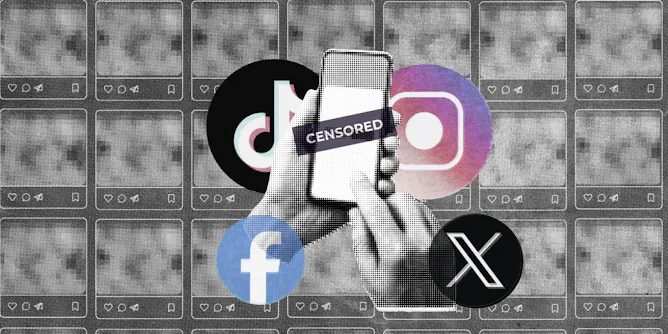
The government’s proposed digital duty of care includes a mechanism for people to opt out of social media algorithms.
Articles on Social media algorithms
Displaying 1 - 20 of 32 articles
This new wave of AI short dramas is absurdly addictive. Understanding the psychology is the first step towards breaking the spell.

Political content on social media finds you even if you’re not looking for it, and it tends to do so through a sensationalized and emotionally charged lens.
A new tool lets researchers get a handle on how social media algorithms affect emotions and polarization.

Dungeon & Dragon’s expansion over the last 50 years was driven by digital social networks in the same way that the evolution of digital social networks was driven by D&D.

Just because you ‘heard it on a podcast’, it doesn’t mean the info is necessarily more trustworthy than a random social media post.

The author of the new book ‘Attention and Alienation’ wonders if the online world can ever become a place where kindness and human flourishing are the prevailing ethos.

AI models can help us to repurpose existing medicines, cutting research costs and timescales.
Boosted by algorithms, many influencers are framing suffering as fitness, and failing young men in the process.

A study of US state legislators found that posting misinformation online was a winning strategy for boosting a politician’s visibility – but not for Democrats.

In the past, adolescents’ musical palettes were dominated by the Top-40 artists, creating a widely shared – if perhaps narrow – repertoire of musical knowledge.
Women’s bodies are sexually objectified no matter what the context – and it’s a serious health issue

Social media platforms are abandoning news – which is bad news for traditional media organisations that have come to rely on them for consumers.
The plaintiffs claims features such as ‘infinite scroll’ leave users less likely to be able to exercise self-control.

Algorithms have been blamed for dividing society. What if they could support social cohesion instead?

What does it say about the online media ecosystem when the end of a 146-day strike is buried under headlines and posts about Swift’s budding romance with NFL star Travis Kelce?

Laughter is one of the most ubiquitous and pleasurable things humans do, which is why companies online want to know what we find funny.
Social media companies’ drive to keep you on their platforms clashes with how people evolved to learn from each other. One result is more conflict and misinformation.

Fighting misinformation doesn’t have to involve restricting content or dampening people’s enthusiasm for sharing it. The key is turning bad habits into good ones.
Social media algorithms can use millions of different parameters to decide what kind of content is shown to users.
Top contributors
-

Postdoctoral research fellow, California Institute of Technology
-
Emerita Provost Professor of Psychology and Business, USC Dornsife College of Letters, Arts and Sciences
-
Assistant Professor of Sociology, Davidson College
-
Professor of Information Systems, Michigan State University
-
Professor of Communication, Inland Norway University of Applied Sciences
-
Professor of Philosophy, University of Southampton
-
Assistant Professor of Computer Science, Johns Hopkins University
-
PhD Student, Department of Kinesiology, University of Windsor
-
Digital Sociologist, Sciences Po Paris, Sciences Po
-
Director of Sydney Executive Plus, Business School, University of Sydney
-
Dean of Global Business, The Fletcher School, Tufts University
-
Senior Lecturer in Cultural Studies and Media, Macquarie University
-
Professor of Informatics and Computer Science, Indiana University
-
Professor of Music Teaching and Learning, University of Southern California
-
Assistant Professor of Management and Organizations, Northwestern University