
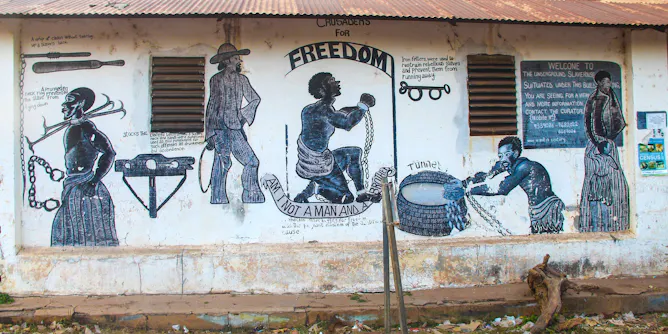
Recognising African agency in colonised territories allows us to rethink borders and revise history.
Articles on Slavery reparations
Displaying all articles

Identifying the transatlantic slave trade as the gravest crime against humanity situates its history within international law.

‘40 acres and a mule’ never happened. Now governments and communities across the US are redistributing land and wealth, from Evanston, Illinois, to Athens, Georgia.

A new archival study uncovers details about Lloyds of London’s role in the transatlantic slave trade. Whether historical or political, reparatory justice relies on such historical evidence.

Some UK families whose wealth largely derives from the transatlantic slave trade have agreed to pay reparations.
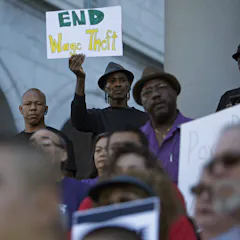
Rebalancing labor relations so that workers are empowered would be an effective way to address racial wealth disparities and atone for the legacy of slavery, a scholar argues.

There are major obstacles in confronting the social movement for reparations for the slave trade. Such reparations are a moral imperative, but politically, successfully obtaining them will be hard.

Former enslaved persons never got ‘forty acres and a mule,’ and their descendants have been denied reparations for the legacy of slavery. Will Joe Biden be the president to change that?
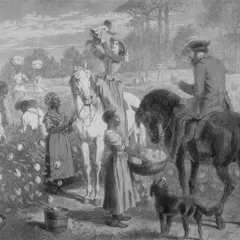
History is full of examples of nations paying out to compensate for slavery. But the money never went to those who suffered under the system, only those who profited.

In a rare series of interviews, the late Ghanaian leader spoke of how the country’s slave trade was revisited as a vehicle for economic development.

Some calls to resolve racial inequities in the US have raised an idea with roots more than a century old: community land trusts to assemble property for the benefit of Black Americans.

There is unlikely to be a strong legal claim for reparations from China for COVID-19.

An oral history based biography of a survivor of colonial genocide in Namibia indicates instances of humanity during an entirely inhumane era.

In the United States, presidential candidates are discussing reparations for the descendants of enslaved men and women.

Several presidential hopefuls have offered proposals to close the racial wealth gap, from baby bonds to reparations. A simulation suggests policies short of direct aid to blacks won’t do the trick.
Old injustices don’t simply disappear with time – they tear a nation apart.
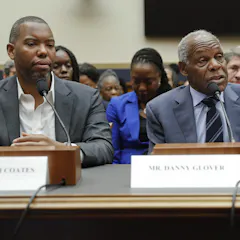
Reparation opponents who oppose truth and reconciliation by insisting that America’s “original sin” of slavery is in the distant past should heed the lessons of Canada and South Africa.

History is complex and multi-dimensional. Any response to what happened in the past should reflect this.
Top contributors
-

Reader in Journalism, City St George's, University of London
-
Professor of Theology, Vanderbilt University
-
Senior Lecturer in Black, Caribbean, and African History, The Open University
-
Professor Emeritus, Department of Political Science, Wilfrid Laurier University
-
Professor of Community Resources and Development, Arizona State University
-
Professor of History, Binghamton University, State University of New York
-
Assistant Professor, Teaching Stream, Black Health Lead, Dalla Lana School of Public Health, University of Toronto
-
Associate Professor of Public Policy, University of Connecticut
-
Professor of Political Science, Texas Tech University
-
Professor of Human Rights and International Humanitarian Law, Queen's University Belfast
-
Professor of Public Policy and Public Affairs, UMass Boston
-
Associate Professor and Director of Christiansborg Archaeological Heritage Project, Associate Graduate Faculty, Rutgers University
-
Professor of Human Rights, University of Bristol
-
Professor of History and Global Human Rights, McMaster University
-
Professor of Sustainability, Arizona State University