

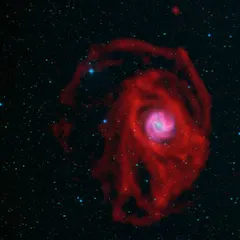
Scientists have discovered the most distant hydroxyl megamaser ever detected. This is a natural space laser.
Articles on SKA
Displaying 1 - 20 of 29 articles

The SKA-Low radio telescope in Western Australia is slowly coming online. It will probe the shape of the universe and study cosmic mysteries.

MeerKAT has made remarkable contributions to South African and international science.

This Town echoes the ways in which music is forged by its social context, while shaping and defining the lives of the people who make it.

To the ǀXam and San people, being in the world as a person includes “the sky’s things” - an understanding of and deep connection with the cosmos.

Their line up of black and white musicians was a mission statement for a fractured nation, while Hall’s doleful vocals starkly illustrated the politics of disillusionment.
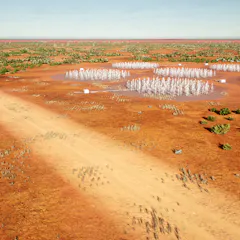
Hundreds of thousands of antennas across the Western Australian outback will transform our view of the Universe.

Sagittarius A* lies in the southern sky, passing directly above South Africa.
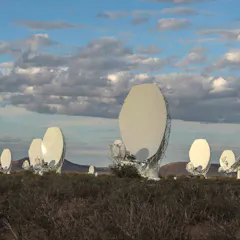
The pandemic has underscored that the world requires agility for survival. That makes blue skies science, which encourages curiosity and nimble thinking, perhaps more important than ever.

CC BY-NC-ND7.23 MB (download)
Radio galaxies may be the oldest galaxy systems, providing clues to the evolution of galaxies.
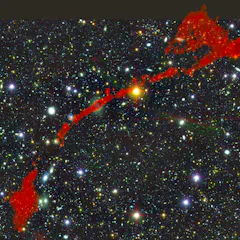
Based on what we currently know about the density of giant radio galaxies in the sky, the probability of finding two of them in this region is extremely small.
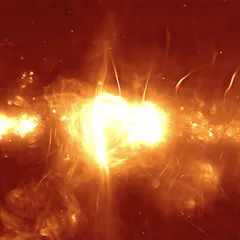
A black hole is an object with such a strong gravitational pull that nothing, not even light, can escape from it.

More than just a musical accolade, UNESCO has recognised the social and political importance of Jamaican music.
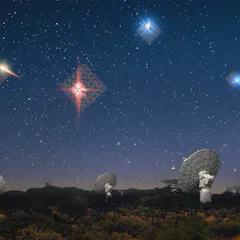
Perhaps precisely because they are so elusive, Fast Radio Bursts have received a lot of attention in the years since their discovery.
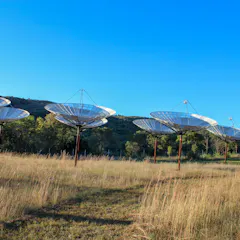
By sharing a location with the SKA, HIRAX will be able to conduct science in “radio-clear” skies across its wide frequency range.
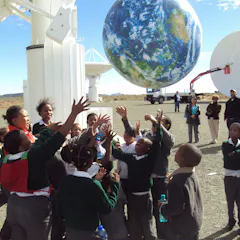
Astronomy is accessible to anyone with a view of the sky.
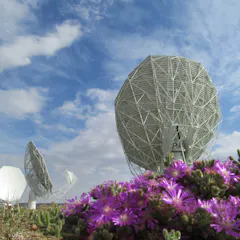
The SKA global project could be a driver that contributes to South Africa’ economic growth.
A precursor to the Square Kilometre Array- the MeerKAT telescope - is being built right now and remarkable progress has been made in the last 12 months.

Astronomy on the continent has been given a much needed boost with Ghana’s converted radio telescope between it and South Africa, to conduct scientific observations.

Africa’s overall contribution to research might be small, but smart people are undertaking smart and important work on and about the continent.
Top contributors
-

Post-doctoral researcher in Astrophysics, University of the Western Cape
-
Lecturer, University of Cape Town
-
Reader in Music, Politics and Society, Newcastle University
-
Director: Wits Centre for Astrophysics; SKA Chair in Radio Astronomy, University of Cape Town; Inter-University Institute for Data Intensive Astronomy
-
Science Director, International Science Council; University of Cape Town
-
Emeritus Professor Department of Chemical Engineering Faculty of Engineering and the Built Environment, University of Cape Town
-
SKA Postdoc in Observational Cosmology, University of the Western Cape
-
PhD Student, University of Cape Town
-
Head of Department, University of Johannesburg
-
Reader in Astrophysics, UCL
-
Full Professor of Physics, University of the Western Cape
-
Senior Lecturer: Entrepreneurship Stellenbosch Business School
-
Editor-in-Chief of the South African Journal of Science and Consultant, Vice Principal for Research and Graduate Education, University of Pretoria
-
Lecturer in Astronomy and Astrophysics, Technical University of Kenya
-
Associate Professor of Astronomy, University of the Western Cape