
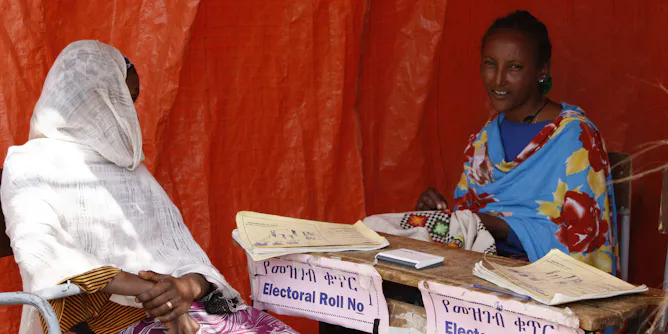
The upcoming elections are arguably among the least politically competitive Ethiopia has experienced since the introduction of multiparty elections in the 1990s.
Articles on Prosperity Party
Displaying all articles

In parliamentary democracies, prime ministers remain in office for as long as they retain the confidence of parliament.
There is a risk of the upcoming election deepening existing regional and political fault lines instead of bridging them.
Ethiopia tried to transit to democracy in 1991 and 2018. Both attempts were unsuccessful.
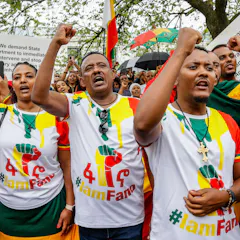
The Fano insurgency is taking place in a territory three times the size of Tigray, stretching the army’s resources.
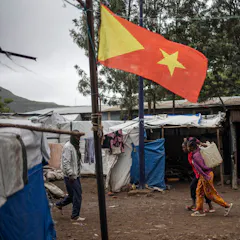
The 2020-2022 war and its lingering effects have thrown the Tigray region into chaos.
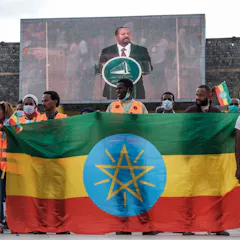
After more than 30 years of federalism, ethnic conflict in Ethiopia hasn’t been resolved – but neither has the country disintegrated.

The rhetoric that presents the Amhara people as a national enemy has gone on, unchallenged, for far too long.

Abiy Ahmed’s use of the military to address a critical challenge is likely to fail.
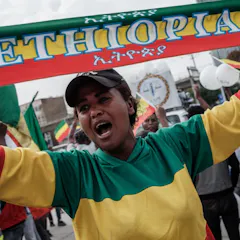
A new government with popular legitimacy will have power to address lingering political, economic and security challenges.

Ethiopia’s party system is extremely volatile due to the prevalence of weakly institutionalised and fragmented political parties.
Top contributors
-

Senior Lecturer of Political Science, Georgia Gwinnett College
-
Lecturer in Comparative Politics, Queen's University Belfast
-
Assistant Professor of Political Science and Strategic Studies , Mekelle University
-
Doctoral Researcher, University of Helsinki
-
Assistant Professor, Political Science, University of Gondar
-
Lecturer, Griffith University
-
Ph.D. Fellow, Center for Constitutional Democracy, Indiana University
-
Director, Centre for Human Rights Education, Curtin University
-
Associate Professor of Sociology and Senior Researcher, The Nordic Africa Institute
-
Associate Professor of Law, Addis Ababa University