
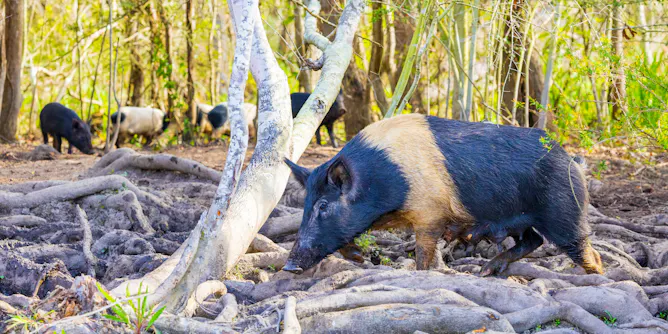
Teaming groups of private landowners with federal efforts yielded measurable success, at least in terms of defending cornfields.
Articles on Pigs
Displaying 1 - 20 of 52 articles

Some critics have bemoaned the flattening of a complex character. But Nolan’s film echoes a literary tradition of reimagining Circe as a survivor, a truth-teller and a figure of female empowerment.
Access to global markets will continue to decrease if the disease is not brought under control.
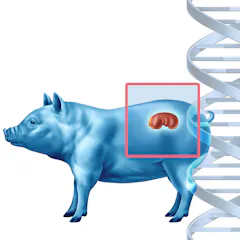
How many human cells does a pig need before it’s considered too human?
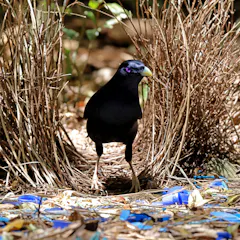
Without being able to get into the heads of animals, it’s hard to say for sure. But instances of pig painters, whale crooners and bird sculptors certainly make it seem plausible.
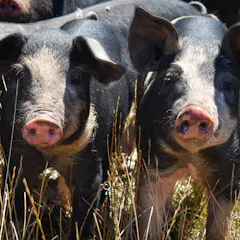
Genetic diversity matters for wildlife – and for the livestock on which we depend. Yet breed after breed is disappearing into extinction.
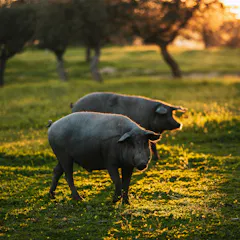
Pigs are an ideal ‘mixing vessel’ for avian and human viruses.
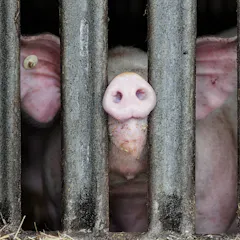
Italy has culled at least 40,000 animals in response to African swine fever, often in opposition to animal activists. The country could do well with exploring other solutions, starting with vaccines.

Pigs, specifically those weighing around 60kg, are useful in human decomposition studies.

Champions of xenotransplantation see it as the solution to organ shortages across the world. But this technology has other applications.

This summer is expected to be dry and hot. Here’s what that means for the risk of mosquito-borne diseases.
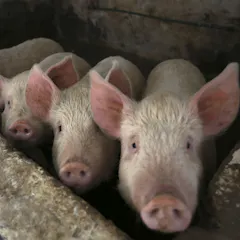
First published in 1975, Animal Liberation opened our eyes to the exploitation of animals. At a time of ‘ag-gag’ laws and ‘skyscraper’ farms, a new edition assesses the state of animal rights today.

Since antiquity people have harnessed sound as a weapon, and the practice continues – in new high-tech ways – today.
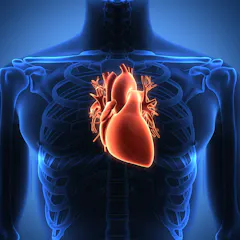
The heart used in the first pig-human transplant was infected with a pig virus. This reveals that using other species as organ donors may not provide a solution for organ shortages.
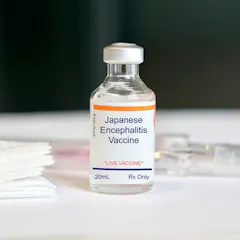
Until now, access to the vaccines has been limited. But that’s expected to change.

New developments in organ transplants from animals show promise. However, there has been no public engagement about a potential risk. It may streamline a pathway to humans for new zoonotic diseases.

African livestock keepers need help: without proactive interventions, increasing temperatures will reduce meat and milk production.
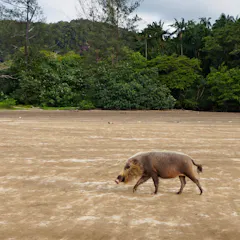
The changing dynamic between Borneo’s pigs and Indigenous people is a powerful reminder of the fragility of the human-nature connection.
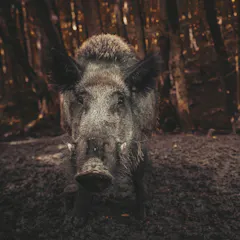
Wild pigs are on every continent, except Antarctica. All up, they likely turn over the the same amount of soil as the area of Taiwan.
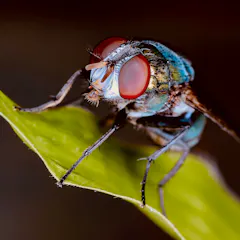
New findings suggest the loss of fertility at high temperatures is a major threat to the survival of some species.
Top contributors
-

Associate Professor of Food Politics and Policy, The University of Melbourne
-
Senior Lecturer in Ethics, Keele University
-
Professor, School of BioSciences and Bio21 Institute, The University of Melbourne
-
Associate Professor in Sustainability and Urban Planning, RMIT University
-
Professor and Chair of Philosophy, Wageningen University
-
Professor and Sixth Century Chair of Human Palaeoecology, University of Aberdeen
-
Senior Lecturer in Urban Planning & Design, Monash University
-
Lecturer in Social Psychology, Lancaster University
-
Associate Professor of Agricultural Economics, Colorado State University
-
Professor of Law, The University of Melbourne
-
Researcher in Conservation Decision Science and Land Use, University of Oxford
-
Senior Lecturer in Epidemiology (One Health), University of Sydney
-
Professor, Food Economics, University of Guelph
-
Senior Lecturer in Science Communication, The University of Western Australia
-
Reader in Law, Lancaster University