
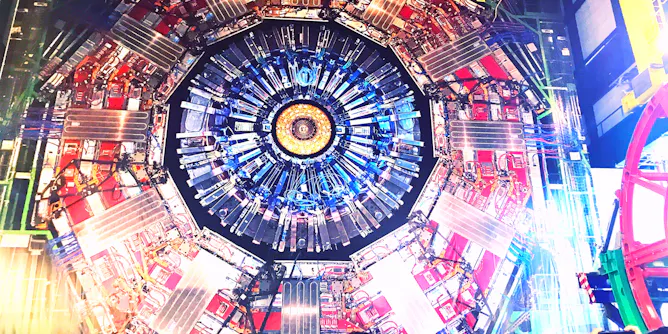
Scientists at Cern’s Large Hadron Collider have seen something that may force us to abandon everything we thought we knew about the world on the level of particles.
Articles on Particle physics
Displaying 61 - 80 of 106 articles
A particle physicist explains just what this keystone theory includes. After 50 years, it’s the best we’ve got to answer what everything in the universe is made of and how it all holds together.
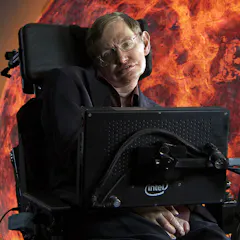
Stephen Hawking thought a form of string theory could be our best bet for a ‘theory of everything’.
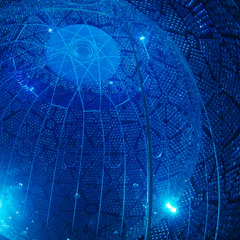
Deep underground, scientists research subatomic particles from space in a bid to understand the building blocks of our universe.
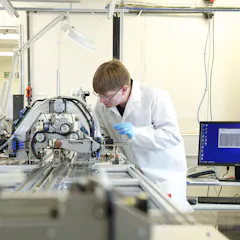
Deep beneath the Alpine ski slopes, patient scientists are waiting to observe a rare radioactive decay that would make us rewrite the Standard Model of Particle Physics.
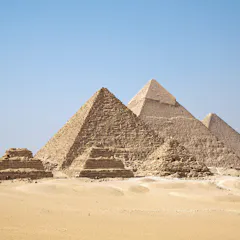
Cosmic particles called muons may revolutionise many areas of science.

The Deep Underground Neutrino Experiment (DUNE) could help unravel the mysteries of antimatter and complete scientists’ next model of the universe.
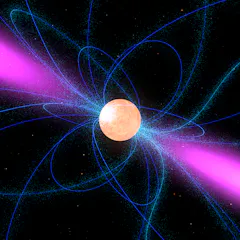
Studying mysterious neutron stars could uncover the secrets of exotic physics – and a way to navigate the stars.
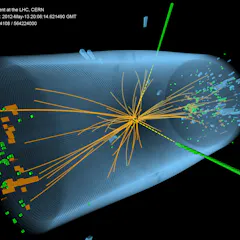
It’s not enough to do groundbreaking research if the results are kept from the public. So CERN is making its results available to everyone via open access, showing how science should be done.
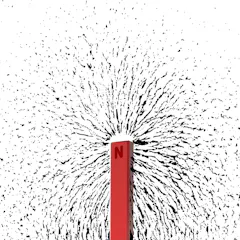
Physicists have theorised about the existence of a magnetic monopole for decades, but we have yet to find one.
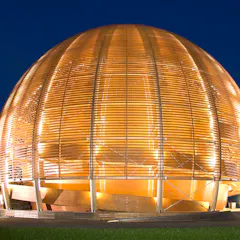
There have been squabbles of course, but the science project in Geneva is an example of putting differences aside to pursue common goals.
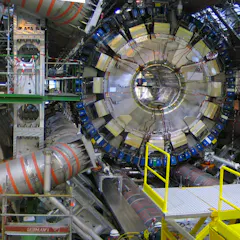
Researchers working on the LHC have been struggling to find new particles lately. But the latest results suggest things may be about to change.
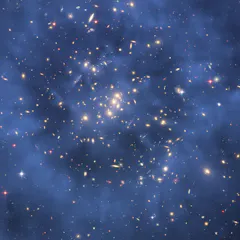
While we know that dark matter exists, we have no idea what it is. Luckily, there is no shortage of suggestions.
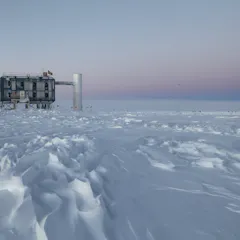
A cubic kilometer of clear, stable ice could help physicists answer big questions about cosmic rays and neutrinos. Hardy scientists collect data via a unique telescope at the frozen bottom of the world.

We talk about mass all the time but what is it that actually gives an object mass? And why do some things have mass and others have no mass at all?
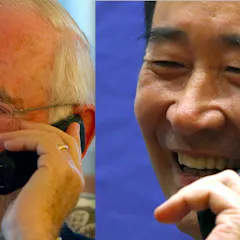
One of tiniest particles in physics has won the biggest prize in science – for the fourth time.
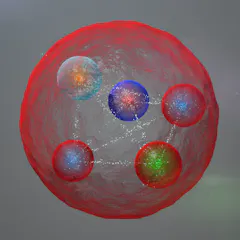
The latest data from the particle accelerator that found the Higgs Boson has confirmed another of our theories about how the universe works.
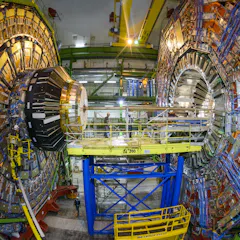
Running the world’s largest particle accelerator requires a lot of energy, but it could reveal the secrets of the universe.

The restart of experiments at CERN’s Large Hardron Collider could mark the start of a new era of discovery or a big disappointment.
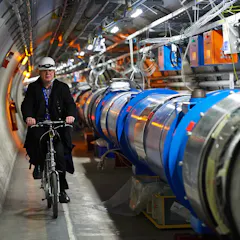
CERN’s huge particle accelerator has been switched back on after a two-year upgrade to continue its search for answers.
Top contributors
-

Particle physicist, University of Cambridge
-
Head of School for Physics, University of Sydney
-
Post Doctoral Research Associate, Centre for the Subatomic Structure of Matter, Adelaide University
-
Professor of Physics, Head of Department, Lancaster University
-
Professor of Physics, Monash University
-
Professor, Philosophy of Science, The University of Melbourne
-
ARC Research Associate (Centre of Excellence for Particle Physics at Tera Scale), Adelaide University
-
Postdoctoral Fellow in Quantum Physics, University of Colorado Boulder
-
Professor of Nuclear Physics, Mississippi State University
-
Associate Professor of Physics, Durham University
-
Senior Lecturer of Particle Physics, Lancaster University
-
Doctoral Student, College of Community and Public Affairs, Binghamton University, State University of New York
-
Royal Society University Research Fellow and Lecturer in Particle Physics, UCL
-
Senior Lecturer in Particle Physics Informatics, Brunel University of London
-
Research Professor and Director of the International Institute for Accelerator Applications, University of Huddersfield