
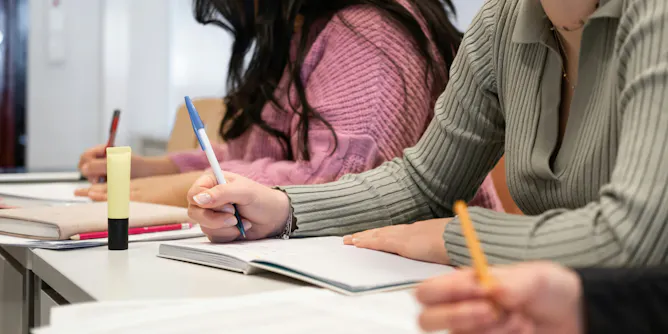
Until recently, the Prairie province has been an outlier with no provincewide mandated testing.
Articles on Numeracy
Displaying 1 - 20 of 99 articles

This gap was already a problem before the latest data. But the most recent results show how things are getting worse.

Yes, there appears to be a downward trend in Year 3 numeracy. But the decline is small and not statistically significant.

National NAPLAN results are released today, putting the spotlight on students’ numeracy and literacy skills.
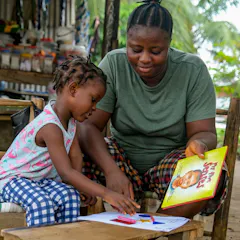
Reading together and taking an interest in homework makes a difference to young children’s learning.
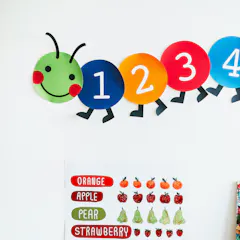
Educators in a research partnership have found that early math screening is a helpful teaching tool that helps educators target instruction to support children’s math learning.

An assessment of a learning intervention showed that the impact differed between groups of pupils.

A new Productivity Commission report looks at how to make workers more adaptable. This starts with making sure school students learn basic maths and English skills.
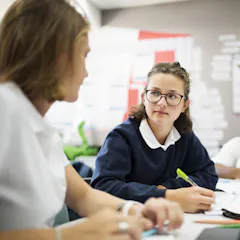
If the results are disappointing, try not to catastrophise them. For one thing, NAPLAN was done about four months ago – students will have made progress since then.

A pilot programme in 15 schools demonstrates how targeted, structured interventions can rapidly close foundational literacy gaps.
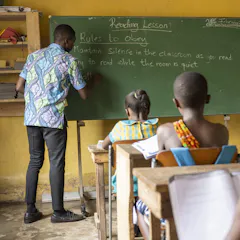
Literacy and numeracy have declined at the basic education level in Ghana.

New analysis shows boys are more confident in tasks involving maps and timetables. Parents can help by telling daughters it’s OK to make mistakes in maths.

Parents can now search how their child’s school has performed in reading, writing, spelling, grammar and numeracy.
My study clearly shows no long-term decline in NAPLAN results from 2008 to 2022. In 2023, they changed the way the test was organised.
Schools have been releasing individual results to families since the start of term 3. Today, we have the overall results.
As part of a new study, Year 7 students got $20 vouchers if they reached personalised goals in their NAPLAN tests.
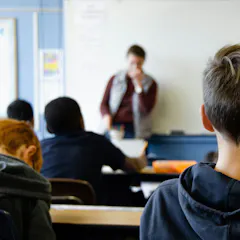
A new report analyses responses from more than 13,430 Australian students to understand their school experiences and how these impact on maths performance.
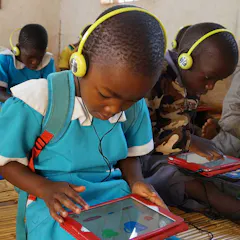
Child-directed educational technology can deliver high quality education for millions of marginalised children worldwide.

Unlike the traditional method of comparing Indigenous students with non-Indigenous students, a new approach compares Indigenous students with their Indigenous peers.

Children benefit enormously from regular, cognitively stimulating interactions with their caregivers.
Top contributors
-

Professor of Education Futures, The University of Melbourne
-
School Education Program Director, Grattan Institute
-
Senior Lecturer in Education, University of New England
-
Senior Research DECRA Fellow, Institute for Learning Sciences and Teacher Education, Australian Catholic University
-
Senior lecturer, University of Ghana
-
Director, Center for Science Communication Research, University of Oregon
-
Senior Lecturer in Mathematics Education, University of Sydney
-
Professor, School of Education, University of Southern Queensland
-
Research Scientist, African Population and Health Research Center
-
Lecturer in Mathematics Education, University of Sydney
-
Professor, Werklund School of Education, University of Calgary
-
Associate Professor in Language, Literacy and TESL, University of Canberra
-
Professor, Southern Cross University
-
Emeritus professor, The University of Western Australia
-
Deputy CEO (Research), Australian Council for Educational Research