

Why haven’t people gotten upset about how our social distancing signs are fostering innumeracy?
Articles on Numeracy
Displaying 41 - 60 of 100 articles
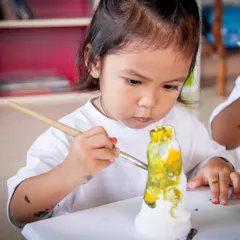
Encouraging a child to hold their paint brush to develop a pincer grip while the child is involved in painting is one example of guided play.

The evidence clearly shows one-on-one tutoring improves disadvantaged students’ skills. An Australian pilot program has now shown the benefits of online tutoring that supports students in their homes.

A wide range of animals seem to have a grasp of numbers – but humans hold the trump card.

While COVID-19 has held back learning, the pandemic presents a historic opportunity to revamp education systems.

Understanding numbers in the news or social media can empower you to figure out risks and make good choices. Here’s what to look out for to make sure you aren’t misled by COVID-19 coverage.
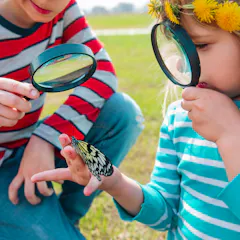
Playful activities that involve choice, active engagement and moments of delight are what children need this summer during the pandemic.

Remote contact with families in the coronavirus emergency is critical, but learning on a screen is not how young children will gain the foundational and developmental skills they need.
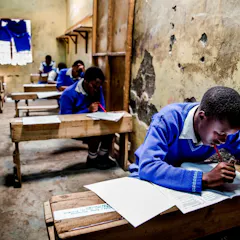
Study presents a model that can be scaled to improve learning outcomes and transition rates for young people living in urban informal settlements.

There’s more to learning than content. As long as kids maintain the essential literacy, numeracy and social skills, they will be well placed to pick up content they may have missed later.

Years 5-7 typically include the transition from primary to secondary but the reading slowdown can’t just be blamed on this, because numeracy progress has improved. So what’s going on with reading?

How mathematically proficient are you? And do you have the skills to back up your level of math confidence? The answers to those questions may have ramifications for your financial and physical health.

The questions in the NAPLAN numeracy tests are often years behind the level of mathematics students following the curriculum are studying that year.

We asked 252 Australian Greens party supporters and 252 One Nation party supporters to do some simple maths. Their answers changed when we told them it was climate change data.

Research shows small financial incentives for doing maths homework can increase maths achievement. But this raises some tricky ethical questions.
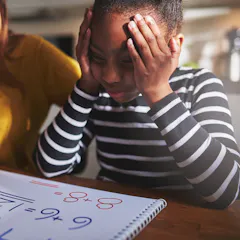
Finger counting and struggling to tell the time or use a calendar are all typical signs of dyscalculia – sometimes called ‘maths dyslexia’.

Changes to the literacy and numeracy standards for new teachers in Victoria have raised questions about what makes a ‘good’ teacher.

The NSW government will review the K-12 curriculum over the next 18 months. Simplistic approaches may suggest reducing the number of subjects, but this would be a backward step.
To assess problem-solving, creative and critical thinking skills on NAPLAN would fit with broader movements in education internationally, but there are some questions to address first.
Getting rid of NAPLAN would allow teachers more time to respond to and address the needs of their students, rather than teaching to the test.
Top contributors
-

Professor of Education Futures, The University of Melbourne
-
School Education Program Director, Grattan Institute
-
Senior Lecturer in Education, University of New England
-
Senior Research DECRA Fellow, Institute for Learning Sciences and Teacher Education, Australian Catholic University
-
Senior lecturer, University of Ghana
-
Director, Center for Science Communication Research, University of Oregon
-
Senior Lecturer in Mathematics Education, University of Sydney
-
Professor, School of Education, University of Southern Queensland
-
Research Scientist, African Population and Health Research Center
-
Lecturer in Mathematics Education, University of Sydney
-
Professor, Werklund School of Education, University of Calgary
-
Associate Professor in Language, Literacy and TESL, University of Canberra
-
Professor, Southern Cross University
-
Emeritus professor, The University of Western Australia
-
Deputy CEO (Research), Australian Council for Educational Research