
At the same time Australia has inked a deal with the US on critical minerals, it’s proposing cuts to facilities that underpin its clean energy ambitions.
Articles on Neutrons
Displaying all articles
Almost everything on Earth is made up of atoms, but where do these fundamental building blocks come from?

An exciting new experiment is being set up at Yale university in the US.
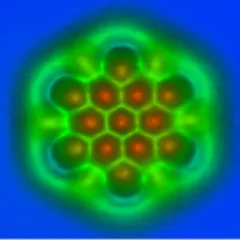
A physicist explains how atoms arrange themselves into molecules – and how scientists are able to image these tiny bits of matter that make up everything around you.

Nuclear isomers are rare versions of elements with properties that mystified physicists when first discovered. Isomers are now used in medicine and astronomy, and researchers are set to discover thousands more of them.
Neutrons are useful in research and medicine. A proposed neutron production facility could help further Canadian research and provide a source of neutrons for medical purposes.
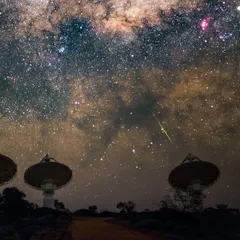
Cosmologists had only been able to find half the matter that should exist in the universe. With the discovery of a new astronomical phenomenon and new telescopes, researchers just found the rest.
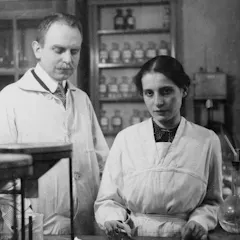
Left off publications due to Nazi prejudice, this Jewish woman lost her rightful place in the scientific pantheon as the discoverer of nuclear fission.
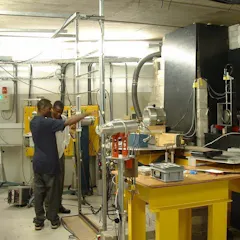
Neutrons can penetrate through matter, which means they can be harnessed for all sorts of important work.
A particle physicist explains just what this keystone theory includes. After 50 years, it’s the best we’ve got to answer what everything in the universe is made of and how it all holds together.
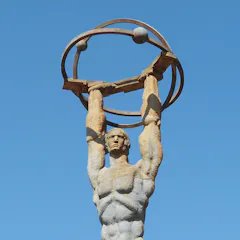
By figuring out fission, physicists were able to split uranium atoms and release massive amounts of energy. This Manhattan Project work paved the way both for atomic bombs and nuclear power reactors.
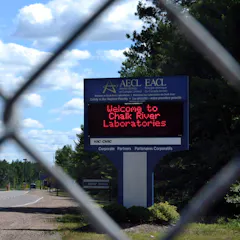
Canada is a world leader in the field of neutron scattering, winning a Nobel Prize in 1994 for its invention. But the looming shutdown of facilities at Chalk River puts us on the sidelines.
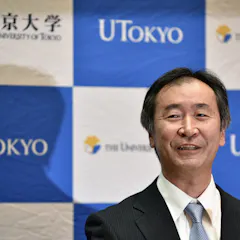
On the journey to discovery with the ‘gifted mentor’ Takaaki Kajita, one of this year’s Nobel Prize winners, from some one who studied with him.
A new time-keeping device based on the orbit of a neutron around an atomic nucleus has been proposed by scientists at the…
Top contributors
-

Professor of Nuclear Physics, Michigan State University
-
Professor, Monash University
-
Professor of Physics, Michigan State University
-
Glenn Starkman is a Friend of The Conversation.
Distinguished University Professor of Physics, Case Western Reserve University
-
Executive Director of the Sylvia Fedoruk Canadian Centre for Nuclear Innovation, University of Saskatchewan
-
McMaster University
-
Associate Professor of Astrophysics, Curtin University
-
Adjunct Professor of Physics, Laurentian University
-
Professor of Astronomy & Astrophysics, University of California, Santa Cruz
-
Assistant Professor of Biochemistry, University of Windsor
-
Assistant Professor in Department of Oncology, Western University
-
Associate Professor of Nuclear Physics, University of Guelph
-
Postdoctoral Fellow of Physics, Stockholm University
-
Postdoctoral research fellow, iThemba LABS
-
Associate Professor of Physics, University of Richmond