
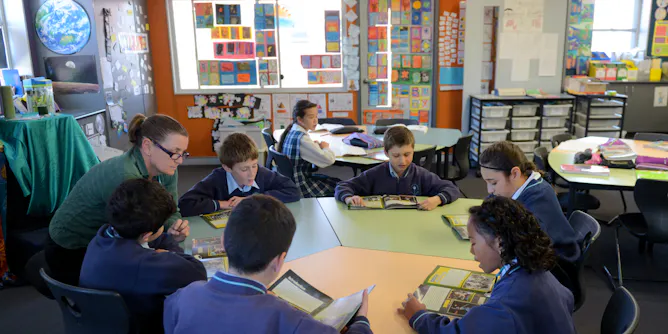
Getting rid of NAPLAN would allow teachers more time to respond to and address the needs of their students, rather than teaching to the test.
Articles on NAPLAN
Displaying 61 - 80 of 134 articles

While we may need to rethink how we use NAPLAN, it is an important and useful tool for researchers and policy makers.

Assessments need to be relevant to the real world and test more complex skills to better predict competency, standards of literacy and teaching.

Students from the Philippines, China and India consistently achieve better results at school than their Australian-born counterparts. This is due to a number of factors, including parents’ values.

Moving away from direct instruction and teaching to the test and towards making sure boys enjoy reading will improve outcomes.
Using equivalent year levels provides us with a clearer picture of the gap for Indigenous students, who can be up to an equivalent of 7.7 years behind their non-Indigenous counterparts in writing.

The year 2017 is finally coming to an end, so here’s a wrap of our coverage for the year, with bonus quiz!

The results are in, and student achievement on NAPLAN has plateaued in literacy and numeracy, with some areas of improvement.

The results of an international study into reading skills offer reason for optimism for Australian students. But tragically, too many children are still being left behind.

Standardised tests are a powerful tool for building an evidence base of what works to guide education policy.

Standardised tests restrict how well students with disability can do, which reinforces the idea that there are things they can’t do that children without disability can.

If we fail to recognise that standardised tests are metro-centric, we will continue to produce disadvantage for rural students.

NAPLAN is good at measuring some aspects of education, including knowledge difference between demographics, but has not produced a positive effect on student learning outcomes.

NAPLAN is great at tracking changes over time and between demographics, but not so great at measuring what factors effect change, engagement or creativity.

High grades might be awarded to papers that show the structural features of highly persuasive writing – papers that follow the “persuasion script”, so to speak.

Pressure on schools to make rapid improvements discourages deeper thinking about long-term solutions. Education can learn a lot from “slow” movements.
The preliminary results of NAPLAN 2017 are out, and the news isn’t good. The annual test of our students’ literacy and numeracy skills shows that not much has changed since 2011, coincidentally – or not…

Writing is a fundamental outcome indicator of learning across subjects and grades. The latest NAPLAN results tell us we need to do more to empower children with these skills.

This year’s preliminary NAPLAN results show Australian students are flatlining after ten years of the controversial tests.

My School data does not show the quality of teaching, and school comparisons and rankings can be misleading.
Top contributors
-

Professor, School of Education, University of Southern Queensland
-
Senior Research DECRA Fellow, Institute for Learning Sciences and Teacher Education, Australian Catholic University
-
School Education Program Director, Grattan Institute
-
Senior Lecturer in Education, University of New England
-
Professor of Education Futures, The University of Melbourne
-
Associate Professor of Education Policy, Australian Catholic University
-
Associate Professor in Language, Literacy and TESL, University of Canberra
-
Professor, Australian Catholic University
-
Vice-Chancellor's Fellow, Melbourne Graduate School of Education, The University of Melbourne
-
Professor (Curriculum Inquiry / Rural Education), University of Canberra
-
Deputy Dean, School of Education, Western Sydney University
-
Researcher, The University of Melbourne
-
Senior Fellow, National Centre for Indigenous Studies, Australian National University
-
Deputy Program Director, School Education, Grattan Institute
-
Senior Lecturer, Education Policy and Leadership, The University of Melbourne