
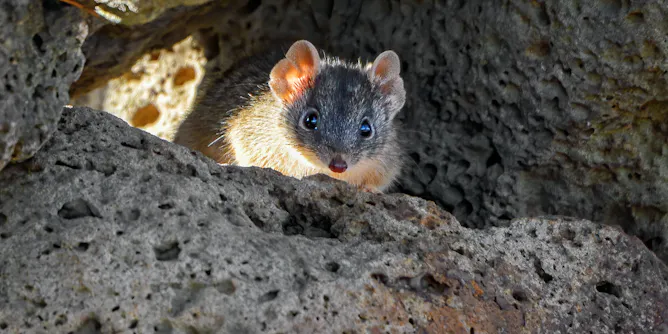
Antechinuses are tiny marsupials famous for their intense sex lives. Now, researchers have documented another unusual behaviour – the cannibalism of their own species.
Articles on Marsupials
Displaying 21 - 40 of 87 articles
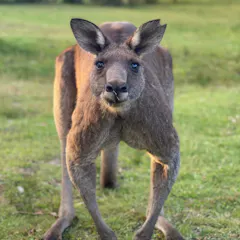
The Marsupial Microbiome Poop Troop collects the droppings of wild marsupials to help save the lives of orphaned joeys.
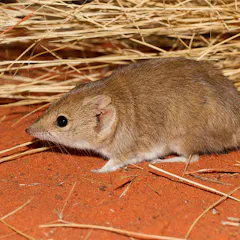
We found three previously unknown species of mulgaras hiding in museum collections – but all three have been driven to extinction since European colonisation of Australia.
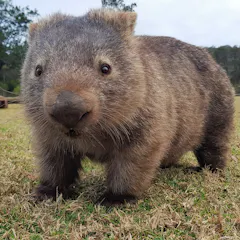
Contributors to the WomSAT website have already reported more than 23,000 wombat sightings. We can use the data to cut the risks to wombats – and anyone with a smartphone can help.
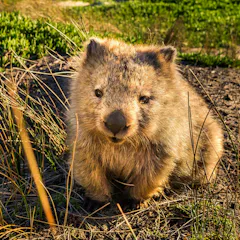
Despite their solitary lifestyle, wombats are at risk from a disease that spreads via their burrows.
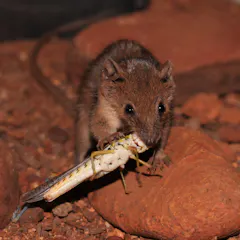
The tiny, mouse-like planigales are some of the smallest marsupials around – and there are two more species of them than anybody realised.
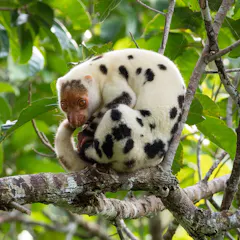
From the cuscus with the fancy coat, to the wallaby often sporting a single white glove, a wide variety of life evolved on island homes in the south-west Pacific.
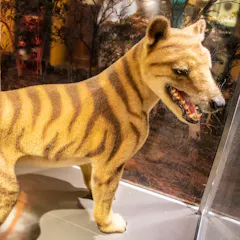
Brain samples of a thylacine that died in 1880 in Berlin were kept safe by researchers for decades. Now, they have finally been analysed.
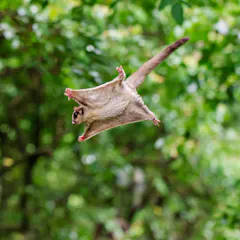
It’s not as well-known as the Hills Hoist clothesline, but here’s another Aussie invention worth celebrating: Glide poles are reconnecting severed landscapes for a special group of marsupials.
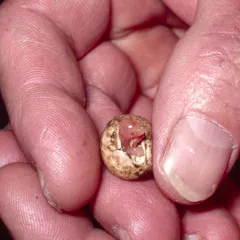
All mammals produce milk. But there’s no milk quite like that produced by monotremes and marsupials. Here’s what’s so special about it.

The ancestors of kangaroos once lived in the trees – but their evolutionary history is murky. Here’s everything we know so far.

Having special foot adaptations helped these sizeable animals wander long distances, which meant a better chance to find plentiful food and water.
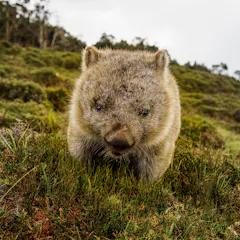
Death by exhaustion, cannibalism, complete body fusion: across the animal kingdom, mating takes many strange forms.
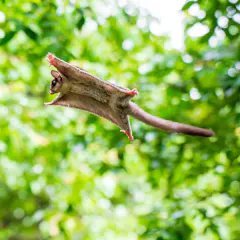
Mammals have evolved flight more often than birds. By studying the genes of the sugar glider, biologists have found a ‘molecular toolkit’ for flight membranes that’s been in us all along.
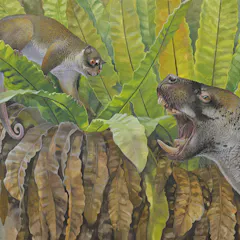
Australia’s Red Centre was once a lush forest filled with strange creatures – and we are slowly discovering more about this enigmatic past.

80,000 years ago, Australia’s landscape was dominated by much larger versions of today’s marsupials – including enigmatic and enormous wombats.
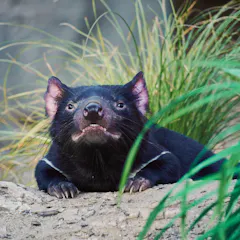
The same technology found in a widely used COVID-19 vaccine could be the key to helping save wild Tassie devils – without any needles.
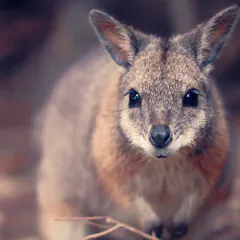
The teeth of the tammar wallaby don’t grow in the way you’d expect – and scientists want to know why.
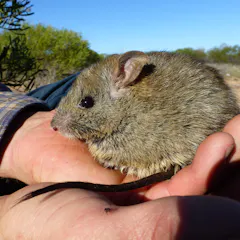
Researchers are in a race against time to learn about the female-oriented social structures of Australia’s small native rodents and marsupials.
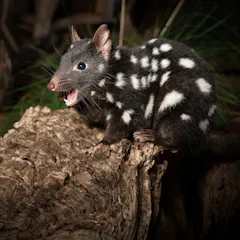
The 1878, the body of Sergeant Michael Kennedy lay in the bush in Victoria’s Wombat Ranges. He’d been shot by the notorious Ned Kelly gang – but the bush would add its own gruesome ending.
Top contributors
-

Curator of Mammals, Western Australian Museum; Curtin University
-
Associate Professor in Biology, Zoology and Animal Science, Western Sydney University
-
Associate Professor in Anatomy, Murdoch University
-
Distinguished Professor of Ecology, Fenner School of Environment and Society, Australian National University
-
Associate Professor, Animal Anatomy and Physiology, Charles Sturt University
-
Associate Professor in Ecology and Environmental Science, Queensland University of Technology
-
Honorary Research Associate in BioSciences, The University of Melbourne
-
Professor, School of Biological Sciences, Monash University
-
Professor, Flinders University
-
Lecturer in Palaeontology, Flinders University
-
Lecturer in Palaeontology, The University of Queensland
-
Professor, Evolution and Ecology Research Centre, UNSW
-
Professor of Biogeochemistry, University of Wollongong
-
Lecturer in Biology, University of Salford
-
Principal Research Fellow Applied Palaeontology & Palaeotourism, CQUniversity Australia