
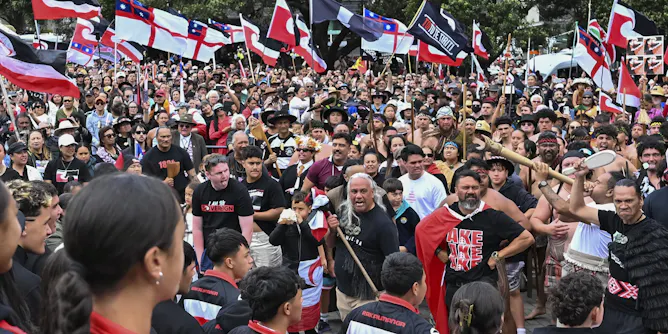
Recent Māori ward plebiscites indicate that while institutional reforms for Indigenous representation are vital, meaningful change isn’t possible without broad public understanding and trust.
Articles on Indigenous peoples
Displaying 21 - 40 of 354 articles
While the rest of nature rises and slumbers to lunar and solar cycles, humans work and sleep to the resetting of their artificial clocks.

When it comes to reconciliation in Canada, we need to remember that the colonial history encompasses many assimilation tactics and its impacts are ongoing.
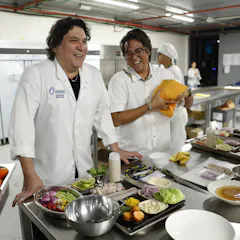
Peru’s culinary popularity masks shocking inequality and food insecurity among the country’s indigenous peoples.
This study is the first archaeological research undertaken on New Guinea’s Great Papuan Plateau. Among the finds are a number of sea snail shells modified for use.
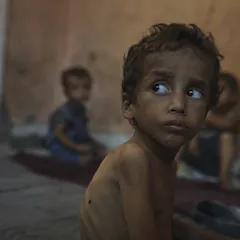
An Indigenous scholar explains how starvation was used to acquire the lands of Indigenous peoples. Her great-grandparents experienced ‘starvation winter’ on the Blackfeet reservation.

New Closing the Gap data show Australia is on track to meet just four targets, while another four are getting worse. It’s time for a different approach.

Amid national truth and reconciliation processes, Scandinavian churches are taking stock of their past policies toward the Sámi people.

President Trump’s politics of resentment recall the US colonial era, when grievances fueled rage and violence.
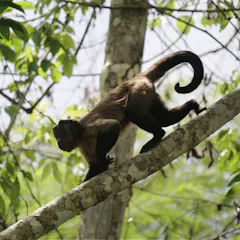
The primate species identified in the Sete de Setembro Indigenous Land have symbolic meanings that are deeply associated with the cultural, ecological and mythological elements of the Paiter-Suruí people’s cosmology
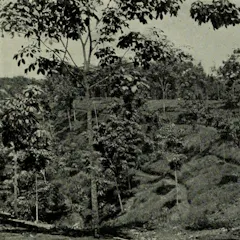
The world’s remaining great primary forests, including those in Borneo, the Amazon and the Congo basin, are still threatened by deforestation. This harmful practice often has colonial origins.
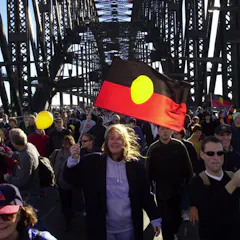
In May 2000, Australians marched to symbolise coming together. But in the decades that followed, promises to Indigenous people have gone unfulfilled.
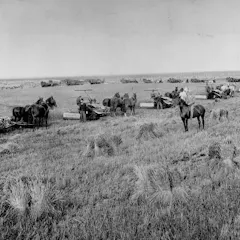
The Treaty 4 Agricultural Benefits Settlement aims to address unmet Crown promises, but tensions over governance, transparency and leadership could undermine its potential for Indigenous communities.
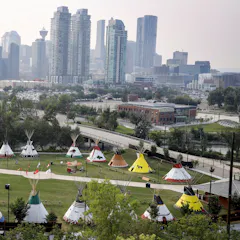
Indigenous nationhood has not just been a part of Indigenous ways of life for centuries, but is now closely tied to established and developing legal and constitutional principles in Canada.
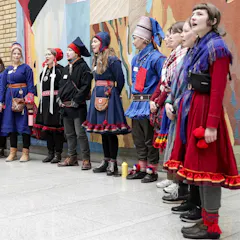
A groundbreaking decision in Europe may signal a shift in the way we engage with Indigenous land rights beyond property rhetoric.

The ǀxam language has been carved into a new building at Rhodes House to honour the labour and suffering of Africans during colonialism.
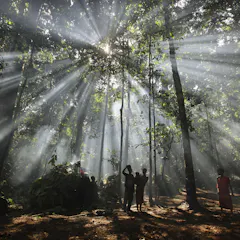
Indigenous futures thinking brings the expertise built up by Indigenous communities over many years into the plans needed for the world to adapt to climate change.
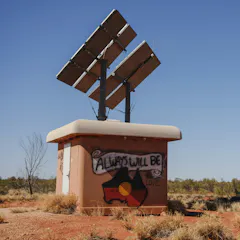
As one workshop participant, a journalism educator, put it: ‘We’re still telling the same stories, it’s like a circle, and we don’t seem to be able to break free from it. Nothing seems to change.’

Private conservation groups channel huge sums of money to parks and protected areas around the world, but often have failed to protect basic rights of Indigenous people living on those lands.
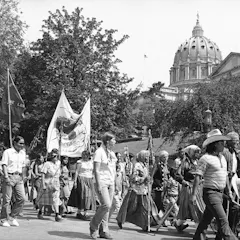
Movements like the Journey of Nishiyuu walk the land to reclaim culture and push for Indigenous nations’ rights.
Top contributors
-

Professor of History, University of Illinois Urbana-Champaign
-
Professor of Economics and Public Policy, ANU College of Arts and Social Sciences, Australian National University
-
Professor Emeritus of Latin American Studies and Geography, University of Florida
-
Adjunct Professor, Stout Research Centre, Victoria University of Wellington and Auckland University of Technology, Professor of Political Science, Charles Sturt University
-
Professor, School of Social and Political Sciences, Director, The (so-called) Australian Centre, The University of Melbourne
-
Professor of Archaeology and Biological Anthropology, School of Social Science, The University of Queensland
-
Partner Investigator, ARC Centre of Excellence for Indigenous and Environmental Histories and Futures, James Cook University
-
Researcher in ethnobiology, Universitat Autònoma de Barcelona
-
Professor of Indigenous Health, Executive Director, Carumba Institute, Queensland University of Technology
-
Professor of Law, University of Technology Sydney
-
PhD student of law, Universidade do Estado do Rio de Janeiro (UERJ)
-
Professor of Geography, School of Law and Society, University of the Sunshine Coast
-
Professor, Griffith Business School, Griffith University
-
UN Expert Mechanism on the Rights of Indigenous Peoples (EMRIP) and Professor in Political Science, Global Affairs and Public Policy, University of Toronto
-
Distinguished Professor, Charles Sturt University