

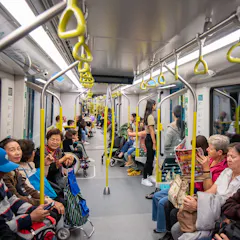
Across ages, genders, cultures and conditions, crowds always walk in a counter-clockwise spiral.
Articles on Human behaviour
Displaying 1 - 20 of 60 articles
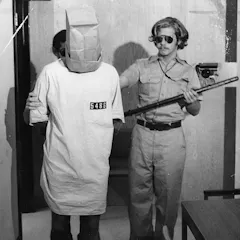
Netflix is billing its new series as a ‘modern reimagining’ of the 1971 experiment. But over the past 55 years, the original has become much criticised.

A messy room isn’t usually created by one great act of mess-making. It results from hundreds of tiny behaviours.
Combining behavioural and data science yields high-quality insights from complex datasets.

COVID no longer constitutes a public health emergency of international concern, but we need to be better prepared for future pandemics.

Despite the popular and intuitive notion that people find climate change psychologically distant, a new review of the evidence shows that’s not the case at all.
There’s so much to process in our daily lives, we need habits to get us through and give the brain a break.

A clinical psychologist explains what has the potential to trigger our usually well-meaning laughter.

Signalling theory tells us lots about the way paid-for verification has disrupted the blue tick system.

Rituals have been around for hundreds of thousands of years – but are they still useful today?
Feeling uneasy about a life choice? Cognitive dissonance could be the culprit.

Research shows hormonal contraceptives may have small but significant effects on behaviour.

Terrible or terrific? There is a lot going when you’re two.
Big data analysis has unveiled startling links between seemingly unrelated things, such as how a person’s physical elevation above sea level might influence their personality.
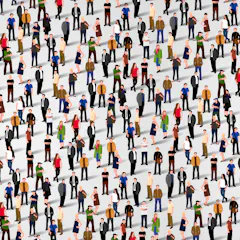
We used computer models to study the evolutionary benefits of identity fusion.

If both people like and trust each other enough to kiss, the good shared feelings they get makes them more likely to stay together.
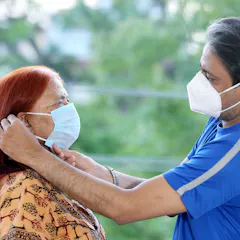
Studies have shown that highlighting individual responsibility isn’t quite as effective as it seems

Irrational behaviour during difficult circumstances is rooted in deeper cognitive and evolutionary psychological mechanisms. Many reflect what are called emergency decision and purchasing contexts.

It’s easy to judge people who escape from quarantine as not doing their bit. But if we use some basic principles from behavioural science, we might stop people wanting to escape in the first place.

Even in hospitals, where hand hygiene is vital, staff don’t always remember to wash their hands. What hope is there for the rest of us? Thankfully, research on handwashing behaviours has some answers.
Top contributors
-

Scientia Professor of Evolution, UNSW
-
Research Fellow, BehaviourWorks Australia, Monash Sustainable Development Institute, Monash University
-
Postdoctoral researcher, National Taiwan Normal University
-
Professor of Psychology, Monmouth University
-
Professor of Evolutionary Studies, Professor of African Prehistory, University of Bergen
-
Principal Investigator, SapienCE - Centre for Early Sapiens Behaviour, University of Bergen
-
Professor of Psychology and Education, USC Dornsife College of Letters, Arts and Sciences
-
Lecturer in Natural Environement, University of Exeter
-
Researcher in Cognitive Science, Lund University
-
Doctoral student, Artificial Intelligence and Machine Learning, University of Oxford
-
Professor and Co-Director of Behavioural Economics in Action at Rotman (BEAR), University of Toronto
-
Ph.D. Candidate, USC Dornsife College of Letters, Arts and Sciences
-
Lecturer in Psychology, University of Essex
-
Professor in Behavioural Neuroscience, Bangor University
-
Professor of Psychology and ARC Laureate Fellow, The University of Queensland