
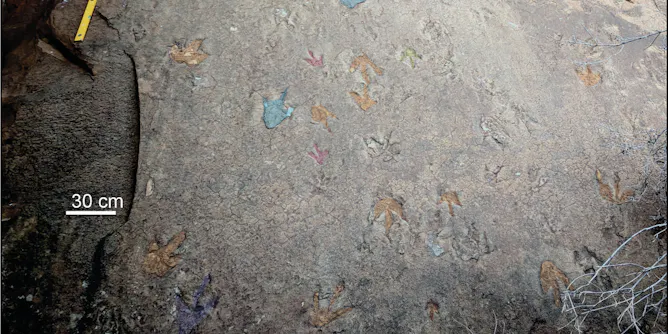
Fossil footprints are a treasure chest of information.
Articles on Fossil tracks
Displaying 21 - 30 of 30 articles
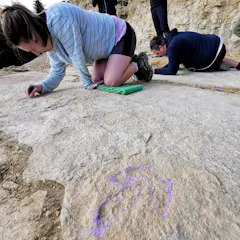
Collectively, the evidence studied by ichnologists helps to paint a picture of long-gone landscapes and the creatures and plants that populated those spaces.
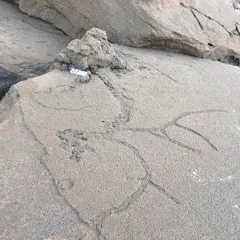
There is something near-miraculous in the concept of tiny creatures, weighing just grams, making tracks and traces so long ago, that are now evident in rock.

Human tracks registered in aeolianites - cemented dune surfaces - are rare at a global level.
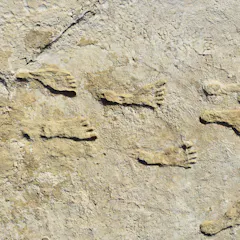
The New Mexico findings could rewrite the history of human migration to the Americas.
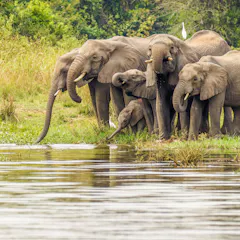
There are no body fossils of elephants from this time period, so the available information of how these gigantic animals moved through the ancient landscapes depends entirely on the track record.
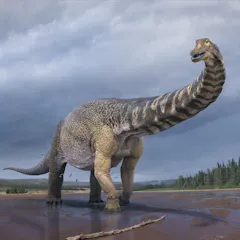
Australotitan was a massive long-necked sauropod estimated to weigh the equivalent of 1,400 red kangaroos.
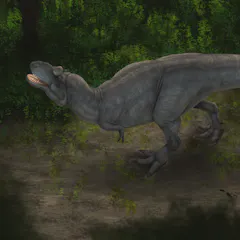
So how accurate is the T. rex’s running speed in that famous Jurassic Park jeep-chase scene?

These surfaces are of profound scientific, cultural, heritage, environmental, and aesthetic importance. Unfortunately, they are threatened - by graffiti.

One avian track, probably made by a large gull or a small goose, was found in sediments that have been dated to about 400,000 years. That makes it the oldest avian track reported from southern Africa.
Top contributors
-

Research Associate, African Centre for Coastal Palaeoscience, Nelson Mandela University
-
Lecturer, University of Cape Town
-
Researcher and curator, Jurassica Museum
-
Specialist Scientist, Council for Geoscience
-
Honorary researcher, Evolutionary Studies Institute, University of the Witwatersrand
-
Clive Thompson is a Friend of The Conversation.
Research Associate, African Centre for Coastal Palaeoscience, Nelon Mandela University; Research Associate, Research Associate, Centre for Transformative Regulation of Work, University of the Western Cape
-
Associate professor in Vertebrate Palaeontology, University of the Witwatersrand
-
Senior Research Assistant (Palaeontology), Queensland Museum
-
Principal Research Fellow Applied Palaeontology & Palaeotourism, CQUniversity Australia
-
Assistant Professor, University of the Witwatersrand
-
Palaeontologist, Earth Science Faculty, University of New England
-
Professor in Geological Sciences, University of Cape Town
-
Senior Lecturer, University of Leicester
-
Professor of Environmental and Geographical Sciences, Bournemouth University; University of Reading
-
Research Associate, African Centre for Coastal Palaeoscience, Nelson Mandela University