
These ‘custodial killers’ are often healthcare workers who murder helpless or dependent people in their care.
Articles on Forensics
Displaying 21 - 40 of 104 articles
We can predict hair and eye colour with reasonable accuracy from DNA, but other characteristics are being investigated.

Maui officials have asked relatives to provide DNA samples to help identify victims of the Lahaina wildfires. Time and exposure to the elements, however, can make DNA retrieval from remains difficult.
Fatal stabbings are the leading cause of homicide in countries with restricted access to firearms, including Australia. New research could help solve these cases.

The Titan disaster happened in international waters, in a commercially operated vessel, and with victims of different nationalities. Any details that emerge will likely be treated with sensitivity.

Similar techniques used to identify criminals have been employed to unmask anonymous authors. But they aren’t foolproof.
You can’t tape off an entire ocean. But ‘aquatic forensics’ is an emerging field, with techniques borrowed from archaeology, marine biology and more.
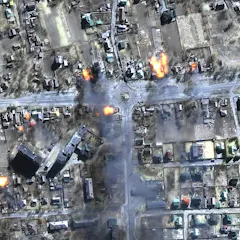
Digital evidence is becoming a routine fixture for war crimes investigations, including the one focused on Ukraine, changing the landscape for international tribunal investigations.

CCTV is a popular form of digital evidence but it can be unreliable and problematic.

Most methods for detecting lies actually detect signs of stress – which makes them extremely unreliable.
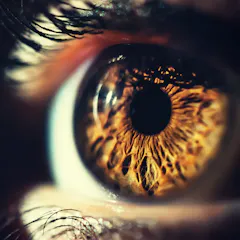
Our DNA contains the information that determines the colour of our eyes.

Human memory doesn’t work like a video camera, simply recording a scene as it happens. But researchers know how to help children recall information accurately.

The remains of murder victims often turn up in suitcases, bins, and similar items. Forensic researchers in Australia are leading the way in helping to solve such cases.

Other recent conflicts that resulted in war crimes allegations help explain how complex it will be to gather evidence of war crimes in Ukraine – and provide answers for families of victims of the war.
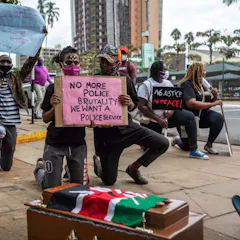
A host of problems are behind police failures, including poor evidence gathering and the mistreatment of witnesses.
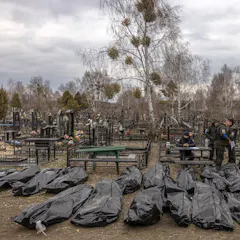
Identifying the victims of a mass casualty event is a crucial part of grieving and community healing.
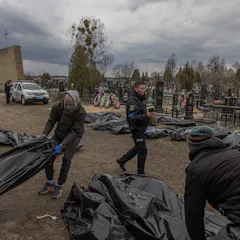
The grisly work of forensic investigators at the scene of a possible war crime.
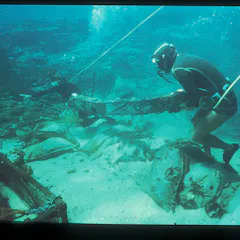
We’re searching for ways to use recovered bones and teeth to better understand time spent in the sea, and the overall journey of the mortal remains.
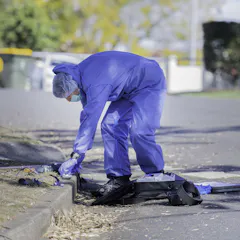
There are no COVID-specific protocols for forensic officers collecting evidence from crime scenes. New recommendations suggest how teams and their equipment can be reorganised to minimise the risk.
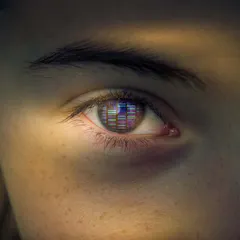
The Australia Federal Police is set to start using controversial technology that predicts the ancestry and appearance of suspects from DNA samples.
Top contributors
-

Associate Professor of Forensic Science, Murdoch University
-
Research fellow, The University of Queensland
-
Lecturer, Business School & Centre for Policy Futures, The University of Queensland
-
Associate Professor of Domestic and Family Violence, Queensland Centre for Domestic and Family Violence Research, CQUniversity Australia
-
Visiting Scholar, University of Wollongong in Dubai (UOWD), University of Wollongong
-
Adjunct Associate Professor - Forensic Genetics, University of Technology Sydney; Adelaide University
-
Adjunct Lecturer in Forensic Sciences, Murdoch University
-
Chancellor’s Postdoctoral Research Fellow, University of Technology Sydney
-
Professor of Forensic Science, University of Lancashire
-
Lecturer in Chemistry, University of Surrey
-
Professor of Forensic Science, University of Hull
-
Director Leverhulme Research Centre for Forensic Science, University of Dundee
-
Professor of Forensic Genetics, University of Technology Sydney
-
Project Lead for International Technical Forensic Services Global Forensic Justice Center, Florida International University
-
Associate Professor of Environmental Sciences, Emory University