
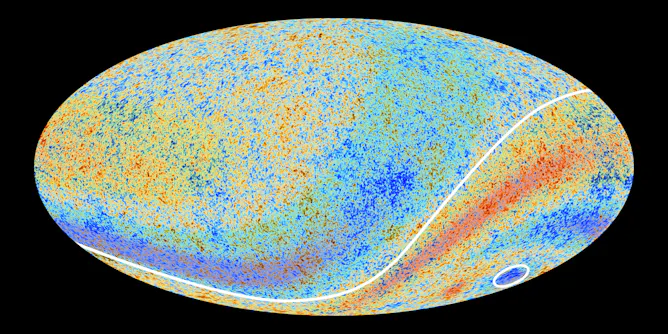
Astronomers have found a giant void in space that explains a mysterious cold spot in the sky. But the search is already on for other voids – and finding them could undermine the discovery.
Articles on Cosmic microwave background
Displaying 21 - 28 of 28 articles
More than 100 million years has been wiped off the age of the first stars but there is still the question of what happened in the first billion years of the universe. Earlier this month the European Space…
One of this century’s greatest potential discoveries concerning the origins of the universe has now fallen to galactic dust. That’s according to a new joint-analysis of all the existing data – including…
In March, scientists working on the BICEP2 experiment, a microwave telescope based at the South Pole, announced that they had seen ‘gravity waves’ from the early universe, created just after the Big Bang…
Recent observations suggest that there is something not quite right with our view of our universe – that something is skewing our view of the oldest radiation arriving at our telescopes. What’s causing…
It’s almost three months since a team of scientists announced it had detected polarised light from the afterglow of the Big Bang. But questions are still being asked about whether cosmic dust may have…
Katherine Mack, astrophysicist at the University of Melbourne, answered questions posed by the public on Reddit. The Conversation has curated the highlights. Dark Matter How do you explain dark matter…
According to cosmologists, galaxies are joined together by filaments, quite literally. These filaments form the cosmic web and are made of mostly dark matter, many stars and some gas. Observing these filaments…
Top contributors
-

Professor of Astrophysics and Royal Society University Research Fellow, University of Hertfordshire
-
Pro Vice-Chancellor Flagship Initiatives, Swinburne University of Technology
-
Cosmologist, University of Tasmania
-
Professor of Extragalactic Astronomy, Head of the Astrophysics Group, University of Bath
-
Honorary research fellow in Physics and Astronomy and author of "The Cosmic Microwave Background - how it changed our understanding of the Universe", Cardiff University
-
Research Fellow in Cosmology, University of Portsmouth
-
Adjunct professor, Physics, L’Université d’Ottawa/University of Ottawa
-
Professor of Astrophysics, University of Sydney
-
John Curtin Distinguished Professor (Radio Astronomy), Curtin University
-
Professor of Astrophysics, Liverpool John Moores University
-
Professor, The University of Queensland
-
Professor in Earth Sciences, Nanyang Technological University, Singapore, and Emeritus Professor of Mineral Physics, University of Cambridge
-
DECRA Fellow, Astrophysics, The University of Melbourne
-
Research Scientist in Cosmology, Bahamas Advanced Study Institute & Conferences
-
Professor of Cosmology, University of Portsmouth
