
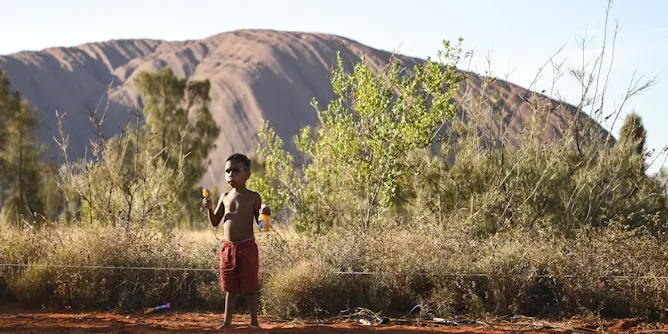
There’s a need to develop new tourism activities at Uluru, especially more educational and immersive experiences that would entail interacting respectfully with traditional owners.
Articles on Closing the Gap
Displaying 81 - 100 of 138 articles

Indigenous children are admitted to out-of-home care at 11 times the rate for non-Indigenous children. The lack of safe housing for mothers fleeing family violence is a key factor.
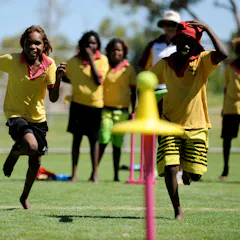
A review of 20 studies shows that sport can improve outcomes for Indigenous youth in education and culture, but the evidence on longer-lasting impacts is lacking.
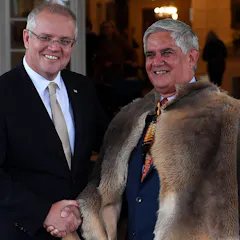
While the new minister has the chance to make a real difference, unrealistic expectations of him should be tempered- real change will take not just the whole government, but the nation.

Indigenous procurement policies are kicking goals, but who for?

There is little reason to think changes made to the Closing the Gap targets and partnerships with Aboriginal and Torres Strait Islander representatives will have much of an impact.

Some targets seem easier to meet than others, while some are just plain unreliable. Here are four things we’ve learnt from the last decade of Closing the Gap policy.
The NDIS has good intentions, but its design doesn’t seem to support the unique needs of Indigenous people living with a disability, particularly if they’re living in remote communities.

Governments have relied on a series of employment programs to tackle the employment gap, but these have not yielded positive outcomes.

Most book clubs are white and middle-class. Even today, books and reading can presume a divide between Indigenous oral story-telling and non-Indigenous literacy.
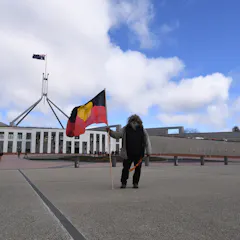
What may appear to be slow progress or steady outcomes for the whole Indigenous population may be masking worsening results.
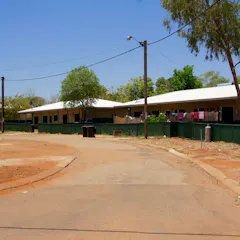
Decent housing underpins the Closing the Gap goals, with a decade-long national remote housing program having made measurable progress. If the Commonwealth pulls out now, hard-won gains could be lost.

Michelle Grattan sits down with Deep Saini to review the week in politics.
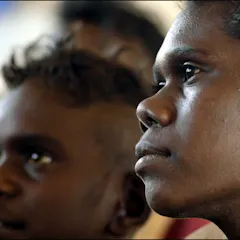
A greater focus on education in all aspects of Aboriginal and Torres Strait Islander life would advance tangible and sustainable change.

Australia is on track to meet its ‘Closing the Gap’ employment target, but more than a decade late.
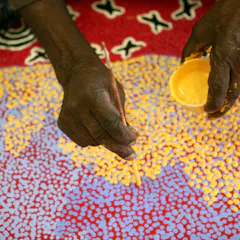
Care needs to be taken in interpreting progress on closing the gaps between Indigenous and non-Indigenous Australians, and ascribing it to actual policy change.
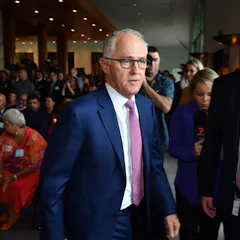
The failed and continually failing political leadership on respect, relationships and reconciliation sets back the quality of current and future education for all Australians.

Politicians make sweeping statements on how to close the gap. But here’s advice from people working directly with Indigenous communities who have evidence for what actually works.
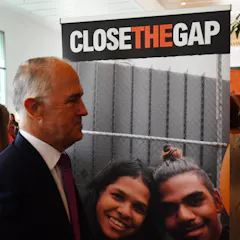
The tenth Closing the Gap report shows only three of the seven targets are on track to be met.
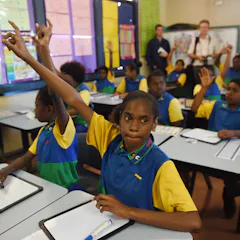
Using equivalent year levels provides us with a clearer picture of the gap for Indigenous students, who can be up to an equivalent of 7.7 years behind their non-Indigenous counterparts in writing.
Top contributors
-

Professorial Fellow, University of Canberra
-
ARC DECRA Fellow, Australian National University
-
Professor of Economics and Public Policy, ANU College of Arts and Social Sciences, Australian National University
-
Director of Monash Indigenous Studies Centre, Chief Investigator for the Australian Research Council Centre of Excellence for the Elimination of Violence against Women (CEVAW), School of Philosophical, Historical & International Studies, School of Social Sciences (SOSS), Monash University
-
Senior Lecturer in Criminology and Social Policy, The University of Queensland
-
Professor of Indigenous Health, Executive Director, Carumba Institute, Queensland University of Technology
-
Senior Lecturer of Indigenous Studies, Indigenous Education and Research Centre, James Cook University
-
Professor of Law, University of Technology Sydney
-
Professor, Principal Research Fellow & Deputy Head of School, School of Education, The University of Queensland
-
Professor of Construction Management, University of Technology Sydney
-
Associate Professor, University of Tasmania
-
Emeritus professor, School of Regulation and Global Governance, ANU, Australian National University
-
Associate Professor of Public Policy, Crawford School of Public Policy, Australian National University
-
Dean, Medical School, Curtin University
-
Senior Lecturer in Social Research and Policy, UNSW