
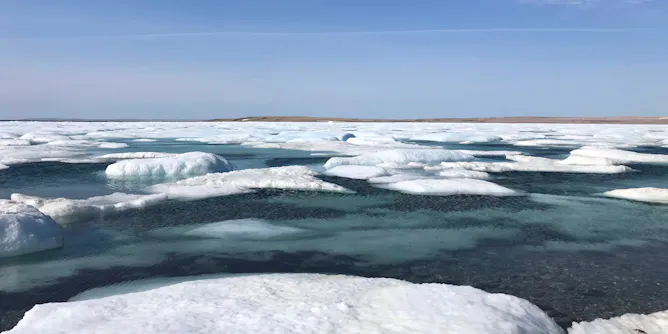
Given increasing geopolitical tensions and economic interest in the region, how can academic research support those who live in and depend on the Arctic?
Articles on Canadian Arctic
Displaying all articles

The more Canadians understand why some risks are being prioritized over others, and why resources are being directed accordingly, the better equipped the country will be to handle what comes next.
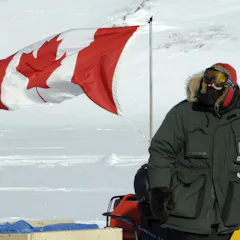
As Arctic competition grows, Canada’s security depends not just on defence, but on migration and retaining people to build resilience in the North.
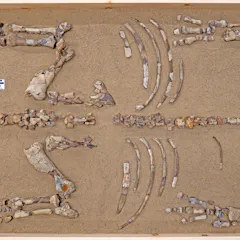
Remains of an ancient Arctic rhino indicate that land mammals traversed the North Atlantic via land bridges, and did so much more recently than previously thought.
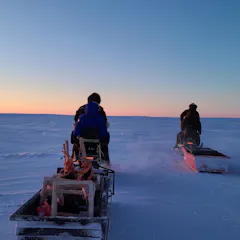
Scientists are pumping seawater onto existing ice to make it thicker and more resilient.
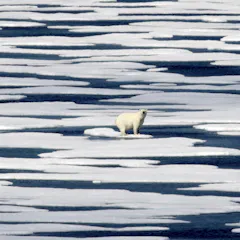
Canadians must recognize that climate change is not only changing our landscape and lifestyle, but also exposing imminent threats to our national security and sovereignty.
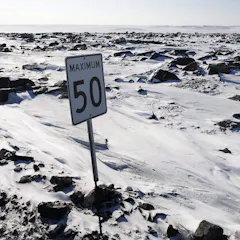
A new survey finds the majority of Canadians, across all regions and political leanings, support the construction of infrastructure in the Arctic.
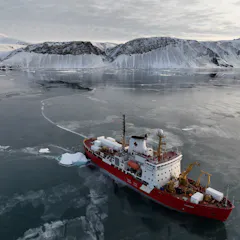
The last ice area is projected to be the last place on Earth to retain year-round sea ice by 2040. A recent Arctic expedition to the area has provided key data that could help guide conservation efforts.

The key to understanding shifts in climate and life on Earth is sustained long-term research. Enabling this research to take place should be a priority for universities and governments.

Canada, and particularly the Canadian Arctic, is warming at a considerably higher rate than the global average. The consequences for Canada could be devastating.
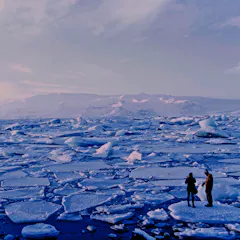
We must recognize the complexity of perspectives on climate change if we want to confront it.

New shipping opportunities are opening up in the Arctic as sea ice continues to recede. But travel is still dangerous and the region isn’t equipped to deal with more vessel traffic.
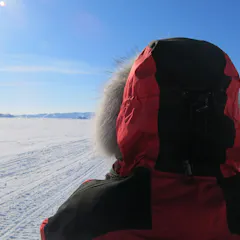
Ecological grief - the mourning that takes place when we lose parts of the natural world - is likely to affect more of us in the future.
Top contributors
-

Vice-Provost, Labrador Campus & Dean, School of Arctic and Subarctic Studies, Memorial University of Newfoundland
-
Research fellow, The University of Western Australia
-
University of Calgary
-
Fellow, Queen's Institute for Energy and Environmental Policy, School of Policy Studies, Queen's University, Ontario
-
Professor Emeritus, Department of Geography and Environment, Western University
-
Head & Research scientist, Palaeobiology, Canadian Museum of Nature & Adjunct Research Professor, Department of Biology, Carleton University
-
Professor of Biology, Trent University
-
Research Assistant, Refuge Arctic, Université Laval
-
Researcher at International Research Laboratory Takuvik, Université Laval
-
PHD Student in Canadian Studies, Trent University
-
Professeur associé/Adjunct professor, École nationale d'administration publique, École nationale d'administration publique (ENAP)
-
Professor & Canada Research Chair in Hydrological Modelling, Schulich School of Engineering, University of Calgary
-
Director, Centre for Climate Repair, University of Cambridge
-
Adjunct Assistant Professor, Peace and Conflict, University of Calgary; L’Université d’Ottawa/University of Ottawa
-
Professor, Graduate School of Public and International Affairs, L’Université d’Ottawa/University of Ottawa