
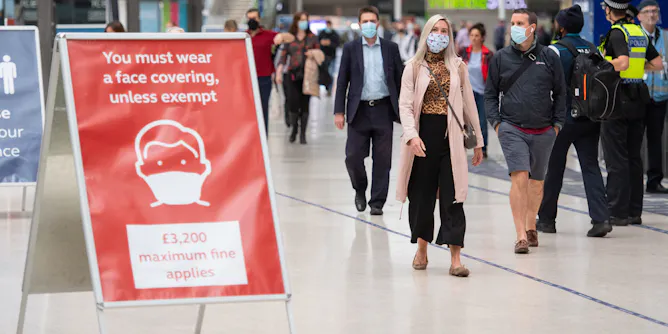
What makes us comply with the rules? Behavioural economics holds some clues for how to enforce coronavirus measures.
Articles on Behavioural economics
Displaying 41 - 60 of 115 articles

Our desire to condemn and punish non-cooperative behaviour is strong. But we must also try to understand the complex emotional motivations of those refusing to wear masks.

Research suggests the coronavirus pandemic’s greatest impact is due to people changing their behaviour voluntarily. So we may be overestimating the costs of government restrictions.
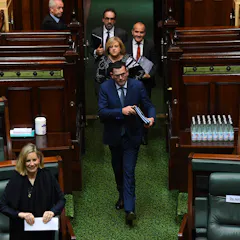
We judge the competency of politicians by what they say and do. This creates perverse incentives for even competent politicians to refuse to admit mistakes.
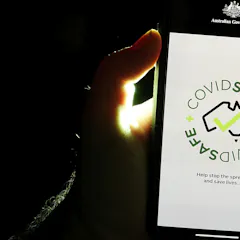
Behavioural economics has three key insights to encourage take-up of the contact-tracing app.

For the app to work well, we might need an 80% take-up. Unless it is made mandatory, we’ll need both private and social incentives.

Behavioural economics research suggests very few people will cooperate unless ‘free riders’ are punished.

The economy is different to health. Worrying about it can make it seriously worse.

There’s no need to raid the supermarket today, but gathering supplies is a reasonable response to the prospect of disaster

There’s a lot of research in consumer behaviour that disputes the notion “more is better”. But it really depends on what type of personality you have.
Stanford professor’s research has led to an increase in the number of kidney transplants in the United States.

Energy companies and other retailers bamboozle us with options to increase their profits. Here’s how the behavioural phenomenon of choice overload works.

Financial rewards can entice us to exercise more, and the benefits are lasting, according to a new research review.

Insights from behavioural (and traditional) economics help explain why discounting – both real and fake – is such an effective marketing ploy.

The Australian Labor Party’s economic agenda seems to have overlooked three fundamental principles of behavioural economics.
Online bookies can tap into the wisdom of the crowd better than pollsters.

The IKEA effect is caked in myth, but the phenomenon of consumers valuing their own efforts is proven and potent.

Most pricing structures nudge us to spend more. But there’s a particularly cunning type of pricing that can get us to swap our preference from a cheaper to a more expensive option.

Picking an dud superannuation fund can cost you about 13 years’ pay over a working lifetime, roughly the value of an apartment in Melbourne or Sydney.

Winning big often involves looking for the opportunities that are the opposite of what everyone else is doing.
Top contributors
-

Professor of Economics, Tasmanian Behavioural Lab, University of Tasmania
-
Associate Professor in Economics, RMIT University
-
Scientia Professor of Economics, UNSW
-
The University of Queensland
-
Professor of Marketing and Consumer Behaviour, Queensland University of Technology
-
Professor of Cognitive Psychology and Director of the Institute for Climate Risk and Response, UNSW
-
Professor of Behavioural Economics, Tasmanian Behavioural Lab, University of Tasmania
-
Associate Professor of Marketing, University of Technology Sydney
-
Professor of Economics, University of Technology Sydney
-
Visiting Fellow, Crawford School of Public Policy, Australian National University
-
Professor of AI and Public Policy, University of Salford
-
Senior lecturer, Canberra School of Government, University of Canberra
-
Professor of Economics and Behavioural Science, University of Stirling
-
Associate Professor of Behavioural Economics , Newcastle Business School, University of Newcastle
-
Lecturer (Assistant Professor), Queensland University of Technology