
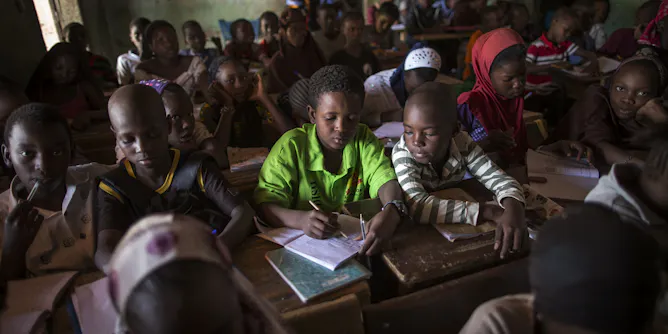
Over the years, our understanding of how language and learning are linked has shifted and changed. There is ample evidence about the value of mother-tongue-based multilingual education.
Articles on African languages
Displaying 41 - 55 of 55 articles

Much of the recent commentary on Sino-African relations has a negative tone. But genuine cultural exchange holds the promise of mutual enrichment.

Universities pay too little attention to the knowledge and experiences that students bring to their institutions from different cultures and backgrounds.

In Africa, standard English dominates in formal institutions. But in everyday usage it is supplanted by the continent’s abundance of languages – and the varieties of English these gave rise to.

Those who don’t want Stellenbosch University to make English the main language of instruction have invoked South Africa’s Constitution - but the assumptions underlying their arguments are false.

Traditional African stories often tackle big, occasionally scary and serious themes. This is even true in children’s stories – though there’s plenty of room for silly fun, too.

There is a new potential coloniser on South Africa’s linguistic block. From 2016, Mandarin will be taught in schools – and this will see African languages bumped even further down the pecking order.

The stories of and attitudes to three particular languages – English, Swahili and Luganda – provide an interesting starting point for a debate around Uganda’s language policy.

There is little value in translating academic texts into “high” or “deep” versions of African languages. Most students read and speak their mother tongues in a far more colloquial fashion.

It is important that all South Africans learn to speak an African language. But is making a single language a compulsory university subject the best way to make this happen?

In Uganda, private schools are simply ignoring a policy that calls for pupils to learn in a mother tongue rather than in English for the first three years of their education.

Using more than one language when teaching and learning science in schools can greatly enhance concept development. This in fact goes to the heart of science.

Is there a place for Shakespeare in African schools, or is his time long past?

There are two functions of language: communication and access to knowledge. Each must be pursued as an objective in its own right rather than being lumped together.

There’s an ongoing debate about how best to promote multilingualism in schools. But is this debate relevant when it comes to teaching science?
Top contributors
-

Professor of African Language Studies, University of the Western Cape
-
Assistant Professor, Harvard University
-
Emeritus Professor of African Linguistics, University of Leipzig
-
Postdoctoral research fellow (Forensic Linguistics/ Language and Law), University of the Western Cape
-
Associate Professor in Applied Linguistics, Adelaide University
-
Lecturer on the New Generation of Academics Programme (nGAP) in African Language Studies, University of the Western Cape
-
Lecturer, Department of African Languages, Makerere University
-
Lecturer in African Languages, Makerere University
-
Subject Head, African Languages, Rhodes University
-
Senior Lecturer in African Languages, Rhodes University
-
Professor and Deputy Vice-Chancellor Teaching Learning, North-West University
-
Professor of Linguistics, University of Cape Town
-
Senior Lecturer, Applied Language and Literacy Studies, University of Cape Town
-
Professor emeritus Applied Language Studies, Nelson Mandela University
-
Adjunct Professor, Richmond American International University