
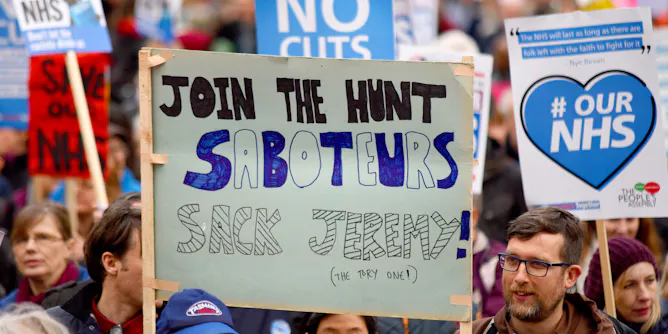
Prioritising economic growth without a plan to curb exploitative business practices is not a solution. The UK needs a return to the forward-thinking social reforms of 1945.
Articles on Welfare state
Displaying 21 - 40 of 67 articles

Targeted income support could help tackle big social and ecological challenges.

Amid further strain on public funding, we ask: What’s the future of the welfare state in developed and developing nations?

Cuts to public spending do not actually result in efficiency savings because they cause more problems for people than they solve.

Labor MP Daniel Mulino argues that the capacity of the state to undertake income redistribution has reached its limits, but that the need for social insurance continues to grow.

The late 1970s marked a high point for economic equality in the UK. Returning to the progressive policies that made that possible could solve today’s cost of living crisis.

The great ‘peace dividend’ looks to be heading for the buffers.

The COVID-19 pandemic has worsened unemployment and poverty, showing the need for the government to permanently expand income support to working-age adults.

Your view depends on whether you see poverty as the result of individual or policy failings.
If the pattern on election night holds, 2020 will be the most dramatic election in 100 years in terms of votes shifting between major parties.

Under municipal control, or through public-private partnerships, platforms technology could transform service delivery to citizens.

State-funded nursery schools now fill significant gaps in welfare provision in England.

PODCAST: The fourth part of a series from The Anthill Podcast on how the world has recovered from past crises examines the aftermath of the second world war in the UK.

States have stepped in after past crises. but they don’t always stick around.

EU migrant households are actually a net benefit on the public purse in much of Europe.

Long before Chasten Buttigieg became a ‘not-so-secret weapon’ in his husband Pete Buttigieg’s presidential campaign, another same-sex couple profoundly reshaped American social policy.

Its extremely common, everywhere, for large numbers of people to pay no net tax. It tells us nothing about the size of the welfare state or about whether it bribes people to keep tax high.

Self-help books can help us get through difficult times by telling us we have the agency to take control. But this method can also ignore structural inequities and negatively influence public policy.

Lots of things have happened in a century, but poverty has proven persistently hard to treat.

An April 2017 survey explored Americans’ opinions about government intervention and welfare policies. It found that on average, they want more from their government, but are highly polarised.
Top contributors
-

Visiting Fellow, School of Policy Studies, University of Bristol
-
Professor, Crawford School of Public Policy, Australian National University
-
Research Professor in Contemporary British History, King's College London
-
Visiting Academic, The Open University
-
Professor of Social Policy, University of Kent
-
Auguste Comte Chair in Social Epistemology, University of Warwick
-
Emeritus Professor of Social Inclusion, University of Portsmouth
-
Professor of Sociology of Youth and Culture, University of Leeds
-
Professor of Social Policy, University of York
-
Professor of Economics and Senior Researcher, Princeton University
-
ANZSOG Adjunct Research Fellow, Curtin University
-
Professor in Social Policy, University of Glasgow
-
Lecturer, Federation University Australia
-
Associate professor, University of Nottingham
-
Professor of Public Health, Newcastle University