
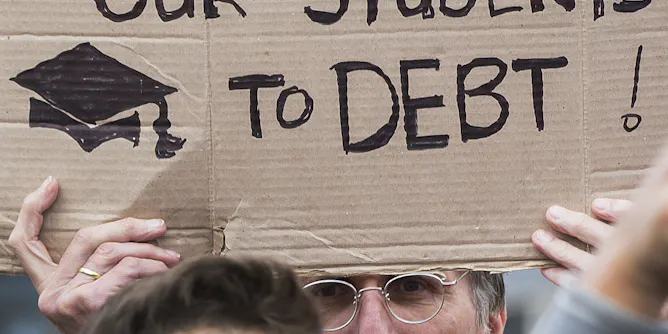
The ministerial task team’s report presents a jaundiced view of an important organisation that’s opened the doors of higher education to many who would otherwise have been closed out.
Articles on University funding
Displaying 101 - 120 of 149 articles

There’s no doubt South African universities need to undergo a real shift. But are the country’s current intellectual and academic forces up to the task?

While spending has grown for preschools, schools and universities, vocational education misses out.

Pension fund managers must consider environmental, social and governance issues when making investment decisions. The student funding crisis is a perfect example of a social issue.
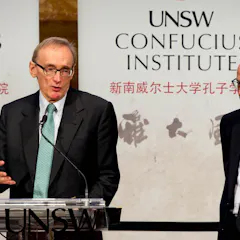
Many centres were set up in Australian universities to take advantage of China’s rising importance, but without ongoing funding they might be subject to interference from external donors.
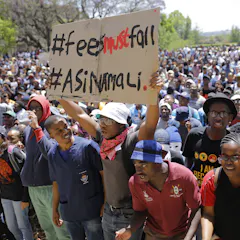
There has been a great deal of research, planning and talking to come up with solutions to South Africa’s higher education funding crisis. Some of these plans must now be put into action.
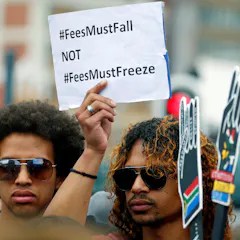
Higher education is a resource intensive enterprise. It cannot effectively function without a massive injection of resources in a sustained and escalated manner.
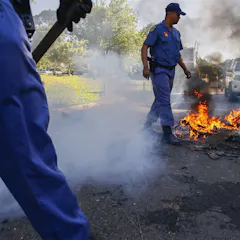
South Africa’s universities have been told to set their own fee increases for 2017. That’s good news for institutions, but it hasn’t been well-received by many students.
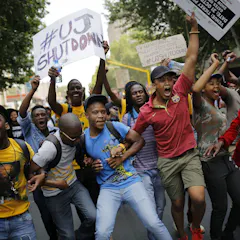
Academia is being asked to do less for more, and universities are at financial breaking point. This has implications for all South Africans.

After almost a decade of failed processes to reform the current funding system, the government must produce a revised system that improves the quality of outcomes for students in all courses.

Students currently pay higher fees for courses that lead to jobs with typically higher wages. But not all students find, or want, a job in their area of study. Should all students then pay the same amount for their university degree?

One option could be to cut per-student funding and instead raise the student contribution from an average of about 40% to 50%, by raising HECS caps.

Demand for research grants has far exceeded supply, with success rates for grant applications falling to record lows.

Africa’s universities must avoid collaborative programmes with the North that become mere tick-box exercises that only benefit Northern researchers and organisations.
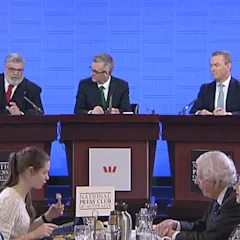
Pyne talked more about changing taxes and incentives to stimulate growth and industry, whereas Carr had clear plans for government investment.

The way the higher education sector uses data from the OECD is often technically correct, but substantively misleading.

Over the next ten years, 40% of jobs are predicted to disappear. Universities will be essential to helping people reskill, upskill and reinvent their jobs.

The onus is now on students, universities and the wider public to make clear where they stand on the options laid out in the discussion paper.

While the government finally ruled out full fee deregulation in its 2016 budget, it is still contemplating uncapping fees for some degree courses. Here’s what else is being discussed.

Increasing the amount that students pay towards their degree is likely to be on the cards of higher education in this year’s election.
Top contributors
-

Professor of Higher Education Policy, Monash University
-
Professor and Director, Mitchell Institute, Victoria University
-
Associate Professor, Melbourne Centre for the Study of Higher Education, The University of Melbourne
-
ARC Laureate Fellow, Swinburne University of Technology
-
Policy Fellow, Mitchell Institute, Victoria University
-
Honorary Senior Fellow, Centre for the Study of Higher Education, The University of Melbourne
-
Honorary Senior Fellow, Melbourne School of Psychological Sciences, The University of Melbourne
-
Professorial Fellow, University of Canberra
-
Professor of Research, Foundations & Higher Education, Northern Arizona University
-
Senior Research Fellow, Curtin University
-
Policy Analyst, Mitchell Institute, Victoria University
-
Professor, Environment and Development Sociology, The University of Queensland
-
Vice-Chancellor, Southern Cross University
-
Professor of Higher Education, University of KwaZulu-Natal
-
Deputy Executive Dean and Associate Dean (Academic), Faculty of Humanities, Arts and Social Sciences, The University of Queensland