
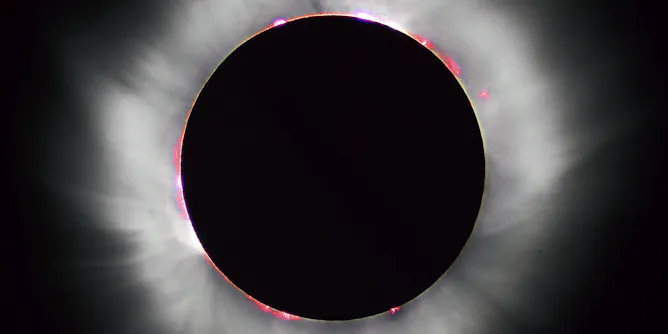
What’s the most impressive natural phenomenon known to humankind? Probably a solar eclipse! Here’s a brief overview ahead of this summer’s big celestial event.
Articles on Total eclipse
Displaying all articles
Astronauts report feeling profoundly awestruck when they go to space, an anthropologist reports. This experience shapes their perspectives even back on Earth.
Eclipses have inspired myths, predictions and scientific discoveries. The total solar eclipse occurring on April 8 provides a once-in-a-lifetime opportunity to engage with science and the cosmos.
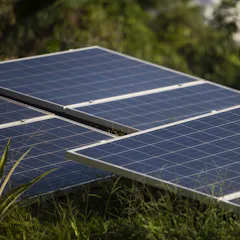
When the Moon blocks the Sun during an eclipse, utility suppliers have to pull power from the grid to make up for gaps in solar energy.

Don’t look up. A solar eclipse may be an incredible spectacle – but you must take care of your eyes.

Witnessing a total solar eclipse can be an unforgettable experience – and apparently, quite addictive.

Calculating when and where exactly we can watch an eclipse in its full glory can be surprisingly hard.
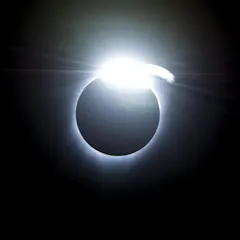
Only a tiny sliver of the Australian continent will witness the totality this time around. But there are five more total eclipses coming over the next 15 years.

Just 12 people have walked on the Moon and they’ll know better than anyone just how big (or small) the place is. But we can make some comparisons with things on Earth to get a measure of the Moon.
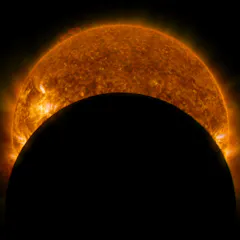
If you’ve ever wondered why you can look at a solar eclipse and why it can harm your eyes, the answer is in the sun’s rays.
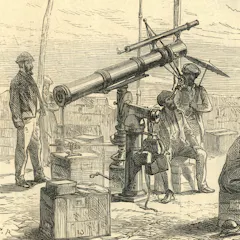
For centuries, scientists have known when and where eclipses will be visible. They pack their bags, head for the line of totality and hope for the best – which doesn’t always happen.
Top contributors
-

Professor of Astronomy, The Ohio State University
-
Dean of Science, University of California, Santa Cruz
-
Research Associate Professor & UWA Research Fellow, The University of Western Australia
-
Adjunct Professor, Centre for Astrophysics, University of Southern Queensland
-
Postdoctoral fellow, Physics, Engineering Physics & Astronomy, Queen's University, Ontario
-
Senior Curator (Astronomy), Museums Victoria Research Institute; The University of Melbourne
-
Manager for Education and Public Outreach, Adjunct Professor of Physics and Astronomy, Queen's University, Ontario
-
Professor (Astrophysics), University of Southern Queensland
-
Professor of Physics and Astronomy, USC Dornsife College of Letters, Arts and Sciences
-
Clinical Associate Professor of Ophthalmology, The University of Western Australia
-
Research Fellow in Astronomy, The University of Western Australia
-
Astronome FNRS à l'Institut d'astrophysique et de géophysique, Université de Liège
-
Professor of Anthropology, Grand Valley State University