
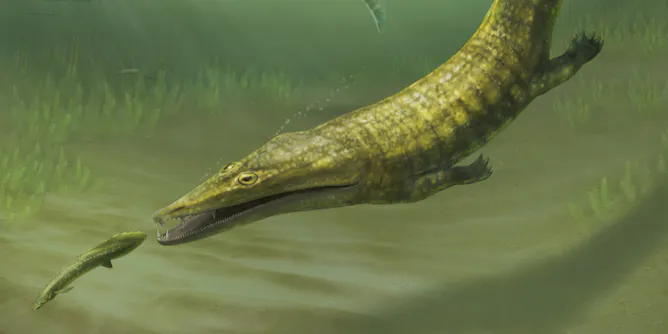
The strange fossils were lost in museum collections around the world for some 50 years.
Articles on Tetrapods
Displaying all articles
Where did the ancestors of all reptiles, birds and mammals emerge? A newly discovered fossil slab from Australia throws the entire timeline into question.
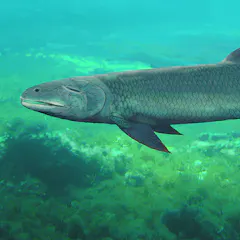
For decades, the sandstone in central Australia yielded tantalising segments of some sort of fossil fish. Now, we have finally pieced together a complete picture of this remarkable species.
New research looks at how different species have managed to cross geographic barriers throughout history and whether their individual traits played a crucial role in these journeys.
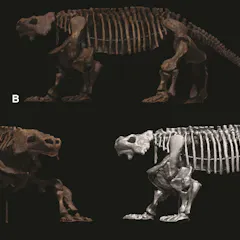
Large pareiasaurs are among the earliest huge plant-eating tetrapods to appear in the history of the development of life on Earth.
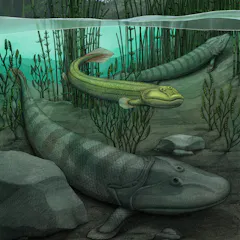
The newly discovered species – Qikiqtania – highlights evolution’s twisty, tangled path.
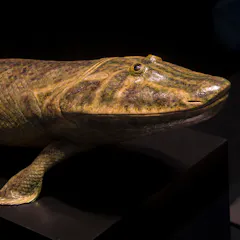
‘Tetrapods’ were the first fish to evolve lungs and walk onto land. They were also our ancestors. Now, a new study sheds light on the size and shape of these unique animals’ brains.
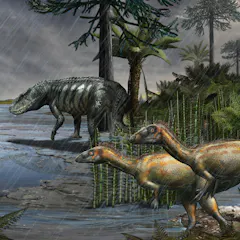
Our new research has discovered how a series of volcanic eruptions 233 million years ago fundamentally changed life on Earth.
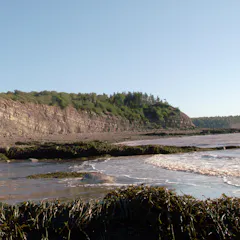
A very early mammal ancestor is one of the most recent discoveries at the Joggins Fossil Cliffs in Nova Scotia. This new finding sheds further light on theories of mammalian evolution.

The arrangement of bones in our specimen’s fins are the same as those of ‘fingers’ in tetrapods. The only difference is the digits are locked within the fin, and not free moving.
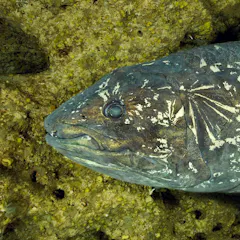
The discovery of a living coelacanth fish rocked the world in 1939, as scientists thought they had died out with the dinosaurs. A new study illuminates how its skull and tiny brain develop.
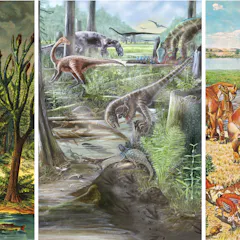
Local tetrapod biodiversity exploded after the dinosaurs, but has barely changed in 60m years.
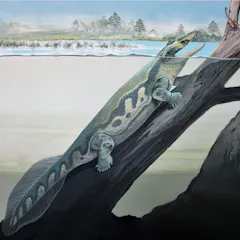
The discovery of two separate fossils tetrapod species proves that they lived all over the world by the end of Devonian.

Little skates that ‘walk’ across the ocean floor show how fish brains evolved to pave the way for working legs.
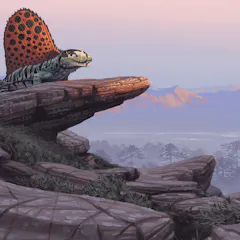
A drying climate caused a mass extinction among plants, but paved the way for the ancestors of modern reptiles, mammals, and birds.
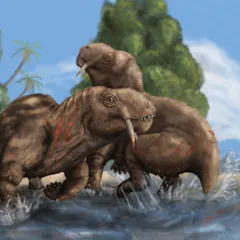
New evidence shows marked similarities between two fossils – one from Brazil, the other South Africa. This confirms compelling geological findings that continents were once one giant land mass.
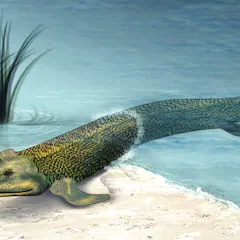
It’s one of the most tantalising questions in evolutionary biology: how did our aquatic ancestors first move from water onto land? Thanks to research published today in PLOS Biology, new light has been…
Top contributors
-

Emeritus Strategic Professor in Palaeontology, Flinders University
-
Research Associate in the College of Science and Engineering, Flinders University
-
Head, Metabolic Genetic Diseases Research Laboratory, Deakin University
-
Assistant Professor in Palaeontology, Trinity College Dublin
-
Palaeontologist, Albany Museum (supported by the Millennium Trust and the DSI-NRF Centre of Excellence in Palaeosciences, the NRF and the NSCF), Rhodes University
-
Reader in Vertebrate Biology, Liverpool John Moores University
-
Professor of Vertebrate Palaeontology, University of Bristol
-
Research associate, University of Bristol
-
Postdoctoral Research Fellow at the Evolutionary Studies Institute (ESI), University of the Witwatersrand, Johannesburg., University of the Witwatersrand
-
PhD candidate, Swansea University
-
ERC Research Fellow in Palaeobiology, University of Birmingham
-
Professor of Evolutionary Biology, Université du Québec à Rimouski (UQAR)
-
Lecturer in Palaeontology, Universidade Federal do Piauí (UFPI)
-
Ph.D. Candidate, Paleontology, Carleton University
-
Ph.D. candidate, Ecology & Evolutionary Biology, University of Toronto