
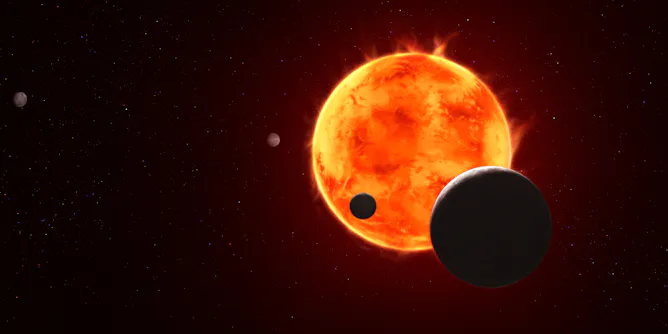
The largest telescope in space has been trained on a rocky exoplanet.
Articles on TESS
Displaying all articles
With more than 5,000 known exoplanets, astronomers are shifting their focus from discovering additional distant worlds to identifying which are good candidates for further study.
Newly discovered super-Earths add to the list of planets around other stars that offer the best chance of finding life. An astronomer explains what makes these super-Earths such excellent candidates.
The primary objective of CHEOPS is to better understand the planets that we’ve already found. And its mission is now in full swing.
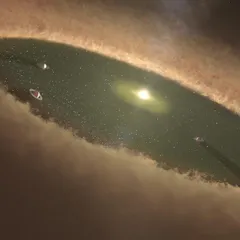
Why isn’t there an endless variety of planets in the universe? An astrophysicist explains why planets only come in two flavors.
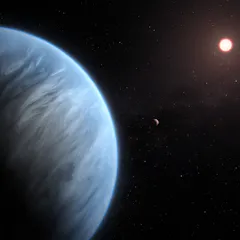
NASA scientists have discovered a new planet orbiting around a nearby star that is in a habitable zone. But does this planet have liquid oceans that can support life?
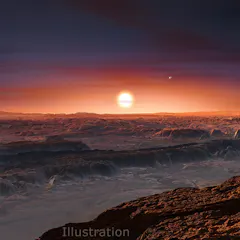
Beyond the outer edge of the Solar System, mysterious, unknown worlds await by the thousands. Astronomers can now finally find them and explore them - but will we find another Earth?
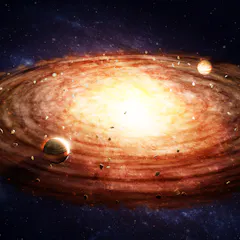
It is always exciting to discover new planets beyond our Solar System. Now a planetary astrophysicist is using a star’s chemistry to predict which ones are likely to host giant planets.
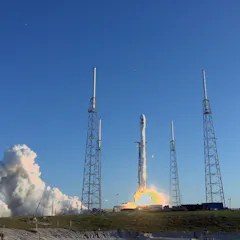
The new planet-hunting telescope TESS was successfully launched today by NASA, and Australia will play a key role in checking out any new worlds it discovers.
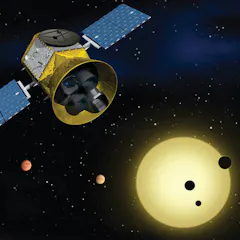
How long before we find a planet just like our own?
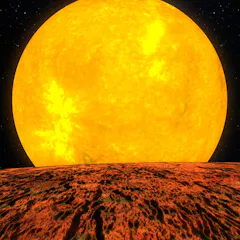
When NASA first started planning the Kepler mission, no one knew if the universe held any planets outside our solar system. Thousands of exoplanets later, the search enters a new phase as Kepler retires.
Top contributors
-

Planetary Astrophysicist, Assistant Professor, Louisiana State University ; Arizona State University
-
Assistant Professor of Physics and Astronomy, University of Nevada, Las Vegas
-
Postdoctoral Fellow, Massachusetts Institute of Technology (MIT)
-
University Distinguished Professor of Astronomy, University of Arizona
-
Assistant Professor of Physics, Massachusetts Institute of Technology (MIT)
-
Associate Dean for Research and Professor of Astronomy and Planetary Sciences, University of Arizona
-
Assistant Professor of Physics and Astronomy, Michigan State University
-
Professor of Astrophysics, Keele University
-
Associate professor, University of Bristol
-
Research Scientist of Planetary Studies, NASA
-
Lecturer in Extrasolar Planets, University of St Andrews
-
Professor (Astrophysics), University of Southern Queensland