

A new study has found that Tasmanian tigers had an adaptation found in no living carnivorous mammal.
Articles on Tasmanian Tiger
Displaying all articles
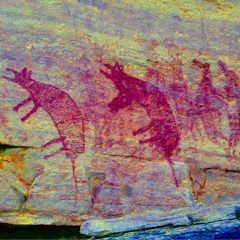
The rock art reveals the Thylacine’s deep significance to Aboriginal peoples.
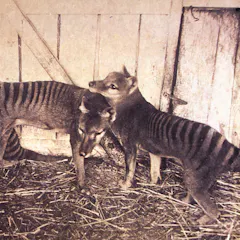
It’s 25 years since The Hunter was published, to international acclaim and some local irritation. The story of a man hunting a thylacine to harvest its genetic material, it is daring and unsettling.
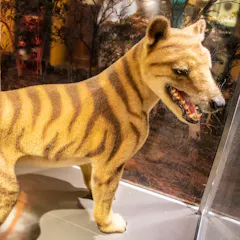
Brain samples of a thylacine that died in 1880 in Berlin were kept safe by researchers for decades. Now, they have finally been analysed.
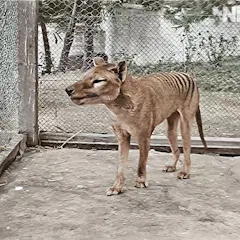
Australia still feels the thylacine’s presence in its landscape, wildlife and culture. A new book explores everything we know about the thylacine and the hope of a return.
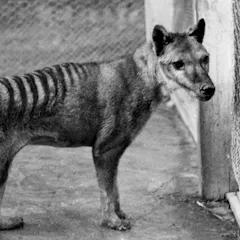
A new biotech partnership could bring the first baby thylacine to life within 10 years. But de-extinction is controversial – should we even be doing this?
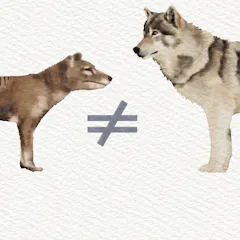
The Tasmanian tiger’s superficial appearance was so similar to a wolf’s that European colonisers assumed it was a threat and hunted it to extinction.
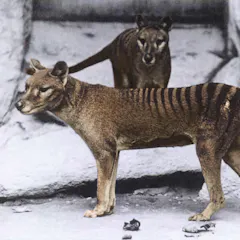
The “Tasmanian tiger” was hunted to extinction based on its perceived size as a predator big enough to take sheep. But it seems this was just a tall tale, and the thylacine weighed just 16.7kg.
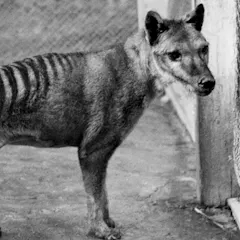
New research has revealed 100 plant and animal species have become extinct in the past two centuries – a far higher number than previously thought.
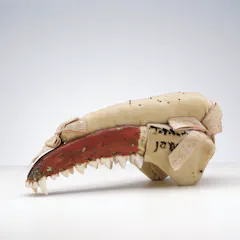
A new book connects disparate objects and texts to tell the story of Tasmania. It is an inspired enterprise.
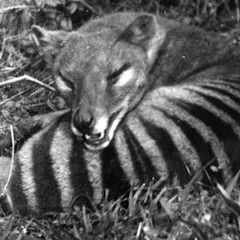
The new Tasmanian tiger genome reveals some fascinating facts about this extinct marsupial, including why they were so similar to dogs, and how they were growing more vulnerable to genetic disease.
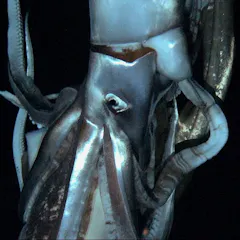
Searching for animals thought to be extinct – or fictional – is difficult, painstaking and often disappointing. But new technology like drones offer hope of a boom in biological discovery.
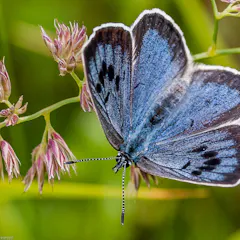
Sometimes pure curiosity driven research can yield wondrous knowledge and practical benefits, as was the case with the large blue butterfly.

Jurassic World is opening in cinemas this Thursday and again raises the idea of resurrecting extinct creatures. But there’s plenty of other contenders before we even think of recreating dinosaurs.
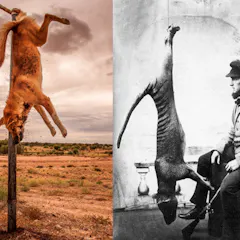
The last Tasmanian tiger died a lonely death in the Hobart Zoo in 1936, just 59 days after new state laws aimed at protecting it from extinction were passed in parliament. But the warning bells about its…
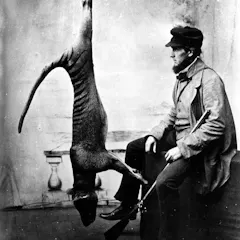
Dingoes were twice the size of female thylacines and could have caused their extinction on mainland Australia through direct attacks, a new Sydney [study](http://www.plosone.org/article/info%3Adoi%2F10.1371%2Fjournal.pone.0034877?utm_source=feedburner&utm_medium=feed&utm_campaign=Feed%3A+plosone%2FEvolutionaryBiology+(PLoS+ONE+Alerts%3A+Evolutionary+Biology…
Top contributors
-

Exhibitions
-
Professor, School of Biological Sciences, Monash University
-
Senior Lecturer, Department of Anatomy and Developmental Biology, Monash University
-
Professor, School of BioSciences, The University of Melbourne
-
Professor in Wildlife Ecology and Conservation, School of Life & Environmental Sciences, Deakin University
-
Chair, The Conversation Media Group
-
Associate Professor, Australian National University
-
Associate Professor in Zoology, University of Tasmania
-
Professor in Ecology, Charles Sturt University
-
Professor of Conservation and Sustainable Livelihoods, Charles Darwin University
-
Matthew Flinders Professor of Global Ecology and Node Leader in the ARC Centre of Excellence for Indigenous and Environmental Histories and Futures, Flinders University
-
Professor of Ecology, Charles Darwin University
-
Adjunct Professor in History, University of Tasmania
-
Senior Lecturer- School of Biomedical Sciences and Queensland Brain Institute, The University of Queensland
-
Professor of Wildlife Conservation, Australian National University