
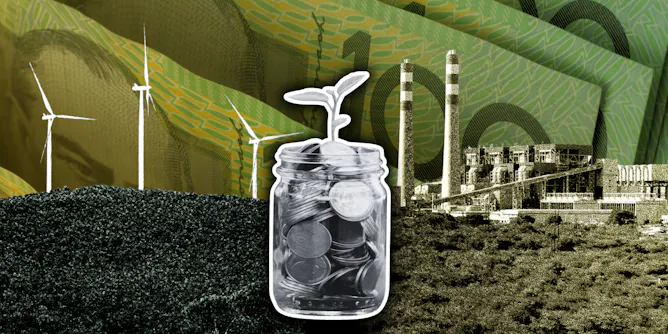
If you care about particular issues – from climate change to weapons of war – it’s worth looking more closely at where your money is really going.
Articles on Sustainable finance
Displaying all articles

Where risk rises, returns have to rise too. Where ecosystems are protected, financing becomes cheaper.
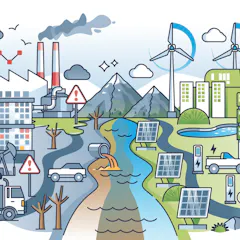
At its most basic level, sciencewashing entails using the vocabulary of science, and borrowing its authority, to claim sustainability outcomes.

As individuals, it’s easy to overlook the power we have when it comes to our finances.

The Net-Zero Banking Alliance, intended to curb lending to carbon-intensive sectors, wasn’t effective and more importantly never made much business sense.

Green bonds have the potential to be a powerful tool in the fight against climate change, but only if they are backed by real accountability.
Green bonds aren’t a new idea. But the government’s decision could help further integrate sustainability into all forms of lending.

Our super funds say they want to invest more in the net zero transition but that regulation blocks them. It’s time to put them to the test, and turn their piles of money toward a greener future.

If big money is going to invest in clean energy and technology, the rules have to be clear. Australia’s launch of a green finance strategy last week was a good start but there is further to go.

Governments and corporations must work together to transform environmental, social and governance policies.

The development effectiveness of these investments could be enhanced by, among other things, greater transparency or better impact measurement.

Green jobs go beyond solar panel installation and wind turbine maintenance. They’re found in fields from design to economics and in many types of management.

Transforming finance could help businesses become more compassionate and inclusive.
New green finance measures aside, UK chancellor Jeremy Hunt’s Edinburgh reforms look like history repeating itself.

Funding is still central in developing new and renewable energy in Indonesia. Research shows that Indonesia could raise US$12.29 billion per year from public fundraising.

The new EU rules on sustainable finance defeat their own objective.

Since the first “climate awareness bond” was issued in 2007, the green-bond market has flourished. But how can investors judge their risk and effectiveness?

It’s time for climate-conscious risk management and investments to be part of the everyday savings and investment decisions made by individuals and businesses across Canada.

There is no need for Canadians to play catch-up on sustainable finance. We can lead.
We need to equip Canada’s financial sector to steer us through a global economic transition on our own terms.
Top contributors
-

Research Director, Institute for Sustainable Futures, University of Technology Sydney
-
Associate Professor, Ivey Business School, Western University
-
Researcher, World Resources Institute
-
Head of Department of Economics, Finance & Accounting, Brunel University of London
-
Professor of Geography and Urbanization Science, Yale University
-
Lecturer in Business and Law, University of Toronto
-
Lecturer, Royal Holloway, University of London
-
Maître de conférences, IAE Paris-Est
-
Head of Sustainable Finance Hub, The University of Melbourne
-
Full Professor, EM Lyon Business School
-
Professor of Sustainability, Arizona State University
-
Research Staff, The Purnomo Yusgiantoro Center
-
Assistant Professor in Finance, University of Exeter
-
Energy Economics & Financing Research Coordinator, The Purnomo Yusgiantoro Center
-
Dean and Professor of Finance, Rotman School of Management, University of Toronto