
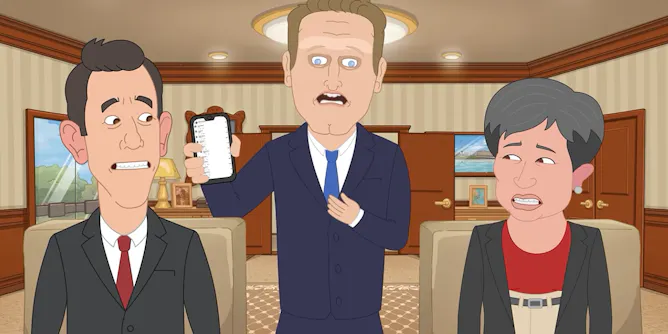
The party’s Please Explain cartoon series has ignited a political firestorm, but behind the punchlines and backlash is an insidious way to spread propaganda.
Articles on Satire
Displaying 1 - 20 of 137 articles

Whether ad-libbing her way through a duet or joking about her glamorous image, Parton turned sexist assumptions into a source of power.

A psychologist explains why the dark humor around Mangione’s case isn’t evidence of nihilism but of what happens when demands for moral seriousness stop feeling credible.

Lady Isabella thinks she’s “aristocracy’s answer to the Kardashians” but visibility has a strange, unexpected effect on her.
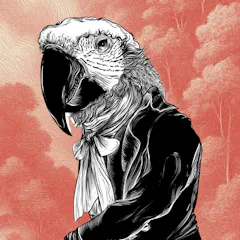
A fictional astrologist, parrot, Chinese philosopher and midwife wrote biting and sought after political satire in the 18th-century.

In Blue Giant, a reality TV trip-to-Mars novel, Jordan Prosser proves he’s a dazzlingly brilliant wordsmith – but is he too clever by half?

A psychologist explains why dark political humor doesn’t prove young people are nihilistic, but rather reveals what happens when moral seriousness no longer feels credible.

Dirt, sex and faeces abound in 18-century literature.

The film is a portrait of a highly dysfunctional family fighting over generational wealth – a familiar story for many.
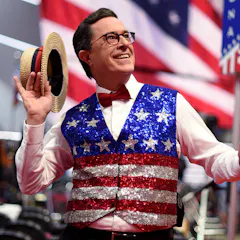
The greatest satirists do more than expose hypocrisy. They reshape how citizens understand power and civic responsibility.

In an online environment which blurs news and entertainment, Iran’s AI propaganda videos are reaching a huge audience globally.

Humor has served many functions since Russia’s full-scale invasion, from providing Ukrainians with a sense of escape and hope to spreading news.

In the right context, films can move across many different genres in the span of their lifetime, depending on the audiences that watch them.

The rapid responses of netizens to political news with memes means that comedy formats like Mock the Week will always be trailing behind

Season 2 of the show points to problems at universities as well as possible remedies.

Pip Finkemeyer’s tech world novel, One Story, is interested in power and performance. It reveals how violence can hide behind language – and the performance of care.

A cartoon built on skewering the powerful and self-righteous isn’t taking its foot off the pedal.

Some contemporary satire prioritises affirming the prejudices of its partisan audience over delivering the democratic benefits it once promised.
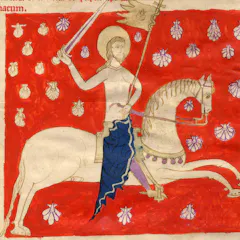
Many people exaggerate their experiences of travel and pilgrimage, but such fabrications date back to the Middle Ages.

‘Eddington’ follows a centuries-old narrative pattern in which disability is framed as punishment, poetic justice or moral revelation.
Top contributors
-

Professor of English, Flinders University
-
Associate Professor in 18th-century Literature, York St John University
-
Lecturer in Journalism, Swansea University
-
Honorary lecturer, School of Social Sciences, UNSW
-
Professor of International Affairs and Comparative Literature, Penn State
-
Associate Professor in the Media School, Indiana University
-
Senior Lecturer in English Literature, York St John University
-
Lecturer in Creative Writing, Flinders University
-
Kidman Chair in Australian Studies and Director, JM Coetzee Centre for Creative Practice, Adelaide University
-
Assistant Professor of Experimental Psychology, Utah Valley University
-
Reader in International Political Economy, University of Warwick
-
Associate Professor, School of Communication, Queensland University of Technology
-
Professor of English, York University, Canada
-
Assistant Professor of Media Communication, University of Arkansas – Fort Smith
-
Emeritus Professor, Cardiff University