
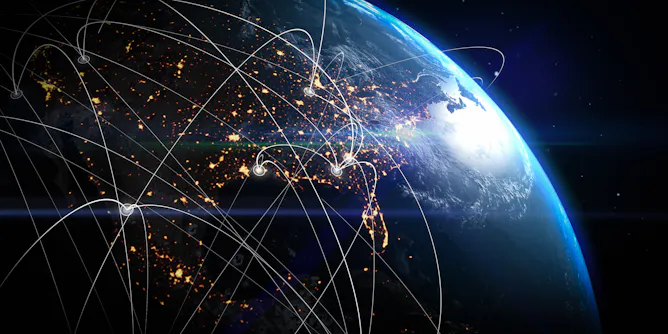
As access to space becomes easier, terrorism is now a tangible threat. The world needs clear rules to avoid turning the final frontier into the next battlefield.
Articles on Satellite technology
Displaying 1 - 20 of 35 articles
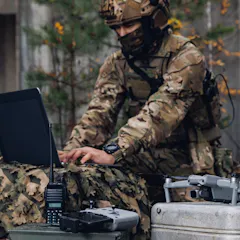
Denying access to intelligence sharing and satellite information could lead to an existential crisis for Ukraine.

An overhaul of the mobile network could help us send texts and make calls in even the remotest areas. But there are technical challenges we’d need to overcome.
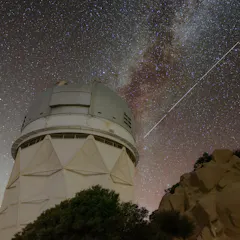
The stars, planets and Milky Way we see at night are part of a wilderness shared across the globe and across centuries. But does BlueWalker 3 herald a night sky polluted with bright satellites?
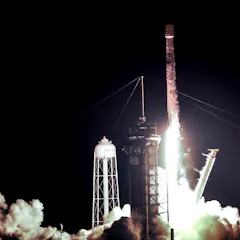
Starlink has plans to connect phones, planes and even cruises to its space satellites. But there are hold-ups.
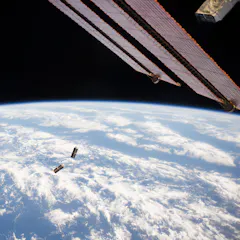
Free space optical communication will allow the same connectivity in space we already have on Earth. And this will provide benefits across a number of sectors.
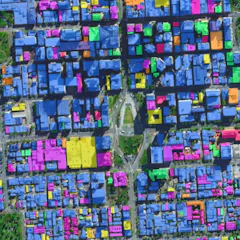
The huge volume and high quality of data streaming down from Earth observation satellites are transforming how we see and shape our cities.
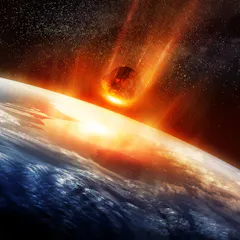
Research suggests a new threat to life on Earth from the meteorite’s crash: Via seismic waves, the impact triggered massive undersea eruptions, as big as any ever seen in our planet’s history.
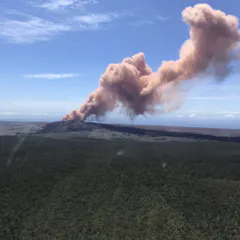
How do scientists predict volcanic eruptions? To do so with accuracy, they need to know the individual volcano and its history very well.
We prefer to go with our guts.
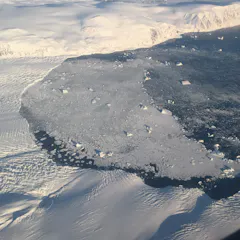
Greenland’s ice is largely responsible for the accelerating pace of sea-level rise. A new analysis shows that, while Greenland accounted for just 5% of the rise in 1993, that figure rose to 25% by 2014.
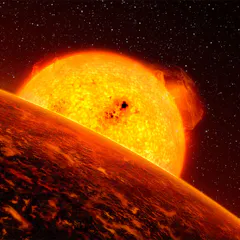
Nimble and cheap commercial science could be the way to get more eyes in the sky.
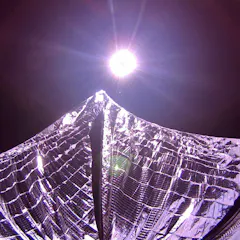
A prototype solar sailing satellite has just successfully been deployed in orbit, pointing the way to the future of space travel.
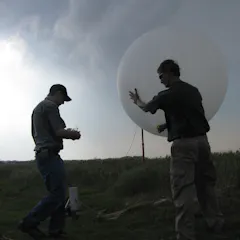
Climate models have been criticised because observations could not find the predicted “hot spot” of strong warming in the troposphere. But analyses now show that the tropospheric hot spot is indeed real.

The tides come in, the tides come out. But what is a sea’s level? Technology has evolved since we first started gauging the height of the ocean in comparison to the land.
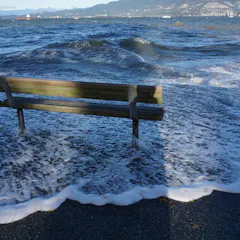
Since 1993, satellites have been used as well as tidal gauges to monitor sea level. A new calibration of this satellite record now shows that the rise in sea level is gathering pace.

Twenty-five years on and the Hubble Space Telescope is still taking some amazing images. But there have been a few glitches over the years, right from day one.
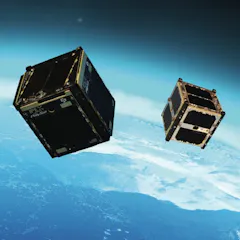
We’re already building satellites that can sit in the palm of your hand. But getting them into orbit can be a challneg, and not only for technical reasons.
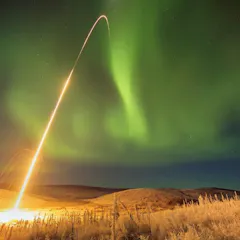
The aurora borealis lights up the Arctic night skies. Also called the Northern Lights, the phenomenon is the result of beams of charged particles tracing along the Earth’s magnetic field and entering the…
Google has managed to map most of the world. Recently, the company offered a behind-the-scenes glimpse into how it’s built the Google Maps application using a combination of technology (the Google Street…
Top contributors
-

Technical Programs, Research School of Astronomy & Astrophysics, Australian National University
-
Associate Professor (hon) at the Centre for Public Awareness of Science, Australian National University
-
Chair Professor, Climate Change Research Centre, UNSW
-
Associate Professor in Astronomy, Monash University
-
Professor of Polar Geodesy and ARC Laureate Fellow, University of Tasmania
-
Senior Lecturer, School of Geography, Planning, and Spatial Sciences, University of Tasmania
-
Professor of Atmospheric Sciences, Climate Change Research Centre, UNSW
-
Senior Lecturer of Social Studies of Technology, The University of Melbourne
-
Adjunct Senior Research Fellow in Environmental Law, University College Dublin
-
Professor of Electrical and Computer Engineering, Utah State University
-
Visiting Researcher & Senior Project Engineer, Australian Centre for Space Engineering Research, UNSW
-
Professor of Electrical and Electronic Engineering and Director of Electronic Warfare Research, City St George's, University of London
-
Associate Professor, Media and Communications, RMIT University
-
Research Fellow, Spatial Modelling, RMIT University
-
Emeritus Professor of International Law, Western Sydney University