

How did speech rules developed and promoted by the left become tools that could be wielded against it?
Articles on Safe Spaces
Displaying all articles

New research highlights how game makers can design for trans-inclusivity – because if we want trans joy in the world, we will have to design for it.

Paradoxically, the very scale of the crisis in Gaza makes worthwhile even the tiniest gesture of solidarity.

Turning our family discussions into ‘brave spaces’ can lead to productive, respectful conversations.

Guided by policy, practice and relationships with students, families and communities, teachers are charged with helping all students thrive. To suggest otherwise is disturbing.

In addition to undermining universities’ and faculty members’ autonomy, the bill blurs distinctions between free expression and academic freedom, and turns academic freedom into a political weapon.

When speakers seek to responsibly disseminate knowledge they must be aware of their audience and how what they are saying may resonate.

Violence against LGBTQ people in Brazil is at an all-time high, but artists refuse to be intimidated.
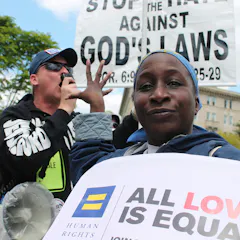
Educators must work to ensure inclusion with diverse student bodies, yet it seems inevitable that in today’s world, talking about identity issues can be risky and emotional. So how to move forward?

Design principles, known as ‘crime prevention through environmental design’, are used all over the world to make cities safer. But some of these principles can be discriminatory and hostile.

In new guidance, students and universities could be banned from censoring controversial speakers on campuses following the first ministerial intervention on free speech in 30 years.

Safe spaces are fundamentally at odds with the rigorous intellectual exchange central to the idea of a university.

No-platforming is turning supposedly ‘critically minded’ events into adolescent cheerleading sessions.

Highly restrictive speech codes are now the norm in some of the world’s universities.
Top contributors
-

Senior Lecturer in Political Theory and Philosophy, Queen's University Belfast
-
Affiliate Professor, GEM
-
Professor of Law and Humanities, Queen Mary University of London
-
Emeritus Professor of Sociology, University of Kent
-
Professor in department Law, Managment, and Social Sciences, EM Lyon Business School
-
Environmental Criminologist and Senior Lecturer in Urban and Regional Planning, Curtin University
-
Associate professor, University of New Brunswick
-
Professor, Political Science, University of Winnipeg
-
Assistant Professor, Faculty of Education, University of New Brunswick
-
Research Fellow and Senior Lecturer in Reconciliation and Peacebuilding, University of Winchester
-
Dr. Coen-Sanchez, L’Université d’Ottawa/University of Ottawa
-
Professor, Department of Languages, Literatures and Linguistics, York University, Canada
-
Head of Guildford School of Acting (GSA), University of Surrey, University of Surrey
-
Senior Lecturer, Centre for Advancing Journalism, The University of Melbourne
-
Associate Professor of Human-Centred Computing, Monash University