
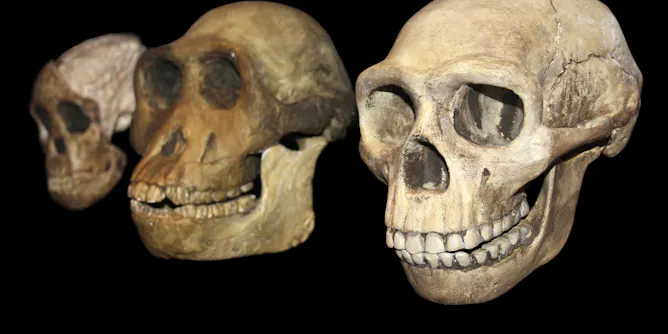
Our understanding of human ancestry has changed dramatically since the discovery of Lucy the ancient hominin 50 years ago. Here is the history of humanity as we know it today.
Articles on Paleoarchaeology
Displaying all articles
On the 50th anniversary of the discovery of ancient hominin Lucy, a leading Ethiopian scientist on why we need to ‘decolonise’ paleo research – and what it’s like to find the oldest human ancestor.

Archaeological data alone can’t always help to answer researchers’ questions: multiple lines of evidence are needed.
Scientists had figured a fossil found in Spain more than a century ago was from a Neandertal. But a new analysis suggests it could be from a lost lineage of our species, Homo sapiens.
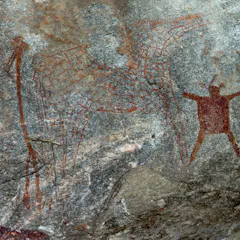
A new study doubles the age of ancient DNA in sub-Saharan Africa, revealing how people moved, mingled and had children together over the last 50,000 years.

Combining evidence from archaeology, geochronology and paleoenvironmental science, researchers identified how ancient humans by Lake Malawi were the first to substantially modify their environment.
Top contributors
-

Assistant Professor of Anthropology, Yale University
-
Professor of Archaeology, Conservation and History, University of Oslo
-
Associate Professor of Anthropology, Binghamton University, State University of New York
-
Associate Professor of Anthropology, Rice University
-
Assistant Professor, University of Alberta
-
Curator of Human Evolution of the Cleveland Museum of Natural History and Research Assistant Professor of Anthropology, Stony Brook University (The State University of New York)
-
Assistant Professor of Geosciences, Penn State
-
Director and Virginia M. Ullman Professor of Natural History and the Environment, Institute of Human Origins, Arizona State University
-
Doctoral Candidate in Anthropology, Binghamton University, State University of New York
-
Professor of Archaeology and Evolutionary Anthropology, Department of Archaeology, Classics and Egyptology, University of Liverpool