
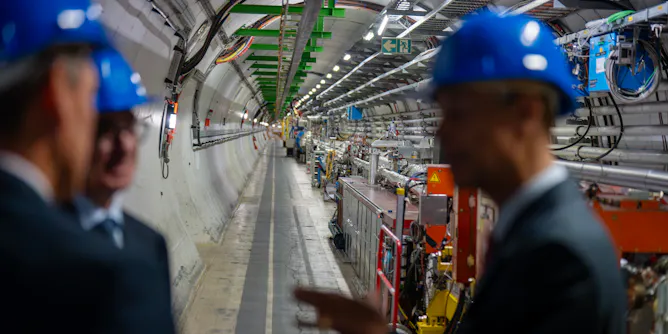
Particle accelerators aren’t just for testing the Standard Model. They’re also used to diagnose and treat disease and study world history.
Articles on Nobel Prize in Physics
Displaying 1 - 20 of 34 articles
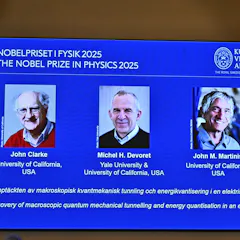
The quantum tunnelling effect is where a particle can pass through a barrier and appear on the other side.

AI could concentrate capabilities in the hands of a relatively small number of organisations.
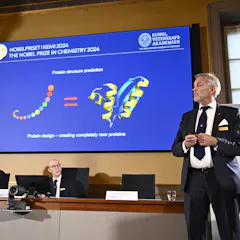
AI will feature in future Nobel prizes as scientists exploit the power of this technology for research.
Two researchers whose work has led to the AI revolution won the 2024 Nobel Prize in physics. A materials physicist explains statistical mechanics, the physics field behind their discoveries.
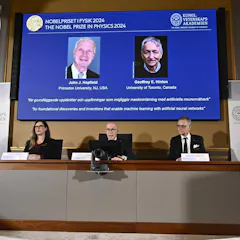
John Hopfield and Geoffrey Hinton, the 2024 Physics Nobel laureates, developed computer systems that can memorise and learn from patterns in data.
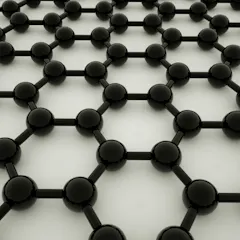
While it’s too early to say whether graphene will live up to the hype, it’s now appearing in everything from motorcycle helmets to aircon units.

Winning a Nobel Prize is a rare achievement, but some researchers have been awarded more than one.
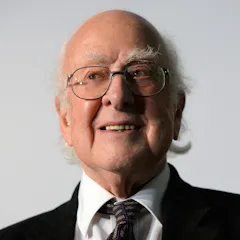
During a walk in the Scottish Highlands, one of the greats of particle physics had the idea of a lifetime
The 2023 Nobel Prize in physics recognized researchers studying electron movement in real time − this work could revolutionize electronics, laser imaging and more.

L'Huillier was busy teaching when she her Nobel prize was awarded.
Three scientists won the 2023 Nobel Prize in physics for their work developing methods to shoot laser pulses that only last an attosecond, or a mind-bogglingly tiny fraction of a second.

The 2023 Nobel Prize in physics has been awarded “for experimental methods that generate attosecond pulses of light for the study of electron dynamics in matter”.

Nope, ‘entangled’ particles don’t communicate.
Quantum mechanics raised tough philosophical questions about the nature of the world – and a physicist named John Bell figured out how experiments could answer them.
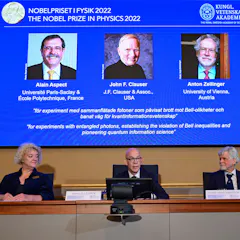
The discovery that particles can be spookily connected has lead to a technological revolution.
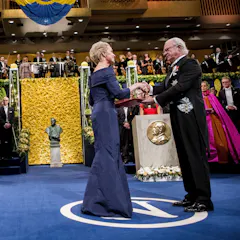
Science fields are improving at being more inclusive. But explicit and implicit barriers still hold women back from advancing in the same numbers as men to the upper reaches of STEM academia.

Part of the 2021 Nobel Prize in Physics was awarded for work modeling Earth’s climate using its chaotic, complex weather. To scientists, chaos lies in the gray zone between randomness and predictability.
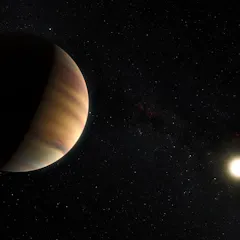
Michel Mayor and Didier Queloz thought it would take years to find a planet outside the solar system – they did it in months.
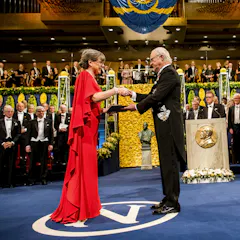
Progress has been made toward gender parity in science fields. But explicit and implicit barriers still hold women back from advancing in the same numbers as men to the upper reaches of STEM academia.
Top contributors
-

Professor and Lincoln Professor of Ethics in Public Affairs, Arizona State University
-
Professor in Physics, The University of Queensland
-
Marketing, Media & Communications Manager Science, Monash University
-
Professor, Monash University
-
Associate Professor, Department of Educational Studies, University of British Columbia
-
Professor at Columbia University, Group Leader at Flatiron Institute, and Adjunct Professor at Monash University, Monash University
-
Emeritus Professor of Science, Technology and Society, University of Glasgow
-
Senior Lecturer and ARC Future Fellow, Monash University
-
Executive Director of the Sylvia Fedoruk Canadian Centre for Nuclear Innovation, University of Saskatchewan
-
Particle physicist, University of Cambridge
-
Postdoctoral Researcher, Centre de Cosmologie Physique de Paris
-
Professor of Physics, Florida State University
-
Professor of Public Affairs, The Ohio State University
-
McMaster University
-
Royal Society Research Professor and Kelvin Chair of Natural Philosophy (Physics and Astronomy), University of Glasgow