
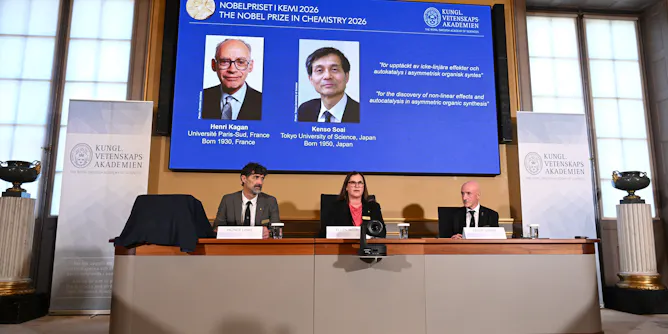
The 2026 Nobel Prize in chemistry gave a hand to handed molecules – and the processes chemists use to create them.
Articles on Nobel Prize in Chemistry
Displaying 1 - 20 of 24 articles
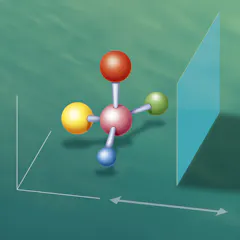
From thalidomide to resveratrol, molecules with the exact same chemical properties can have drastically different effects in the body depending on how they’re arranged in space.
The prize was awarded for work that produces one version of a mirror image molecule.
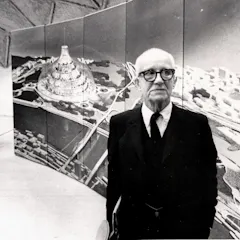
Few 20th-century scientific figures are as hard to classify as Buckminster Fuller.

By trapping different molecules, metal-organic frameworks could make for efficient breath sensors that predict lung disease, cancer or diabetes.
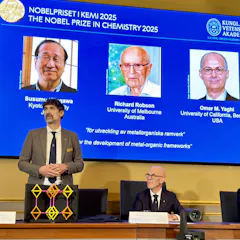
Just a gram of these tiny crystals can have an internal surface area as big as a soccer field. A materials expert explains the almost magical chemistry of MOFs.
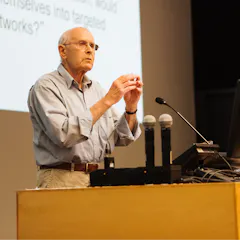
Richard Robson was struck by an idea in 1989. Decades later, his story shows the importance of fundamental science.
AI could concentrate capabilities in the hands of a relatively small number of organisations.
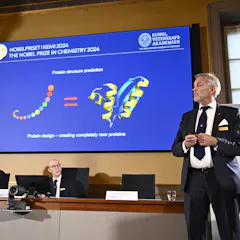
AI will feature in future Nobel prizes as scientists exploit the power of this technology for research.
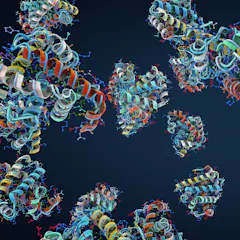
The prize honors innovation at Google DeepMind and in academia. Three researchers share the award for using machine learning to predict proteins’ 3D shapes and design the molecules from scratch.
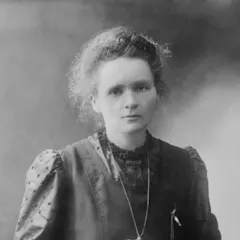
Winning a Nobel Prize is a rare achievement, but some researchers have been awarded more than one.
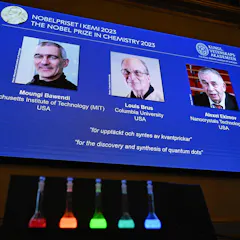
Louis Brus explains some of the foundational research – and how even the letter carrier wants to shake your hand when you’ve just won a Nobel Prize.

Quantum dots are a prime example of the way nanotechnology engineers materials at an atomic scale.

The Nobel Prize categories were set up more than a century ago. Since then, science has grown and evolved in unpredictable ways.
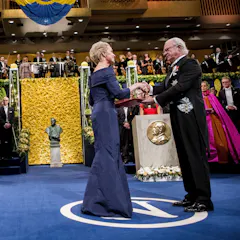
Science fields are improving at being more inclusive. But explicit and implicit barriers still hold women back from advancing in the same numbers as men to the upper reaches of STEM academia.
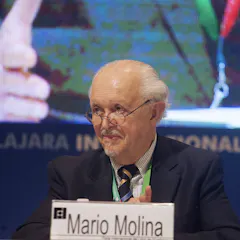
Molina, who died on Oct. 8, ‘thought climate change was the biggest problem in the world long before most people did.’ His research on man-made depletion of the ozone layer won the 1995 Nobel Prize.
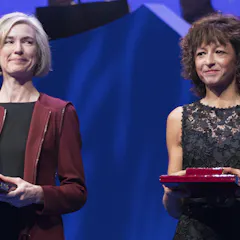
Emmanuelle Charpentier and Jennifer Doudna were awarded the Nobel prize in chemistry for Crispr but they weren’t the only key figures in its development.
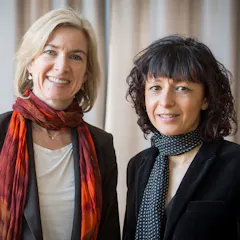
The tools to rewrite the genetic code to improve crops and livestock, or to treat genetic diseases, has revolutionized biology. A CRISPR engineer explains why this technology won the Nobel, and its potential.
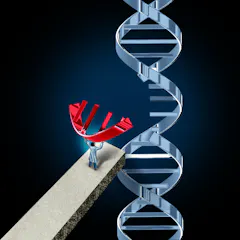
Most scientific discoveries these days aren’t easily ascribed to a single researcher. CRISPR is no different – and ongoing patent fights underscore how messy research can be.
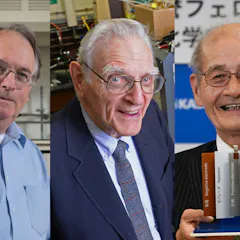
M. Stanley Whittingham, John B. Goodenough and Akira Yoshino made the batteries in our pockets possible.
Top contributors
-

Professor of Chemistry, Connecticut College
-
Professor of Chemistry, Vanderbilt University
-
Research Assistant Professor at U-M Life Sciences Institute and Assistant Professor of Biological Chemistry, U-M Medical School, University of Michigan
-
Professor of Molecular Biophysics, University of Oxford
-
Professor Emeritus of Chemistry, Columbia University
-
Ph.D. Student in Materials Science and Engineering, University of Washington
-
Professor of Advanced Technology Transitions, Arizona State University
-
Associate Tutor and PhD Candidate in Philosophy of Science, Manchester Metropolitan University
-
Professor and Lincoln Professor of Ethics in Public Affairs, Arizona State University
-
Shah Rising Star Assistant Professor of Chemical Engineering, Herbert Wertheim College of Engineering, UF Health Cancer Center, University of Florida
-
Associate Professor of Social Work, University of Memphis
-
Visiting Research Scholar in Chemistry, University of Richmond
-
PhD Candidate in Intellectual Property Law, University of Liverpool
-
Director of Energy Lancaster and Professor of Physical Chemistry, Lancaster University
-
Professor of Artificial Intelligence, University of Bath