
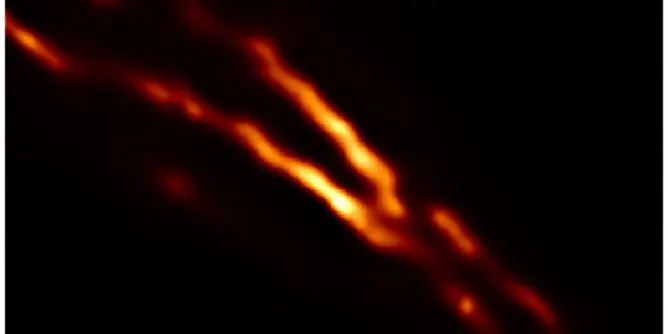
Astronomers have taken a close-up look at the jets of plasma streaking away from a supermassive black hole - one of the strangest and most energetic features of galaxies.
Articles on Milky Way
Displaying 41 - 60 of 98 articles
Billions of galaxies are in the universe, with billions of stars in every galaxy. Could billions of planets be out there too?
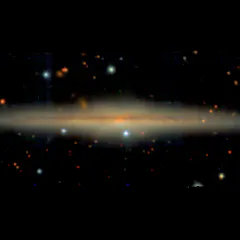
A galaxy 320 million light-years away has a surprisingly similar structure to the Milky Way, suggesting our galaxy isn’t as unique as it once seemed to astronomers.
Thanks to the discovery of five twinkling galaxies in a rare alignment, astronomers have been able to calculate — for the first time — the properties and geometry of an invisible gas cloud in space.
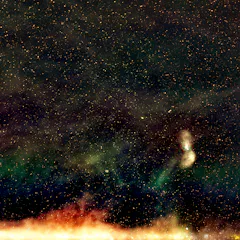
Some of the baby radio galaxies found may not be ‘babies’ at all. Rather, they may be ‘angsty teens’, rapidly growing into adults much faster than researchers had anticipated.
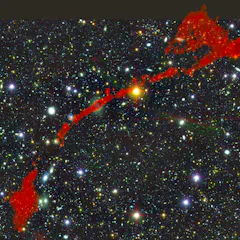
Based on what we currently know about the density of giant radio galaxies in the sky, the probability of finding two of them in this region is extremely small.
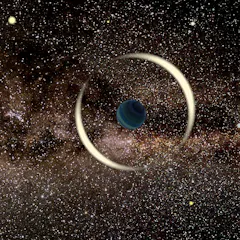
Not all planets orbit stars. Rogues float through the galaxy in darkness and are almost impossible to see.
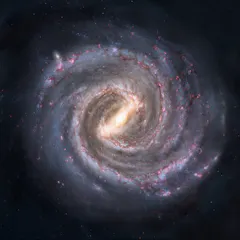
A new method suggests we should aim to detect dark matter haloes by tracing galactic gas.
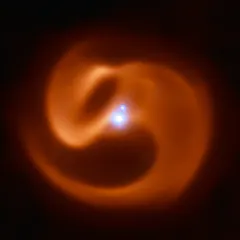
Surprising findings on an exquisite and huge star system in our Milky Way suggest future potential for an extremely rare gamma-ray burst. This event has never been observed in our galaxy.

Towns and cities create an orange glow on the horizon at night. It’s so widespread that it even disturbs sea creatures.

China’s Qixi Festival is a celebration of love based on the legend of a mortal who married a goddess, causing his furious mother-in-law to create a Milky Way to divide these two twinkling stars.
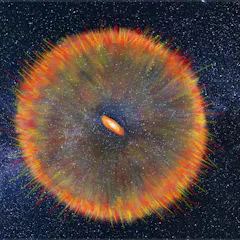
This observation means astronomers can now develop and test theories that explain how high-mass stars gain their mass.

There is a massive black hole in the center of the Milky Way galaxy. Measurements of star orbits near this black hole suggest that there may be a second companion black hole nearby.
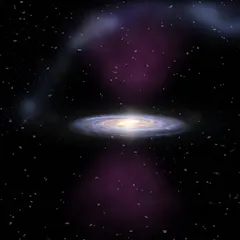
New research shows the supermassive black hole at the centre of the Milky Way spat out an enormous beam of radiation 3.5 million years ago

Dung beetles are largely invisible. And yet without their vital activities, the world would have a lot more faeces in it.
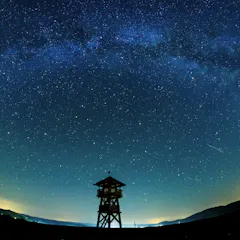
The diameter of the Milky Way is a billion billion kilometres.

There’s mounting evidence that increased lighting has a range of negative effects.
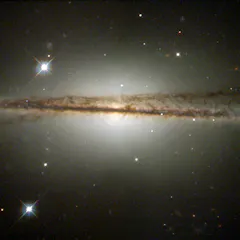
The Milky Way’s disc of stars becomes increasingly warped and twisted the further away they are from the galaxy’s centre.
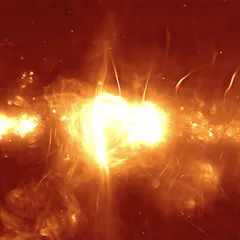
A black hole is an object with such a strong gravitational pull that nothing, not even light, can escape from it.
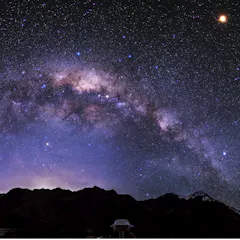
The Gaia satellite has uncovered the remains of a galaxy buried deep in the Milky Way.
Top contributors
-

Professor of Astrophysics, University of Sydney
-
Professor, Radio Astronomy, University of Sydney
-
Post-doctoral researcher in Astrophysics, University of the Western Cape
-
Senior Lecturer in Physics, Western Sydney University
-
Professor at the International Centre for Radio Astronomy Research (ICRAR), The University of Western Australia
-
ARC DECRA Fellow in Astronomy, University of Sydney
-
Postdoctoral Researcher in Radio Astronomy, University of Sydney
-
Professor (Astrophysics), University of Southern Queensland
-
ARC DECRA Fellow in Astronomy, University of Sydney
-
Professor of Physics, University of Wisconsin-Milwaukee
-
PhD student, University of Sydney
-
Associate Lecturer, Curtin Institute of Radio Astronomy (CIRA), Curtin University
-
Lecturer, University of Cape Town
-
Assistant Professor of Galaxy & Black Hole Astrophysics, ETH Zurich
-
Lecturer in Mathematics, University of Dundee